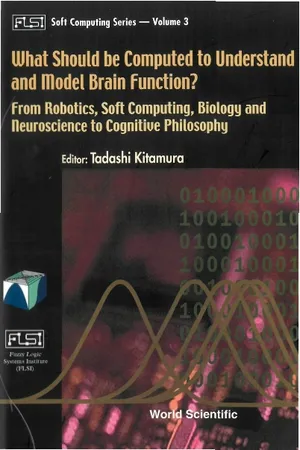
This volume is a guide to two types of transcendence of academic borders which seem necessary for understanding and modelling brain function. The first type is technical transcendence needed to make intelligent machines such as a humanoid robot, an animal-like behavior architecture, an interpreter of fiction, and an evolving learning machine. This technical erosion is conducted into areas such as biology, ethology, neuroscience and psychology, as well as robotics and soft computing. The second type of transcendence of cross-disciplinary boundaries cuts across scientific areas such as biology and cognitive science/philosophy, into comprehensive, less technical and more abstract aspects of brain function. These aspects enable us to know in what direction and how far an intelligent machine will go.
eBook - PDF
What Should Be Computed To Understand And Model Brain Function?: From Robotics, Soft Computing, Biology And Neuroscience To Cognitive Philosophy
From Robotics, Soft Computing, Biology and Neuroscience to Cognitive Philosophy
- 323 pages
- English
- PDF
- Available on iOS & Android
eBook - PDF
What Should Be Computed To Understand And Model Brain Function?: From Robotics, Soft Computing, Biology And Neuroscience To Cognitive Philosophy
From Robotics, Soft Computing, Biology and Neuroscience to Cognitive Philosophy
About this book
Information
Table of contents
- Contents
- Series Editor's Preface
- Volume Editor's Preface
- Chapter 1 Consideration of Emotion Model and Primitive Language of Robots
- Chapter 2 An Architecture for Animal-like Behavior Selection
- Chapter 3 A Computational Literary Theory: The Ultimate Products of the Brain/Mind Machine
- Chapter 4 Cooperation between Neural Networks within the Brain
- Chapter 5 Brain-like Functions in Evolving Connectionist Systems for On-line Knowledge-Based Learning
- Chapter 6 Interrelationships, Communication, Semiotics and Artificial Consciousness
- Chapter 7 Time Emerges from Incomplete Clock Based on Internal Measurement
- Chapter 8 The Logical Jump in Shell Changing in Hermit Crab and Tool Experiment in the Ants
- Chapter 9 The Neurobiology of Semantics: How Can Machines be Designed to Have Meanings?
- Chapter 10 The Emergence of Contentful Experience
- Chapter 11 Intentionality and Foundations of Logic: A New Approach to Neurocomputation
- About the Authors
- Keyword Index
Trusted by 375,005 students
Access to over 1.5 million titles for a fair monthly price.
Study more efficiently using our study tools.
Frequently asked questions
Yes, you can cancel anytime from the Subscription tab in your account settings on the Perlego website. Your subscription will stay active until the end of your current billing period. Learn how to cancel your subscription
No, books cannot be downloaded as external files, such as PDFs, for use outside of Perlego. However, you can download books within the Perlego app for offline reading on mobile or tablet. Learn how to download books offline
Perlego offers two plans: Essential and Complete
- Essential is ideal for learners and professionals who enjoy exploring a wide range of subjects. Access the Essential Library with 800,000+ trusted titles and best-sellers across business, personal growth, and the humanities. Includes unlimited reading time and Standard Read Aloud voice.
- Complete: Perfect for advanced learners and researchers needing full, unrestricted access. Unlock 1.5M+ books across hundreds of subjects, including academic and specialized titles. The Complete Plan also includes advanced features like Premium Read Aloud and Research Assistant.
We are an online textbook subscription service, where you can get access to an entire online library for less than the price of a single book per month. With over 1.5 million books across 990+ topics, we’ve got you covered! Learn about our mission
Look out for the read-aloud symbol on your next book to see if you can listen to it. The read-aloud tool reads text aloud for you, highlighting the text as it is being read. You can pause it, speed it up and slow it down. Learn more about Read Aloud
Yes! You can use the Perlego app on both iOS and Android devices to read anytime, anywhere — even offline. Perfect for commutes or when you’re on the go.
Please note we cannot support devices running on iOS 13 and Android 7 or earlier. Learn more about using the app
Please note we cannot support devices running on iOS 13 and Android 7 or earlier. Learn more about using the app
Yes, you can access What Should Be Computed To Understand And Model Brain Function?: From Robotics, Soft Computing, Biology And Neuroscience To Cognitive Philosophy by Tadashi Kitamura in PDF and/or ePUB format, as well as other popular books in Computer Science & Computer Science General. We have over 1.5 million books available in our catalogue for you to explore.