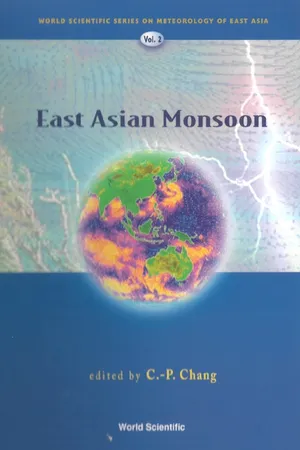
The East Asian summer monsoon has complex space and time structures that are distinct from the South Asian summer monsoon. It covers both subtropics and midlatitudes and its rainfall tends to be concentrated in rain belts that stretch for many thousands of kilometers and affect China, Japan, Korea, and the surrounding areas. The circulation of the East Asian winter monsoon encompasses a large meridional domain with cold air outbreaks emanating from the Siberian high and penetrates deeply into the equatorial Maritime Continent region, where the center of maximum rainfall has long been recognized as a major planetary scale heat source that provides a significant amount of energy which drives the global circulation during boreal winter.The East Asian summer monsoon is also closely linked with the West Pacific summer monsoon. Both are part of the global climate system and are affected by El Nino—Southern Oscillation (ENSO) and surface temperature variations in the western Pacific and surrounding oceans, the tropospheric biennial oscillation, and the South Asian summer monsoon. In addition, typhoons in the western North Pacific are most active during the East Asian summer monsoon. They may be considered as a component of the East Asian summer monsoon as they contribute substantial amounts of rainfall and have major impacts on the region.Because of its impacts on nearly one-third of the world's population and on the global climate system (including effects on the climate change), the study of the East Asian monsoon has received increased attention both in East Asian countries and in the United States. This book presents reviews of recent research on the subject.
eBook - PDF
East Asian Monsoon
About this book
Information
Table of contents
- PREFACE
- CONTENTS
- Part I East Asian Summer and Winter Monsoon
- Part II Interannual Variations
- Part III General Circulation Modeling
- Part IV Synoptic and Mesoscale Processes
- Part V Interactions with Other Circulations
Trusted by 375,005 students
Access to over 1.5 million titles for a fair monthly price.
Study more efficiently using our study tools.
Frequently asked questions
Yes, you can cancel anytime from the Subscription tab in your account settings on the Perlego website. Your subscription will stay active until the end of your current billing period. Learn how to cancel your subscription
No, books cannot be downloaded as external files, such as PDFs, for use outside of Perlego. However, you can download books within the Perlego app for offline reading on mobile or tablet. Learn how to download books offline
Perlego offers two plans: Essential and Complete
- Essential is ideal for learners and professionals who enjoy exploring a wide range of subjects. Access the Essential Library with 800,000+ trusted titles and best-sellers across business, personal growth, and the humanities. Includes unlimited reading time and Standard Read Aloud voice.
- Complete: Perfect for advanced learners and researchers needing full, unrestricted access. Unlock 1.5M+ books across hundreds of subjects, including academic and specialized titles. The Complete Plan also includes advanced features like Premium Read Aloud and Research Assistant.
We are an online textbook subscription service, where you can get access to an entire online library for less than the price of a single book per month. With over 1.5 million books across 990+ topics, we’ve got you covered! Learn about our mission
Look out for the read-aloud symbol on your next book to see if you can listen to it. The read-aloud tool reads text aloud for you, highlighting the text as it is being read. You can pause it, speed it up and slow it down. Learn more about Read Aloud
Yes! You can use the Perlego app on both iOS and Android devices to read anytime, anywhere — even offline. Perfect for commutes or when you’re on the go.
Please note we cannot support devices running on iOS 13 and Android 7 or earlier. Learn more about using the app
Please note we cannot support devices running on iOS 13 and Android 7 or earlier. Learn more about using the app
Yes, you can access East Asian Monsoon by Chih-pei Chang in PDF and/or ePUB format, as well as other popular books in Biological Sciences & Science General. We have over 1.5 million books available in our catalogue for you to explore.