![]()
General Covariance and the
Passive Equations of Physics
Shlomo Sternberg
1. What Do I Mean by ‘Passive Equations’ ?
By the passive equations of physics, I mean those equations that describe the motion of a small object in the presence of a force field, where we ignore the effect produced by this small object.
For example, Newton’s laws say that any two objects attract one another. But if we study the motion of a ball or a rocket in the gravitational field of the earth, we ignore the tiny effect that the ball or rocket has on the motion of the earth.
If we have a small charged particle in an electromagnetic field, the Lorentz equations describe the motion of the particle when we ignore the field produced by the motion of the particle itself.
To explain what I mean by general covariance will take the whole lecture.
2. The Sources of This Lecture
The first source of my lecture is a late paper by Albert Einstein, Leopold Infeld and Banesh Hoffman entitled ‘The Gravitational Equations and the Problem of Motion,’ published in the Annals of Mathematics, 39 (1938). It opens with the following words:
In this paper we investigate the fundamentally simple question of the extent to which the relativistic equations of gravitation determine the motion of ponderable bodies.
It will take a bit of effort to explain what this ‘fundamentally simple question’ is. I should comment that the Einstein–Infeld–Hoffman paper is technically difficult to read, because it was written before the appropriate mathematical language — the theory of generalized functions — was developed. The person who extracted the key idea from this paper in modern mathematical language was J.M. Souriau, who applied the Einstein–Infeld–Hoffman method to determine the equations of motion of a spinning charged particle in an electromagnetic field. His paper, ‘Modèle de particule à spin dans le champ électromagnétique et gravitationnel,’ appeared in Annales de l’institut Henri Poincaré, 20 (1974). This is the second source of my lecture.
My purpose herein is to explain how the Einstein–Infeld–Hoffman method, as formulated for spinning particles by Souriau, can be viewed as a principle for determining the passive equations of physics in a very general setting.
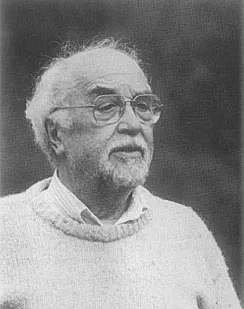
Figure 1. Jean Marie Souriau.
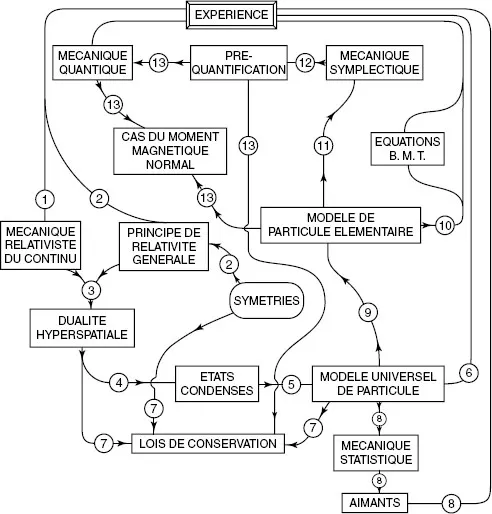
Souriau’s paper is itself not an easy read. He has a wonderful but idiosyncratic mode of exposition. For example, here is the flow chart presented on page 2 of the paper (Figure 2).
3. What is the ‘Fundamentally Simple Question’ Posed by Einstein, Infeld and Hoffmann?
There are two fundamental principles of general relativity:
- The distribution of energy-matter determines the geometry of space time.
- A small piece of ponderable matter moves along a geodesic in the geometry determined as above.
Figure 2. Flow chart, J.M. Souriau, ‘Modèle de particule à spin dans le champ électromagnétique et gravitationnel,’ Annales de l’institut Henri Poincaré, 20 (1974), p. 2.
I will spend some time explaining the meanings of the word ‘geodesic.’
Many distinguished physicists thought that these were two independent principles. The point of the Einstein–Infeld–Hoffman paper was to explain how they are related.
4. Einstein’s Comment on the First Principle
Referring to the impact of the work of his predecessors Heinrich Rudolf Hertz and Hendrik Antoon Lorentz, which led to the elucidation of the first principle, Einstein remarked: ‘People slowly accustomed themselves to the idea that the physical states of space itself were the final physical reality’ (Albert Einstein, ‘The History of Field Theory,’ lecture to the general public, February 3, 1929).
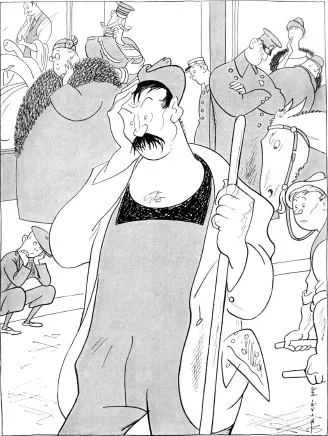
Figure 3.‘People slowly accustomed themselves to the idea that the physical states of space itself were the final physical reality’ — Albert Einstein (cartoon by Rea Irvin, The New Yorker, 1929; © Rea Irvin/The New Yorker Collection).
Figure 3 shows The New Yorker’s take on Einstein’s comment.
5. What Is a Geodesic?
Before the papers by Einstein–Infeld–Hoffman and Souriau, there were several (equivalent) definitions of what a geodesic is. They all try to extend to more general geometries a characteristic property that straight lines have in Euclidean geometry:
- A straight line is ‘the shortest distance between two points.’
- A straight line is ‘self-parallel’ in the sense that it always points in the same direction at all its points.
A curved line will (in general) be pointing in different directions at different points.
For example, on a sphere, the geodesics are (portions of) great circles. To...