Advances In The Homotopy Analysis Method
eBook - ePub

Advances In The Homotopy Analysis Method

  1. 428 pages
  2. English
  3. ePUB (mobile friendly)
  4. Available on iOS & Android
eBook - ePub

Advances In The Homotopy Analysis Method

About this book

Unlike other analytic techniques, the Homotopy Analysis Method (HAM) is independent of small/large physical parameters. Besides, it provides great freedom to choose equation type and solution expression of related linear high-order approximation equations. The HAM provides a simple way to guarantee the convergence of solution series. Such uniqueness differentiates the HAM from all other analytic approximation methods. In addition, the HAM can be applied to solve some challenging problems with high nonlinearity.This book, edited by the pioneer and founder of the HAM, describes the current advances of this powerful analytic approximation method for highly nonlinear problems. Coming from different countries and fields of research, the authors of each chapter are top experts in the HAM and its applications. Contents:

  • Chance and Challenge: A Brief Review of Homotopy Analysis Method (S-J Liao)
  • Predictor Homotopy Analysis Method (PHAM) (S Abbasbandy and E Shivanian)
  • Spectral Homotopy Analysis Method for Nonlinear Boundary Value Problems (S Motsa and P Sibanda)
  • Stability of Auxiliary Linear Operator and Convergence-Control Parameter (R A Van Gorder)
  • A Convergence Condition of the Homotopy Analysis Method (M Turkyilmazoglu)
  • Homotopy Analysis Method for Some Boundary Layer Flows of Nanofluids (T Hayat and M Mustafa)
  • Homotopy Analysis Method for Fractional Swift–Hohenberg Equation (S Das and K Vishal)
  • HAM-Based Package NOPH for Periodic Oscillations of Nonlinear Dynamic Systems (Y-P Liu)
  • HAM-Based Mathematica Package BVPh 2.0 for Nonlinear Boundary Value Problems (Y-L Zhao and S-J Liao) Graduate students and researchers in applied mathematics, physics, nonlinear mechanics, engineering and finance. Key Features:
    • The method described in the book can overcome almost all restrictions of other analytic approximation method for nonlinear problems
    • This book is the first in homotopy analysis method, covering the newest advances, contributed by many top experts in different fields

Frequently asked questions

Yes, you can cancel anytime from the Subscription tab in your account settings on the Perlego website. Your subscription will stay active until the end of your current billing period. Learn how to cancel your subscription.
No, books cannot be downloaded as external files, such as PDFs, for use outside of Perlego. However, you can download books within the Perlego app for offline reading on mobile or tablet. Learn more here.
Perlego offers two plans: Essential and Complete
  • Essential is ideal for learners and professionals who enjoy exploring a wide range of subjects. Access the Essential Library with 800,000+ trusted titles and best-sellers across business, personal growth, and the humanities. Includes unlimited reading time and Standard Read Aloud voice.
  • Complete: Perfect for advanced learners and researchers needing full, unrestricted access. Unlock 1.4M+ books across hundreds of subjects, including academic and specialized titles. The Complete Plan also includes advanced features like Premium Read Aloud and Research Assistant.
Both plans are available with monthly, semester, or annual billing cycles.
We are an online textbook subscription service, where you can get access to an entire online library for less than the price of a single book per month. With over 1 million books across 1000+ topics, we’ve got you covered! Learn more here.
Look out for the read-aloud symbol on your next book to see if you can listen to it. The read-aloud tool reads text aloud for you, highlighting the text as it is being read. You can pause it, speed it up and slow it down. Learn more here.
Yes! You can use the Perlego app on both iOS or Android devices to read anytime, anywhere — even offline. Perfect for commutes or when you’re on the go.
Please note we cannot support devices running on iOS 13 and Android 7 or earlier. Learn more about using the app.
Yes, you can access Advances In The Homotopy Analysis Method by Shijun Liao in PDF and/or ePUB format, as well as other popular books in Biological Sciences & Science General. We have over one million books available in our catalogue for you to explore.

Information

Chapter 1
Chance and Challenge:
A Brief Review of Homotopy Analysis Method
Shijun Liao
Shanghai Jiao Tong University, Shanghai 200240, China
[email protected]
A brief review of the homotopy analysis method (HAM) and some of its current advances are described. We emphasize that the introduction of the homotopy, a basic concept in topology, is a milestone of the analytic approximation methods, since it is the homotopy which provides us great freedom and flexibility to choose equation type and solution expression of high-order approximation equations. Besides, the so-called “convergence-control parameter” is a milestone of the HAM, too, since it is the convergence-control parameter that provides us a convenient way to guarantee the convergence of solution series and that differs the HAM from all other analytic approximation methods. Relations of the HAM to the homotopy continuation method and other analytic approximation techniques are briefly described. Some interesting but challenging nonlinear problems are suggested to the HAM community. As pointed out by Georg Cantor (1845–1918), “the essence of mathematics lies entirely in its freedom”. Hopefully, the above-mentioned freedom and great flexibility of the HAM might create some novel ideas and inspire brave, enterprising, young researchers with stimulated imagination to attack them with satisfactory, better results.
Contents
1.1. Background
1.2. A brief history of the HAM
1.3. Some advances of the HAM
1.3.1. Generalized zeroth-order deformation equation
1.3.2. Spectral HAM and complicated auxiliary operator
1.3.3. Predictor HAM and multiple solutions
1.3.4. Convergence condition and HAM-based software
1.4. Relationships to other methods
1.5. Chance and challenge: some suggested problems
1.5.1. Periodic solutions of chaotic dynamic systems
1.5.2. Periodic orbits of Newtonian three-body problem
1.5.3. Viscous flow past a sphere
1.5.4. Viscous flow past a cylinder
1.5.5. Nonlinear water waves
References
1.1. Background
Physical experiment, numerical simulation and analytic (approximation) method are three mainstream tools to investigate nonlinear problems. Without doubt, physical experiment is always the basic approach. However, physical experiments are often expensive and time-consuming. Besides, models for physical experiments are often much smaller than the original ones, but mostly it is very hard to satisfy all similarity criterions. By means of numerical methods, nonlinear equations defined in rather complicated domain can be solved. However, it is difficult to gain numerical solutions of nonlinear problems with singularity and multiple solutions or defined in an infinity domain. By means of analytic (approximation) methods, one can investigate nonlinear problems with singularity and multiple solutions in an infinity interval, but equations should be defined in a simple enough domain. So, physical experiments, numerical simulations and analytic (approximation) methods have their inherent advantages and disadvantages. Therefore, each of them is important and useful for us to better understand nonlinear problems in science and engineering.
In general, exact, closed-form solutions of nonlinear equations are hardly obtained. Perturbation techniques [1–4] are widely used to gain analytic approximations of nonlinear equations. Using perturbation methods, many nonlinear equations are successfully solved, and lots of nonlinear phenomena are understood better. Without doubt, perturbation methods make great contribution to the development of nonlinear science. Perturbation methods are mostly based on small (or large) physical parameters, called perturbation quantity. Using small/large physical parameters, perturbation methods transfer a nonlinear equation into an infinite number of sub-problems that are mostly linear. Unfortunately, many nonlinear equations do not contain such kind of perturbation quantities at all. More importantly, perturbation approximations often quickly become invalid when the so-called perturbation quantities enlarge. In addition, perturbation techniques are so strongly dependent upon physical small parameters that we have nearly no freedom to choose equation type and solution expression of high-order approximation equations, which are often complicated and thus difficult to solve. Due to these restrictions, perturbation methods are valid mostly for weakly nonlinear problems in general.
On the other side, some non-perturbation methods were proposed long ago. The so-called “Lyapunov’s artificial small-parameter method” [5] can trace back to the famous Russian mathematician Lyapunov (1857–1918), who first rewrote a nonlinear equation
images
(1.1)
where r and t denote the spatial and temporal variables, u(r, t) a unknown function, f(r, t) a known function,
images
0 and
images
0 are linear and nonlinear operator, respectively, to such a new equation
images
(1.2)
where q has no physical meaning. Then, Lyapunov regarded q as a small parameter to gain perturbation approximations
images
(1.3)
and finally gained approximation
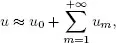
images
(1.4)
by setting q = 1, where
images
(1.5)
and so on. It should be emphasized that one has no freedom to choose the linear operator
images
0 in Lyapunov’s artificial s...

Table of contents

  1. Cover
  2. Half Title
  3. Title Page
  4. Copyright
  5. Preface
  6. Contents
  7. Chapter 1. Chance and Challenge: A Brief Review of Homotopy Analysis Method
  8. Chapter 2. Predictor Homotopy Analysis Method (PHAM)
  9. Chapter 3. Spectral Homotopy Analysis Method for Nonlinear Boundary Value Problems
  10. Chapter 4. Stability of Auxiliary Linear Operator
  11. Chapter 5. A Convergence Condition of the Homotopy Analysis Method
  12. Chapter 6. Homotopy Analysis Method for Some Boundary Layer Flows of Nanofluids
  13. Chapter 7. Homotopy Analysis Method for Fractional Swift–Hohenberg Equation
  14. Chapter 8. HAM-Based Package NOPH for Periodic Oscillations of Nonlinear Dynamic Systems
  15. Chapter 9. HAM-Based Mathematica Package BVPh 2.0 for Nonlinear Boundary Value Problems