Physics Olympiad - Basic To Advanced Exercises
eBook - ePub

Physics Olympiad - Basic To Advanced Exercises

  1. 380 pages
  2. English
  3. ePUB (mobile friendly)
  4. Available on iOS & Android
eBook - ePub

Physics Olympiad - Basic To Advanced Exercises

About this book

This book contains some of the problems and solutions in the past domestic theoretical and experimental competitions in Japan for the International Physics Olympiad. Through the exercises, we aim at introducing the appeal and interest of modern physics to high-school students. In particular, the problems for the second-round of competition are like long journey of physics, beginning with fundamental physics of junior-high-school level, and ending with the forefronts of updated physics and technology.

Contents:

  • Part I: Theory:
    • General Physics
    • Mechanics
    • Oscillations and Waves
    • Electromagnetism
    • Thermodynamics
    • Modern Physics
  • Part II: Experiments:
    • How to Measure and Analyze Data
    • Practical Exercises
    • Appendices: Mathematical Physics


Readership: High school students and high school teachers, as well as undergraduates.

Frequently asked questions

Yes, you can cancel anytime from the Subscription tab in your account settings on the Perlego website. Your subscription will stay active until the end of your current billing period. Learn how to cancel your subscription.
No, books cannot be downloaded as external files, such as PDFs, for use outside of Perlego. However, you can download books within the Perlego app for offline reading on mobile or tablet. Learn more here.
Perlego offers two plans: Essential and Complete
  • Essential is ideal for learners and professionals who enjoy exploring a wide range of subjects. Access the Essential Library with 800,000+ trusted titles and best-sellers across business, personal growth, and the humanities. Includes unlimited reading time and Standard Read Aloud voice.
  • Complete: Perfect for advanced learners and researchers needing full, unrestricted access. Unlock 1.4M+ books across hundreds of subjects, including academic and specialized titles. The Complete Plan also includes advanced features like Premium Read Aloud and Research Assistant.
Both plans are available with monthly, semester, or annual billing cycles.
We are an online textbook subscription service, where you can get access to an entire online library for less than the price of a single book per month. With over 1 million books across 1000+ topics, we’ve got you covered! Learn more here.
Look out for the read-aloud symbol on your next book to see if you can listen to it. The read-aloud tool reads text aloud for you, highlighting the text as it is being read. You can pause it, speed it up and slow it down. Learn more here.
Yes! You can use the Perlego app on both iOS or Android devices to read anytime, anywhere — even offline. Perfect for commutes or when you’re on the go.
Please note we cannot support devices running on iOS 13 and Android 7 or earlier. Learn more about using the app.
Yes, you can access Physics Olympiad - Basic To Advanced Exercises by The Committee of Japan Physics Olympiad in PDF and/or ePUB format, as well as other popular books in Biological Sciences & Science General. We have over one million books available in our catalogue for you to explore.

Information

PART I
Theory
Chapter 1
General Physics
Elementary Problems
Problem 1.1. The SI and the cgs systems
The units of fundamental physical quantities, such as length, mass and time, are called the fundamental units, from which the units of other physical quantities are derived.
In the International System of Units (SI), the unit of length is the meter (m), that of mass is the kilogram (kg) and that of time is the second (s). Other units can be composed of these fundamental units. For example, the unit of mass density is kg/m3, because the unit of volume is m × m × m = m3.
On the other hand, there are units composed of the gram (g), the unit of mass; the centimeter (cm), the unit of length; and the second (s), the unit of time. This system of units is called the cgs system of units. In the cgs system, the unit of volume is cm3 and the unit of mass density is g/cm3.
The unit size in the SI is not the same as that in the cgs system. For example, 1 m3 in the SI unit is 106 cm3 in the cgs unit.
How many times larger is the unit size in the SI as compared with the unit size in the cgs system for each of the following physical quantities?
Enter the appropriate numbers in the blanks below.
the unit of volume:
10 a times a =
image
(1) the unit of speed: 10 i times i =
image
(2) the unit of acceleration: 10 j times j =
image
(3) the unit of force: 10 k times k =
image
(4) the unit of energy: 10 l times l =
image
(5) the unit of pressure: 10 m times m =
image
(the 1st Challenge)
Answer i = 2, j = 2, k = 5, l = 7, m = 1
Solution
(1) The unit of speed in the SI is m/s. The unit size of speed in the SI is 1 m/s = 1 × 102 cm/s (because 1 m = 1 × 102 cm). Therefore, it is 102 times the unit size of speed in the cgs system.
(2) The unit of the acceleration in the SI is m/s2. 1m/s2 =1 × 102 cm/s2. Therefore, the answer is 102 times.
(3) Force is “(mass) × (acceleration)”, therefore the unit of force in the SI is N = kg⋅m/s2. 1N=1 × 103 g × 102 cm/s2 =105 g⋅cm/s2=105 dyn (because 1 kg = 103 g). Therefore, the answer is 105times.
(4) Energy is “(force) × (distance)”, therefore the unit of energy in the SI is J = N⋅m. 1 J = 105 dyn × 102 cm = 107 erg. Therefore, the answer is 107 times.
(5) Pressure is “(force)/(area)”, therefore the unit of pressure in the SI is Pa = N/m2. 1Pa=105 dyn/104 cm2 =10dyn/cm2. Therefore, the answer is 10 times.
image
Problem 1.2. The pressure due to high heels and elephants
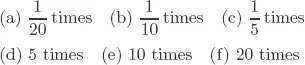
Suppose the total weight of a person who wears high heels is 50 kg and is carried only on the ends of both heels equally (assume the cross section at the end of one heel to be 5 cm2). Also, suppose the total weight of an elephant is 4000 kg and is carried equally on the four soles (assume the cross section of one sole to be 0.2 m2). How many times larger is the pressure exerted on one sole of the elephant compared with the pressure exerted on the end of one heel of the high heels?
Choose the best answer from (a) through (f).
image
(the 1st Challenge)
Answer (e)
Solution
It is important to express the units of physical quantities in the SI. Let the gravitational acceleration be g. The person’s weight, 50 g, is carried on the ends of both heels equally. Hence, the pressure exerted on the end of one heel is pH =
image
= 5 × 10⁴ g Pa (because 5 cm2 = 5 × 10⁻⁴ m2); th...

Table of contents

  1. Cover
  2. Half Title
  3. Title
  4. Copyrights
  5. Preface to the English Edition
  6. Contents
  7. Part I. Theory
  8. Part II. Experiment
  9. Appendix. Mathematical Physics
  10. Index