![]()
Part I
Introduction and Critical Success Factors in E-Commerce Operations Management
![]()
Chapter 1 INTRODUCTION
Learning Objectives
After completing this chapter, you should be able to:
Define and describe “e-commerce.”
Define and describe “operations management.”
Define and describe “e-commerce operations management.”
Explain why e-commerce operations management is important for business success.
Overview of This Chapter
This chapter introduces and defines some of the principle terms that will be used throughout the book. This chapter also tries to help justify why the subject of this book is an important for students of business. The chapter ends with an overview of the book’s architecture used to organize the material for student learning purposes.
What is E-Commerce?
Origin of the Term
The need for more timely information leads to the development of world’s largest and most widely used networks, called the Internet. The Internet is an international collection of hardware and software from hundreds of thousands of private and public computer networks. It represents a global platform that permits digital information to be shared and distributed at very little cost to users. The Internet provides a wide range of information interaction functions, including: communication (i.e., sending e-mails, transmitting data, etc.), accessing information (i.e., searching databases, reading electronic books, etc.), and supplying information (i.e., transferring files, graphics, etc.).
It is no wonder that people of commerce quickly saw opportunities in using the Internet to conduct business. The universality that the Internet offered had to be and was capacitated by businesses into universally accepted standards for storing, retrieving, formatting, and displaying information in a networked environment. This capacitated environment of the Internet is called the World Wide Web (WWW) and permits businesses to get online and conduct a variety of business activities. Tim Berners-Lee of the European Labortory for Particle Phyics was credited in 1990 with developing several protocols used in the initial development of the WWW (Deithel, et al. 2001, p. 12). One example of the use of the WWW standardization capacity is the use of Web sites in conducting business transactions. It is this capacity of the WWW that allows users of a computer over the Internet to locate and view multimedia documents such as text, graphics, animations, and videos that make up Web sites. As the use of the WWW matured during the 1990’s, new terms emerged to more acturately differentiate the different types of business transactions that were taking place over the Internet. One of these new terms was called “electronic commerce” hereafter referred to as “e-commerce.”
E-Commerce Definition
E-commerce is the exchange transactions which take place over the Internet primarily using digital technology. These exchange transactions include buying, selling, or trading of goods, services, and information. This encompasses all activities supporting market transactions including marketing, customer support, delivery, and payment. The term, brick-and-mortar business, is often used to describe traditional or regular business commerce (i.e., non-e-commerce) exchange transactions.
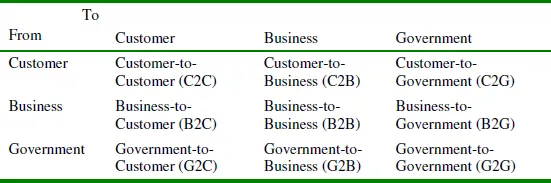
As we can see in Table 1, there are at least nine different categories of e- commerce (Wood 2001, pp. 1-6; Laudon and Laudon, p. 110; Balasubramanian and Mahajan 2001). The customer can sell items directly to other customers (e.g., like the C2C eBay online auction business that allows people to auction items they own to other people directly), or as a C2B organization where online registrations can be performed for products consumers purchase, or as a C2G organization where individual voters in the United States can contact their governmental representatives directly over the Internet. The B2C organizations are now able, through online registration, to keep better track of their customers for purposes of product recalls and product updates. The B2B organizations can transact product and material purchases, share design specifications for new products, and perform research and development activities all online. The B2G organizations allow businesses to fulfill government obligations on reporting their behavior on such issues of environmentalism, taxes, and legal actions in a timely manner. All of the G2C, G2B and G2G organizations can share information required by law and current legislation that might otherwise take years to convey. These governmental organizations allow for a much needed expedience in the disemination of information concerning the governance of people and assurance that laws will be promptly obeyed.
Table 1. Categories of e-commerce
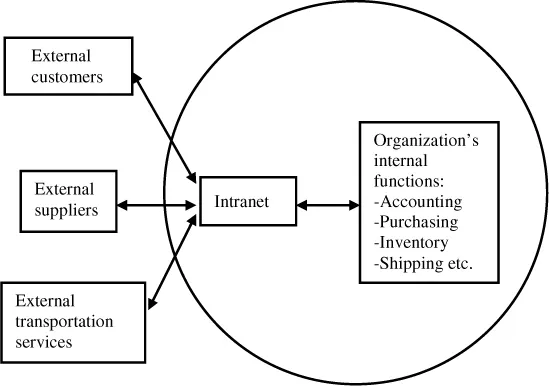
Figure 1. Intranet and extranet
This book takes a very broad view in its definition of e-commerce exchange transactions to include all information sharing that supports business transactions. This would include all transactions internal to the business organizations and those external with customers and government agencies. Also, it incorporates the term “electronic business” or hereafter refered to as “e-business.” E-business describes the uses of the Internet and digital technology for the management of business processes internal to the organization. The use of intranets (i.e., networks within a single organization) as shown in the circled area in Figure 1 are also included in e-commerce. They link internal organization functions together for efficieny, timeliness, and issues of privatacy within the firm. As intranets are expanded to include external organizations (e.g., suppliers) as authorized users of an organization’s intranet, they create extranets which are also included in the definition of e-commerce in this book.
What is Operations Management?
Operations Management (OM) can be defined as the design, operation, and continued improvement of the system that creates and delivers a firm’s products and services (Chase et al. 2001, p. 6). It is viewed primarily as a line management function, equal in standing, organizationally, to accounting, marketing, finance, and information systems. As a management function, OM involves all of the basic management tasks of planning, directing, organizing, staffing, motivating, and controlling.
The primary objective of an OM manager is to manage and control the “production process.” The production process presented in Figure 2 involves taking inputs (e.g., raw materials, human resources, etc.) and transforming them, using technology, processes, and rules, into consumable outputs (e.g., finished products or services) in the most efficient and effective manner. To do this OM mangers must perform a variety of tasks. These tasks include, among other things, managing product and service quality, forecasting demand, managing inventory, scheduling production, purchasing goods and services, managing the supply chain of an organization, aiding in the design and development of products, and managing human and technical resources. OM managers must also control the transformation process and allow for corrective feedback to make sure they are achieving organizational goals. Since OM also involves improving operating systems, additional tasks might include reengineering jobs or processes and working with consultants to alter existing systems for improved efficiency and productivity as changes in technology or markets demand.
Table 2. Types of e-business models
Type of model | Description |
Advertiser | Company makes money by selling advertising space on their Web site. The Advertiser then lures target audience by giving them some free service or information. Many companies who maintain a Web site have started using this type of model as an extra source of e-commerce income. |
Service | Company creates a Web site that offers customers a service or range of services. Online brokerage houses, travel agencies, etc. are typical examples. |
Virtual mall | Company offers a wide range of differing manufactured products on a Web site. One of the most typical examples is AMAZON.COM. |
e-tailing | Company can offer a single customized product, like Dell Computers which offers a customized computer system over the Web. They can also offer non-customized products like brandname appliances. |
Information
disseminator | Company offers up-to-date source of information of a specific nature. An example would be an online newspaper from a specific city or covering a specific type of news. |
Sales facilitator | Company connects buyers with sellers on a Web site that attracts customers with the promise of finding an inexpensive source for the product or service they are looking for while selling access linkage to the seller’s site. |
e-procurement | Company provides efficient and cost reducing linkages between buyers and sellers of industrial organizations. |
Online auction site | Company that provides a market place for buyers and sellers to exchange goods and services to the highest bidder. |
While there are many other tasks that OM managers may be asked to perform, those listed in Figure 2 are considered by most OM managers as basic, fundamental, and critical factors necessary for a successful operation. When a task becomes so important that it can determine the successfulness of an organization, it becomes what is called a critical success factor (Laudon and Laudon 2001, p. 307). As we will see in Chapter 2, these critical success factors (CSFs) must be included in the development of strategies for successful business operations. Indeed, the rest of this book is devoted to learning how these CSFs can be incorporated in e-commerce operations. While these tasks have been performed by OM managers for many decades, e-commerce is viewed as a revolution, altering how they can and should be performed. This revolution is called “e-commerce operations management.”
What is E-Commerce Operations Management?
E-commerce operations management is the application of all operations management tasks applied in an e-commerce setting. It is the combination of the use of the Internet and digital technology to perform the basic OM activities necessary for the successful running of a business. It involves all the typical OM activities (i.e., pu...