![]()
Chapter 1
Childhood in Liuhe
Liuhe, hometown of Madame Wu Chien-Shiung, is located northeast of Shanghai, about an hour away by car and along the Yangtze River.
A typical village in the “South of Yangtze” area, Liuhe has a strategic position near the mouth of the Yangtze River, overlooking Chongming Island in the middle. Liuhe is also the area’s agricultural provider and a commerce center of Taicang County. It is busy and crowded with both carts and ships. Liuhe has been called “The Six Countries Pier” since the Yuan Dynasty (1279–1368), and “Junior Shanghai” indicating its prosperity. In the Yongle Year of the Ming Dynasty (1368–1644), the Grand Eunuch Zheng He departed from there for his seven naval expeditions.
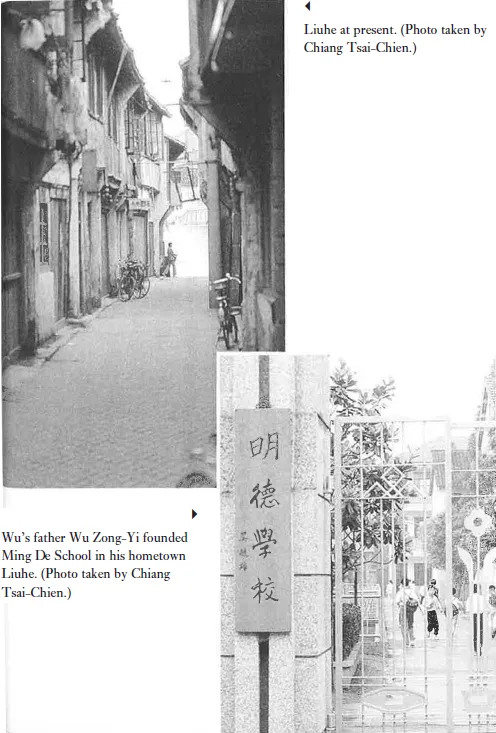
In spite of China’s economy opening up in recent decades, Liuhe still maintains its old world charm. It has a few little new buildings in the periphery and several new roads connecting to other cities. It still has the historical buildings in the center of town: old wooden two-storied buildings, covered with black tiles, with wooden windows, doors and ceiling beams. Stone-tablet-covered lanes crisscross the old buildings, where people open grocery stores, or set up tailor or barber shops.
There is indeed a Liu River (Liuhe means “Liu River” in Chinese) flowing by the edge of town, with peach trees on both banks, and several cement bridges across it. The water in the river is mostly stagnant and quite muddy as a result of population growth and industrial pollution.
Wu Chien-Shiung was born in Shanghai on May 13, 1912 (April 29 in the lunar calendar). Her birth brought much pleasure to her scholarly family in this village. As it was also the year of the inauguration of the Republic of China, there was a sense of renewal everywhere in the air.
Wu was the second child, but the first daughter in the family. According to tradition, all children in this generation had Chien as a first character in their first name, and the second character would follow this sequence ‘Ying-Shiung-Hao-Jie’ (heroes and outstanding figures). Wu had an older brother Chien-Ying born in 1909, and a younger brother Chien-Hao born in 1920. When Wu Chien-Shiung was born, her grandfather Wu Yi-Feng, a junior scholar (Xiu-Cai) in the National Civil Service Examinations in the late Qing Dynasty (1644–1911), was still alive. Because her grandfather somewhat favored a male heir, Wu Chien-Shiung was never spoiled, even as the only girl in the family.
Her father Wu Zong-Yi was born in 1888, and he was 24 when Wu arrived. Zong-Yi was very progressive, knowledgeable and courageous. He was very close to Wu Chien-Shiung, loved her very much, and had a profound influence on her life.
Wu Zong-Yi studied in the Third Elementary School in Taicang County, and went on to the Nanyang Public School in Shanghai upon graduation. Nanyang Public School was founded in 1896, as proposed by Sheng Xuan-Huai, a principal in the Self-Strengthening Faction in the late Qing Dynasty. It had the mission to educate a new generation of Chinese to become fluent in foreign languages and technologies. It was called “Public School” as it was funded by both private businesses and by the government.
Nanyang Public School gradually expanded into various colleges, and was renamed Higher School of Commerce and Industry of the Ministry of Trade in 1905 when Sheng Xuan-Huai fell out of favor. The school had graduated three to four hundred students, and selected tens of them to go abroad for further study. Nanyang Public School was the predecessor of Jiaotong University.1
In such a relatively open environment, Wu Zong-Yi began his contact with the ideas of freedom and equality from the West. He read extensively, particularly books on human rights and democracy. These activities had a major effect in molding his thought process.2
Books and periodicals spreading new ideas were officially banned from campus. While reading these materials in secret, Wu Zong-Yi could not understand why such reasonable ideas were outlawed. This increasing resentment drove him to join the resistance movement by boycotting classes. After the boycott, Wu Zong-Yi was no longer willing to stay in Nanyang Public School, withdrew and transferred with several like-minded students to Ai-Kuo (love your country) Academy, founded by Cai Yuan-Pei.
Cai Yuan-Pei was a widely respected revolutionary and educator. His ideal of education centered on academic freedom, tolerance and diversity. The professors in Ai-Kuo Academy were not only experts in their fields, but also invariably had revolutionary ideas. Free discussions and progressive thought flourished on campus. Various journals circulated freely and student organizations democratically elected their leaders and published their own periodicals. Cai Yuan-Pei attempted to implement a democratic system that he believed in on campus.
In 1903, the government exposed and seized the revolutionary Jiangsu Tribune in Shanghai. The imprisonment of two prominent revolutionaries, Zhang Bing-Lin and Zou Yong, shook China at large. Cai Yuan-Pei was implicated because of his editorial involvement with the newspaper, and was exiled to Qingtao. The academy was closed and Wu Zong-Yi discontinued his studies.
The Jiangsu Tribune case quieted down next year and Cai Yuan-Pei returned to Shanghai to start another newspaper. Wu Zong-Yi joined the newspaper spreading revolt against the Qing government. In 1907, he joined the Athletic Association founded by his father and others, with the mission of building a healthy body able to serve China. In 1908, Chen Ying-Shi was sent by Sun Yat-Sen from Japan to Shanghai to actively organize revolt activities. Wu Zong-Yi introduced himself to Chen as a former student of Cai Yuan-Pei, and expressed his readiness to join the revolution. He was later admitted to the Alliance Society.
Wu Zong-Yi also joined the Shanghai Merchant Corporation in 1909, to study military techniques. This group became the stronghold of the revolutionaries in 1910. It played a critical role in liberating Shanghai during the October 1911 Shanghai Revolt, which succeeded in overthrowing the Qing Dynasty and led to the founding of the Republic of China. In 1913, Yuan Shih-Kai became Acting President of the Republic. He greatly consolidated power and suppressed opponents. This act led to the Second Revolution against Yuan. Wu Zong-Yi participated in attacking the Shanghai Arsenal, and taking over the Weapon Depot. The Second Revolution unfortunately failed rapidly due to the superiority of Yuan’s army, and Zong-Yi had to return home to Liuhe.
Wu Chien-Shiung was born in Shanghai during this chaotic time. The young Wu was very smart, good-looking, likable, and contemplative. She was nicknamed Wei-Wei. Wu started her education like most students of that time, with recital of poems, reading of characters, and simple arithmetic. She already showed an unusual talent in these early studies.
One day her grandfather Wu Yi-Feng called her mother: “Ping-Ping”. Little Wu frowned and objected: “Grandpa, Mom is named Fu-Hua, Fan Fu-Hua, not Ping-Ping.” Delighted by such an alert and naughty granddaughter, he followed: “Wei-Wei, do you know why your Mom is named Fu-Hua?” Wu Chien-Shiung pondered for a while, and said: “Yes, it was from the mission of Sun Zhong-Shan that we should drive away the foreign occupiers and rebuild China (Fu-Hua). Dad always said that Sun is a good man, so he changed Mom’s name to remind us of the mission.” Up to that point, Wu Yi-Feng had felt disappointed in having a female grandchild; he finally gave up the prejudice and increasingly treasured his only granddaughter.3
Her father was without doubt the biggest influence in the development of the young Wu Chien-Shiung. In her memory, this period of growing-up was a happy one. The three siblings read a lot, always encouraged by their father. Wu said that her father was always ahead of his time, inquisitive and hungry for learning.4
Wu Chien-Shiung said her father was indeed very progressive. Even before the founding of the Republic of China, he recognized that the time of Empress Dowager (Cixi) and her heirs had passed, and that there would be major changes in the East. He wished his children to be suitably prepared to live in a modern world. This would require a profound understanding of the value of Chinese culture, enabling them to have a meaningful and rich life.
Not only was Wu Zong-Yi progressive, he had broad interests and was quite accomplished in radio, hunting, playing the accordion, singing, and reciting classical poems. Though he was not demanding of his children, he gave Wu an extra push because he recognized her quiet curiosity and unusual talent. He frequently read aloud the scientific news articles in the Shanghai newspaper, “Shen”, to her (before she could read). The primitive quartz radio that he put together really fascinated her and she was intrigued by the ability of the radio to receive news from far away.
The Wus lived in an old, two-story house to the right of the plaza in front of the Tian-Fei (Goddess) Temple in central Liuhe. Wu would play with other children in the plaza, but preferred to stay home listening to the radio. She was quieter and more thoughtful than other children her age.5
She received her elementary school education at the Ming De School founded by her father. She was proud of and inspired by her father’s process in founding the school, his courage and his introducing of modern concepts to the village.
When Wu was very young, Liuhe was not peaceful. There was a group of bandits who preyed on the village, robbing and kidnapping. The locals could not do much. Even the police department was looking the other way.
Because Wu Zong-Yi had received military training in the Shanghai Merchant Corps and had participated in attacking the Shanghai Arsenal during the Second Revolution, he founded a local militia upon his return to Liuhe, and developed a plan to eliminate the bandits by executing their leader.
The leader of the bandits was Wang Ying-Biao. Wu Zong-Yi monitored their routine and selected the right time to invade their headquarters. He led the attack and personally killed Wang. Without a leader, the gang dissolved and disappeared from the area.
With the return of peace, Wu Zong-Yi turned his attention to education. There was a Temple of the Fire God that had fallen out of active service because of the turmoil caused by the bandits. Its courtyard was used for training the local militia. He gained the support of the local men, removed the clay statue of the Fire God, and renovated the temple into a school. The arched entrance gate proudly proclaimed “Ming De Women’s Vocational School” — a name taken from the proverb: “The journey of education is in understanding morals (Ming De’s direct translation in English means “understanding morals”)”. Zong-Yi served as the school principal.
The school had only a few children from close relatives at the beginning. Wu Zong-Yi would go door to door with Chien-Shiung to recruit students, rich and poor. There was no charge for attending the school. It would teach sewing, embroidery, gardening, and similar practical trades. Zong-Yi wanted to eliminate ignorance through education, and prejudice against women — embedded in the old saying “Moral is an uneducated woman.” Ming De School even admitted girls obliged to care for their brothers — with the brothers attending the school too.
Not only was Wu Chien-Shiung hungry for learning, it is clear from interviews that her father’s personality had ...