![]()
Chapter 1
Lattice Structure, Phonons,
and Electrons
1.1 Introduction
Guessing the technical background of students in a course or readers of a book is always a hazardous enterprise for an instructor, yet one must start a book or a course somewhere on the landscape of knowledge. Here, we begin with some essential concepts from condensed-matter physics and statistical mechanics. The definition of essential, too, is questionable and is presently intended to be information that recurs too frequently in the later parts of the text to leave the requisite information to the many excellent reference sources on these subjects.
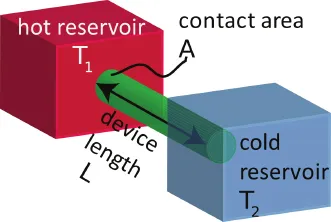
Our overarching objective is to develop the tools required to predict thermal transport in structures such as the one shown in
Fig. 1.1. Arguably the most important thermal characteristic of an object is its thermal conductivity (
) defined as:
For roughly a century, thermal conductivity was considered a basic material property in the engineering sense (e.g., with minor accommodation for variations in temperature), and therefore, the effects of the geometric terms in Eq. (1.1) were assumed to normalize with the others such that the final property was independent of size and shape. However, with the advent of microscale fabrication (and later nanoscale fabrication), the technical community was able to create tiny materials that exhibited deviations from the size-independent property assumption. In such circumstances, knowledge of not only a material’s size and shape becomes crucial but also the details of the atomic-scale carriers of thermal energy (Chen, 2005). At this level, in order to retain the utility of the concept of thermal conductivity (and it does remain useful for many purposes) we need to understand many additional factors, including:
• What type of quantum-mechanical carrier dominates heat flow in the material?
• How is thermal energy distributed among these carriers?
• How fast do the carriers move through the material?
• How much thermal energy does each carrier hold as it moves?
• How do the carriers scatter as they move through the material?
• How do the boundaries and interfaces impede carriers?
The answers to these questions require a much deeper perspective on the mechanisms of thermal energy transport than is provided in traditional engineering expositions on heat conduction. Thus we embark here on the first of two background chapters: the present on lattice structure and the subsequent on statistics of energy carriers.
Fig. 1.1 Schematic of a general contact-device-contact arrangement.
The study of thermal energy in any material should rightly begin with a description of the material itself, for thermal energy, unlike other forms of energy such as optical, electronic, and magnetic, is routinely generated, stored, and transported by a diverse set of ‘carriers’. The reason for broader context of thermal energy derives from the second law of thermodynamics, which dictates that all forms of energy tend toward disorder (or ‘thermalization’). In this text, we will make every reasonable attempt to unify the analysis, i.e., to generalize concepts so that they apply to multiple carriers, but this objective is occasionally elusive. In such cases, the text will make clear the relevant restrictions by carrier and material types. The list of interesting materials and physical structures is almost endless, and therefore given the subject of ‘nanoscale’ physics, the text begins with an admittedly cursory treatment of interatomic bonding but then highlights where possible a compelling structure — the graphene carbon lattice — to illustrate important and unique thermal behavior at the nanoscale.
1.2 Atom-to-Atom Bonding in Solid Lattices
The details of interatomic bonding determine a broad assortment of physical material properties, ranging from mechanical strength to electrical conductivity. The primary interest here relates to the resultant vibrational characteristics of atoms that exist in an ordered arrangement, i.e., in a regular crystal. However, we start with a simpler situation: that of a diatomic molecule.
Figure 1.2 shows a schematic of two atoms separated by an equilibrium distance r = r0 about which the atoms vibrate at various (but restricted) frequencies. A generic potential energy field U(r) b...