Endohedral Fullerenes: From Fundamentals To Applications
eBook - ePub

Endohedral Fullerenes: From Fundamentals To Applications

From Fundamentals to Applications

  1. 448 pages
  2. English
  3. ePUB (mobile friendly)
  4. Available on iOS & Android
eBook - ePub

Endohedral Fullerenes: From Fundamentals To Applications

From Fundamentals to Applications

About this book

Endohedral fullerenes represent a novel family of carbon nanostructures, which are characterized by a robust fullerene cage with atoms, ions, or clusters trapped in its interior. Since the first separation of the endohedral metallofullerene La@C 82 in 1991, a large variety of endohedral structures have been isolated and their endohedral nature has been proved by experimental studies. Within the past two decades, the world of endohedral fullerenes was significantly enlarged by the clusterfullerenes and the new carbon cages including non-IPR (IPR=isolated pentagon rule) structures. Resulting from the charge transfer from the encaged species to the fullerene cage, endohedral fullerenes hold a lot of fascinating properties inaccessible by the empty fullerenes, and consequently promise potential applications in biomedicine, molecular electronics and photonics etc.

The book provides a comprehensive overview of endohedral fullerenes focused on the new advances in the past decade, including its fundamentals (structures), synthesis, isolation, characterization, properties, functionalization as well as the applications, thus representing the most updated and broad review of this exciting field.

Contents:

  • The Early Days of Metallofullerene Research (Hisanori Shinohara)
  • Synthesis and Isolation of Endohedral Fullerenes — A General Review (Fupin Liu, Jian Guan, Tao Wei, Song Wang and Shangfeng Yang)
  • Crystallographic Study of Endohedral Metallofullerenes (Yun-Peng Xie, Shasha Zhao and Xing Lu)
  • Metal Nitride Clusterfullerenes — New Advances and Challenges (Tao Wei, Song Wang, Fupin Liu, Jian Guan, Alexey A Popov, Lothar Dunsch and Shangfeng Yang)
  • Metal Carbide Clusterfullerenes (Taishan Wang and Chunru Wang)
  • The Discovery of Non-IPR Fullerenes (Wei Xu, Chunying Shu and Chunru Wang)
  • Metal Oxide Clusterfullerenes (Steven Stevenson)
  • Nitrogen Atom-Based Endohedral Fullerenes and Potential Applications (B J Farrington and K Porfyrakis)
  • Noble-Gas Fullerenes (R James Cross, Jr)
  • Electrochemical Properties of Endohedral Metallofullerenes (Luis Echegoyen, Frederic Melin and Manuel N Chaur)
  • Chemical Functionalization of Endohedral Metallofullerenes (Yutaka Maeda)
  • Computational Studies of Endohedral Fullerenes: Bonding, Isomerism, Internal Dynamics, Spectroscopy, and Chemical Reactivity (Alexey A Popov)
  • Biomedical Applications of Trimetallic Nitride Endohedral Metallofullerenes (Jianyuan Zhang, Boris M Kiselev, Youqing Ye and Harry C Dorn)
  • Higher LUMO Level Endohedral Fullerene and Fullerene Bisadduct Acceptors for Polymer Solar Cells (Yongfang Li)


Readership: Advanced undergraduates and graduate students, scientists in Chemistry, Physics, and Materials Science, researchers and professionals in the fields of fullerenes and all-carbon nanomaterials, and the general public.

Frequently asked questions

Yes, you can cancel anytime from the Subscription tab in your account settings on the Perlego website. Your subscription will stay active until the end of your current billing period. Learn how to cancel your subscription.
No, books cannot be downloaded as external files, such as PDFs, for use outside of Perlego. However, you can download books within the Perlego app for offline reading on mobile or tablet. Learn more here.
Perlego offers two plans: Essential and Complete
  • Essential is ideal for learners and professionals who enjoy exploring a wide range of subjects. Access the Essential Library with 800,000+ trusted titles and best-sellers across business, personal growth, and the humanities. Includes unlimited reading time and Standard Read Aloud voice.
  • Complete: Perfect for advanced learners and researchers needing full, unrestricted access. Unlock 1.4M+ books across hundreds of subjects, including academic and specialized titles. The Complete Plan also includes advanced features like Premium Read Aloud and Research Assistant.
Both plans are available with monthly, semester, or annual billing cycles.
We are an online textbook subscription service, where you can get access to an entire online library for less than the price of a single book per month. With over 1 million books across 1000+ topics, we’ve got you covered! Learn more here.
Look out for the read-aloud symbol on your next book to see if you can listen to it. The read-aloud tool reads text aloud for you, highlighting the text as it is being read. You can pause it, speed it up and slow it down. Learn more here.
Yes! You can use the Perlego app on both iOS or Android devices to read anytime, anywhere — even offline. Perfect for commutes or when you’re on the go.
Please note we cannot support devices running on iOS 13 and Android 7 or earlier. Learn more about using the app.
Yes, you can access Endohedral Fullerenes: From Fundamentals To Applications by Shangfeng Yang, Chun-Ru Wang in PDF and/or ePUB format, as well as other popular books in Biological Sciences & Science General. We have over one million books available in our catalogue for you to explore.

Information

CHAPTER 1
The Early Days of Metallofullerene Research
Hisanori Shinohara*
1.1. Fullerenes with Metal Atom Encapsulated: Discovery
Endohedral metallofullerenes are an interesting class of fullerenes because electron transfer from the encaged metal atom to the carbon cage has been known to occur, and this oftentimes (dramatically) alters the electronic and magnetic properties of the fullerenes.
In this chapter, I will briefly describe the history and evolution of metallofullerene research in the early days, where a series of exciting and novel results were obtained on daily basis.
The first idea (and also an experimental trial of the synthesis) of metallofullerenes was presented by the Sussex University–Rice University joint research team headed by Harry Kroto and Rick Smalley in 1985. A week after the first experimental observation of the so-called ā€œmagic numberā€ soccerball-shaped C60 in a laser-vaporized cluster beam mass spectrum by Kroto et al.,1 the same research group also found a magic number feature due to LaC60 in a mass spectrum prepared by laser vaporization of a LaCl2-impregnated graphite rod.2
Image
Fig. 1 Laser-vaporization supersonic cluster-beam Time-of-Flight mass spectrum of various lathanum-carbon clusters. LaC60 is seen as an enhanced (magic number) peak.
They observed a series of Cn+ and LaCn+ ion species with LaC+60 as a magic number ion in the mass spectrum (Fig. 1) and concluded that a La atom might be encaged within the (then hypothetical) soccerball-shaped C60. This was obviously the first experimental proposal of the so-called ā€œendohedral metallofullerenesā€ concept. They first tried Fe with no success and then found that La was the correct atom for encapsulation within fullerenes. Interestingly, even today Fe has not been encapsulated by fullerenes because of a substantial lack of electron transfer from Fe to fullerenes. Instead, Fe has been known as one of the best metal catalysts in synthesis of single-wall carbon nanotubes.3
Further circumstantial (but not direct) evidence that metal atoms may be encaged in C60 was also reported by the Rice group, showing that LaC60+ ions did not react with H2, O2, NO and NH3,4. This suggests that reactive metal atoms are protected from the surrounding gases and are indeed trapped inside the C60 cage.
The first direct evidence of the soccerball (truncated icosahedron) C60 was amply demonstrated in 1990 by a historical experiment done by Kraetschmer, Huffman and co-workers. They succeeded in producing macroscopic quantities of soccerball-shaped C60 by using resistive heating of graphite rods under a He atmosphere.5,6 The resistive heating method was then superseded by the so-called contact arc discharge method developed by the Rice group7 since the arc discharge method can produce fullerenes order of magnitudes larger than that by resistive heating. Since then, this arc discharge method has become a standard method for fullerene synthesis.
1.2. Macroscopic Synthesis of Metallofullerenes
The first production of macroscopic quantities of endohedral metallofullerenes were also reported by the Rice group.8 They used the high-temperature laser vaporization method, originally developed for C60 synthesis, of La2O3/graphite composite rods and the contact arc discharge technique to produce various sizes of La-metallofullerenes. Contrary to the previous expectation, only the La@C82 fullerene survived in solvent and was extractable by toluene even though La@C60 and La@C70 were also seen in the mass spectra of the sublimed film from raw soot. In other words, the major La-metallofullerenes with air stability was La@C82, and La@C60 and La@C70 were somehow unstable in air and in solvents.
I would like to point out here in passing that the symbol @ is conventionally used to indicate that atoms listed to the left of the @ symbol are encaged in the fullerenes. For example, a C60-encaged metal species (M) is then written as M@C60.8 The corresponding IUPAC nomenclature is, however, different from this conventional M@C60 representation. It is recommended by IUPAC that La@C82 should be called [82] fullerene-incar-lanthanum and be written iLaC82.9 However, throughout this chapter the conventional M@C2n description is used for endohedral metallofullerenes for brevity, unless otherwise noted.
The speciality of the La@C82 fullerene was soon confirmed by Whetten and co-workers.10 However, they also observed that at relatively high loading ratios of La2O3 in composite rods, a di-lanthanofullerene, La2@C80, was also produced by the resistive-heating method and found to be another solvent-extractable major lanthanofullerene.10,11
Image
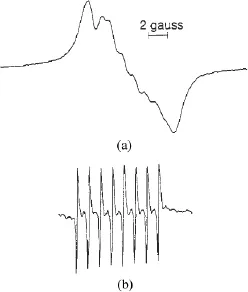
Fig. 2 EPR spectrum (9.112 GHz) at ambient temperature of (a) solid degassed toluene extract (dried) resulting from arc burning of a composite graphite/La2O3 rod and (b) a degassed solution of the dried extract in 1,1,2,2-tetrachloroethane12.
The first important information on the electronic structure of La@C82 was provided by the IBM Almaden research group. The charge state of the encaged La atom was studied by Johnson et al.12 using electron paramagnetic resonance (EPR). The EPR hyperfine splitting (hfs) analysis of La@C82 revealed that the La atom is in the +3 charge state and that the formal charge state of La@C82 should be written as La3+@C823āˆ’: three outer electrons of La are transferring to the C82 cage.13
Several other research groups extended their works to endohedral yttrium compounds. The Rice–Minnesota University14 and Nagoya University15 research groups also reported solvent-extractable Y@C82 and Y@C82 fullerenes and observed the EPR hfs of Y@C82. From the hfs analyses, both groups concluded that the charg...

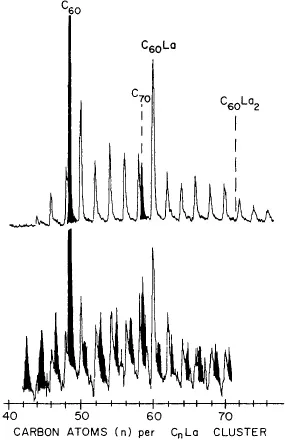
Table of contents

  1. Cover
  2. Halftitle
  3. Title
  4. Copyright
  5. Dedication
  6. Foreword
  7. Contents
  8. Chapter 1 The Early Days of Metallofullerene Research
  9. Chapter 2 Synthesis and Isolation of Endohedral Fullerenes — A General Review
  10. Chapter 3 Crystallographic Study of Endohedral Metallofullerenes
  11. Chapter 4 Metal Nitride Clusterfullerenes — New Advances and Challenges
  12. Chapter 5 Metal Carbide Clusterfullerenes
  13. Chapter 6 The Discovery of Non-IPR Fullerenes
  14. Chapter 7 Metal Oxide Clusterfullerenes
  15. Chapter 8 Nitrogen Atom-Based Endohedral Fullerenesand Potential Applications
  16. Chapter 9 Noble-Gas Fullerenes
  17. Chapter 10 Electrochemical Properties of Endohedral Metallofullerenes
  18. Chapter 11 Chemical Functionalization of Endohedral Metallofullerenes
  19. Chapter 12 Computational Studies of Endohedral Fullerenes: Bonding, Isomerism, Internal Dynamics, Spectroscopy, and Chemical Reactivity
  20. Chapter 13 Biomedical Applications of Trimetallic Nitride Endohedral Metallofullerenes
  21. Chapter 14 Higher LUMO Level Endohedral Fullerene and Fullerene Bisadduct Acceptors for Polymer Solar Cells
  22. Index