Canonical Quantum Gravity: Fundamentals And Recent Developments
eBook - ePub

Canonical Quantum Gravity: Fundamentals And Recent Developments

Fundamentals and Recent Developments

  1. 324 pages
  2. English
  3. ePUB (mobile friendly)
  4. Available on iOS & Android
eBook - ePub

Canonical Quantum Gravity: Fundamentals And Recent Developments

Fundamentals and Recent Developments

About this book

This book aims to present a pedagogical and self-consistent treatment of the canonical approach to Quantum Gravity, starting from its original formulation to the most recent developments in the field.

We start with an innovative and enlightening introduction to the formalism and concepts on which General Relativity has been built, giving all the information necessary in the later analysis. A brief sketch of the Standard Cosmological Model describing the Universe evolution is also given alongside the analysis of the inflationary mechanism. After deepening the fundamental properties of constrained dynamic systems, the Lagrangian approach to the Einsteinian Theory is presented in some detail, underlining the parallelism with non-Abelian gauge theories. Then, the basic concepts of the canonical approach to Quantum Mechanics are provided, focusing on all those formulations which are relevant for the Canonical Quantum Gravity problem. The Hamiltonian formulation of General Relativity and its constrained structure is then analyzed by comparing different formulations. The resulting quantum dynamics, described by the Wheeler–DeWitt equation, is fully discussed in order to outline its merits and limits. Afterwards, the reformulation of Canonical Quantum Gravity in terms of the Ashtekar–Barbero–Immirzi variables is faced by a detailed discussion of the resulting Loop Quantum Gravity Theory. Finally, we provide a consistent picture of canonical Quantum Cosmology by facing the main features of the Wheeler–DeWitt equation for the homogeneous Bianchi models and then by a detailed treatment of Loop Quantum Cosmology, including very recent developments.

Contents:

  • Introduction to General Relativity
  • Elements of Cosmology
  • Constrained Hamiltonian Systems
  • Lagrangian Formulations
  • Quantization Methods
  • Quantum Geometrodynamics
  • Gravity as a Gauge Theory
  • Loop Quantum Gravity
  • Quantum Cosmology


Readership: Researchers in theoretical physics, quantum physics, general relativity and astrophysics.

Trusted by 375,005 students

Access to over 1 million titles for a fair monthly price.

Study more efficiently using our study tools.

Information

Chapter 1
Introduction to General Relativity
In this chapter we will analyze the affine and metric properties of a 4-dimensional manifold, stressing the tensor character of all fundamental geometric objects. Then we will introduce the concepts of geodesics, curvature, and geodesic deviation in order to characterize the motion of test-particles in a generic spacetime. By means of the fundamental General Relativity and Equivalence principles we develop the basic ideas at the ground of General Relativity theory, matching them with the previously constructed formalism. Hence, we write down Einstein’s equations describing the geometrodynamics of spacetime and we also outline the role played by matter fields.
Finally, we provide an important formalism, commonly called vierbein representation, which allows to determine the existence of a local gauge-like symmetry associated to the Lorentz group which can be identified with an internal symmetry. In fact, the action of the local Lorentz group leaves unchanged both the metric and the Riemann tensors. In Chapter 7 this will be the starting point in order to represent General Relativity in the fashion of a non-Abelian Yang-Mills theory.
1.1 Parametric manifold representation
Let us consider a differentiable 4-dimensional manifold
image
embedded in a Minkowskian 5-dimensional space M5, endowed with the natural scalar product.
It is possible to define a parametric representation of
image
via a 5-dimensional vector,
image
, of which each component is a function of 4 parameters uÎź. We can project
image
on an orthonormal basis {
image
}
image
where the · indicates the common scalar product using the Minkowski metric ηIJ = diag{−1, 1, 1, 1, 1}. The manifold is said to be infinitely differentiable if XI (uμ) ∈ C∞, for I = 0, …, 4.
On the other hand, it is also possible to define an adapted basis on
image
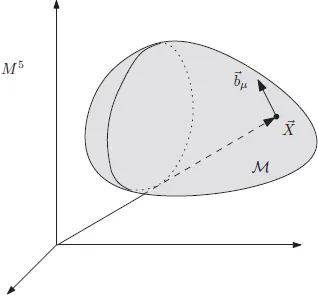
, which is given at each point by the set of the vectors which are tangent to the manifold itself (see figure 1.1). The tangent vectors {
image
} read
image
image
Figure 1.1 A drawing of the embedded manifold
image
described by the 5-dimensional vector
image
, with the basis vectors
image
.
Then, it follows that any vector
image
can be projected onto the basis {
image
} as follows
image
where the V I are the components in the 5-dimensional Minkowskian space. In this way we defined the contravariant components of
image
as V Îź. It is possible to define the covariant components via the scalar product with the basis vectors
image
Hence, we generally obtained that Vμ ≠ V μ and that the two different kinds of components are linked by the non-trivial relation
image
1.2 Tensor formalism
The set of parameters {uÎź} defines a coordinate system adapted to the tangent hypersurface at every point of
image
. Any geometrical quantity belonging to the tangent hypersurface can be expressed as a function of {uÎź}.
If we choose a different parametrization of the manifold, we obtain a coordinate transformation which we request to be invertible and differentiable, i.e. a diffeomorphism, on
image
image
hence, we obtain the transformation of the basis vectors of the tangent hypersurfaces,
image
Vectors on
image
transforming this way, i.e. via the derivatives of the old variables with respect to the new ones, are called covariant. It then follows
image
vectors transforming as Vρ are called contravariant, i.e. via the derivatives of the new variables with respect to the old ones.
A scalar quantity is an object independent of the choice of coordinates. We write it as a contraction of covariant and contravariant quantities
image
where we used the common property of the derivative chain rule
image
We define a tensor...

Table of contents

  1. Cover Page
  2. Halftitle Page
  3. Title Page
  4. Copyright
  5. Contents
  6. Preface
  7. List of Figures
  8. List of Notations
  9. 1.  Introduction to General Relativity
  10. 2.  Theory requirements Elements of Cosmology
  11. 3.  Constrained Hamiltonian Systems
  12. 4.  Lagrangian Formulations
  13. 5.  Quantization Methods
  14. 6.  Quantum Geometrodynamics
  15. 7.  Gravity as a Gauge Theory
  16. 8.  Loop Quantum Gravity
  17. 9.  Quantum Cosmology
  18. Bibliography
  19. Index

Frequently asked questions

Yes, you can cancel anytime from the Subscription tab in your account settings on the Perlego website. Your subscription will stay active until the end of your current billing period. Learn how to cancel your subscription
No, books cannot be downloaded as external files, such as PDFs, for use outside of Perlego. However, you can download books within the Perlego app for offline reading on mobile or tablet. Learn how to download books offline
Perlego offers two plans: Essential and Complete
  • Essential is ideal for learners and professionals who enjoy exploring a wide range of subjects. Access the Essential Library with 800,000+ trusted titles and best-sellers across business, personal growth, and the humanities. Includes unlimited reading time and Standard Read Aloud voice.
  • Complete: Perfect for advanced learners and researchers needing full, unrestricted access. Unlock 1.4M+ books across hundreds of subjects, including academic and specialized titles. The Complete Plan also includes advanced features like Premium Read Aloud and Research Assistant.
Both plans are available with monthly, semester, or annual billing cycles.
We are an online textbook subscription service, where you can get access to an entire online library for less than the price of a single book per month. With over 1 million books across 990+ topics, we’ve got you covered! Learn about our mission
Look out for the read-aloud symbol on your next book to see if you can listen to it. The read-aloud tool reads text aloud for you, highlighting the text as it is being read. You can pause it, speed it up and slow it down. Learn more about Read Aloud
Yes! You can use the Perlego app on both iOS and Android devices to read anytime, anywhere — even offline. Perfect for commutes or when you’re on the go.
Please note we cannot support devices running on iOS 13 and Android 7 or earlier. Learn more about using the app
Yes, you can access Canonical Quantum Gravity: Fundamentals And Recent Developments by Francesco Cianfrani, Orchidea Maria Lecian, Matteo Lulli, Giovanni Montani in PDF and/or ePUB format, as well as other popular books in Biological Sciences & Science General. We have over one million books available in our catalogue for you to explore.