![]()
Chapter 1
Basic Considerations in the Analysis of Economic Development
Introduction
Considerable attention had been paid to the relationships between agriculture and population growth, since the time of Malthus; additionally, the “green revolution” and population growth was two prevalent research topics. Nonetheless, the relationships among technical change, population growth and economic development are poorly understood. This book attempts to construct a general equilibrium model (in order to obtain a general equilibrium growth accounting) that allows a simultaneous consideration of the effects of technical change on agricultural and non-agricultural sectors alike, and of population growth on economic development. This chapter first provides a brief overview of pre-World War II history as it relates to the Japanese economy. Second, it examines the theoretical considerations of agriculture, population and technical change. Third, it presents a critical review of the literature pertaining to Japanese agricultural and non-agricultural sectors.
1. Theoretical Considerations of Agriculture, Population and Technical Change
1.1. Historical Growth Patterns in the Japanese Economy
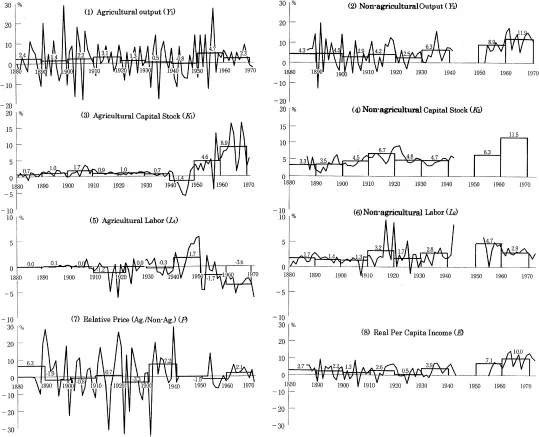
Figure 1-1 shows the annual growth rates of agricultural and non-agricultural outputs, inputs (the capital and labor in each sector), the relative price (agricultural price/non-agricultural price) and per capita income for the period 1880–1970. These are the endogenous variables in our model which has the matrix Ax = b (see Chapter 2). The histogram in Fig. 1-1 also gives the historical average growth rate of each of the eight endogenous variables in each decade. For example, the value of the agricultural output in the 1880s shows 2.4. This means that real agricultural output grew at the rate of 2.4% between 1880 and 1890. Figure 1-1 also shows that the growth rate of per capita income (in real term) accelerated over time. This would indicate the phenomena of the trend acceleration of the Japanese economy, pointed out by Ohkawa and Rosovsky [1973] (see 3.2 in this chapter). Note that the trend acceleration is especially apparent after World War II. On the other hand, we find many numerous wave motions causing the long term wave motions in the moving average of the annual growth rate of each variable when we observe the annual growth rates for the variables.
Figure 1-1 Annual Growth Rates of Endogenous Variables
Let us now consider the depression periods in the Japanese economy. Figure 1-1 shows that the growth rates of per capita income and non-agricultural output in the years 1890, 1898, 1900–1901, 1907–1908, the depression years, have zero or negative numerical values. However as a whole, Japanese economy experienced strong development until 1919. Economic difficulties came after the year 1920; Negative or zero growth rates of per capita income and non-agricultural output were experienced in the depression year of 1920, the Kanto earthquake of 1923, the monetary depression of 1927, the Great Depression of 1929, as Fig. 1-1 indicates. Especially after the heavy crops of rice harvested in 1930, which is indicated by a large positive growth rate of the agricultural output and a large negative growth rate of the relative price (agricultural price/non-agricultural price) in that year, there occurred an agricultural panic (stagnation) period which roughly corresponds to the period between the two World Wars.
If we compare the growth rates of each variable in the agricultural sector with those of the non-agricultural sector, the growth rates of output and inputs in the non-agricultural sector are much larger. Especially note that the growth rates of agricultural labor are zero or negative except during the depressions and between the two World War and become smaller after World War II, indicating the unequal development between agriculture and non-agriculture. The proportions of labor and capital employed in agriculture, and the share of income produced by agriculture which were 71, 43 and 50% respectively in 1880 decreased to 23, 7 and 6% respectively in 1965 (see Table 2-4 in Chapter 2. Also, this shows the agricultural and non-agricultural gap structure (Ohkawa–Rosovsky [1973]). For, agricultural labor’s share in Japan was 23% in 1965, but it produced only 6% of total income).
Next observe the output growth in each sector. Among the variation in the output growth in each sector, the variation in the output of agriculture was very large in the beginning of the whole period (the period of Meiji era) and decreased trend-wise over time. This was due to the fact that agricultural technology was still in its infancy so that agricultural output was severely dependent on the weather and natural conditions. Note that the agricultural depression period which occurred in the 1930s rather than 1920s (the depression period of the Japanese economy as a whole) was characterized by very low growth rates of agricultural output and input. On the other hand, non-agricultural output shows a pattern similar to that of per capita income, and we can observe the trend acceleration (Ohkawa–Rosovsky [1973]) as a whole and the depression period in the 1920s similarly. The variation in the growth of non-agricultural output was fairly large in the beginning of the period. This stems from the fact that non-agricultural technology was still in a developing stage and was concentrated on fabrics, spinning and weaving which utilized the agricultural products as raw materials.
The agricultural sector shows a relatively smaller variation in the uses of factor inputs than the non-agricultural sector. However, agricultural labor decreased and agricultural capital increased (i.e., capital was substituted for labor) in Japanese agriculture, especially after World War II. It is also seen that the uses of non-agricultural labor increased, and those of non-agricultural labor decreased and became negative in the depression periods and during the two World Wars. The relative price of agricultural output shows the largest variation owing to the low price elasticity of agricultural products and the large variation in variation of this agricultural output. However, the relative price decreased quite markedly after World War II, partly due to the agricultural price policy, the development of agricultural technology and the improvement of plant breeding. We can also observe in Fig. 1-1 that in the year of rice riot (1918) agricultural products had an extremely high relative price.
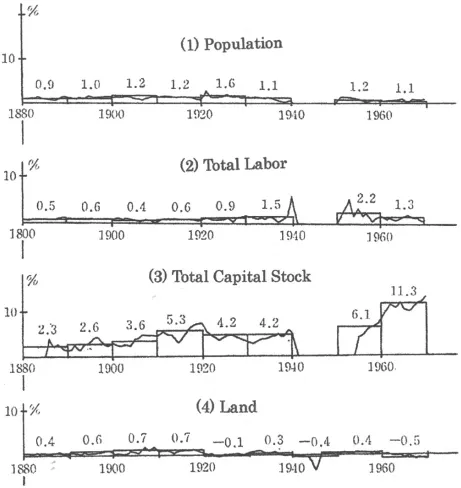
The annual and decadal growth rate of the five exogenous variables in our model are graphed in Fig. 1-2. These are population, land, total labor land and total capital. The growth rates of population and labor are around 1 % and remain almost constant; note however that the growth rates of labor and population are different in the short run. Population has a relatively high growth rate in the periods between 1900–1930 but labor has a relatively high growth rate in the 1930s and the 1950s (this is related to the First Demographic Dividend. First Demographic Dividend means that the decrease of birth rate decreases the burden of children, and increases the production age’s share. This contributes to the economic growth). Land increased until 1920 but decreased sharply in the 1940s and again after 1960. Population, labor and land increased at fairly constant rates of 1.2, 0.9 and 0.2% etc., while total capital increased at much higher rates (about 5 or 6% on the average over the entire period). Especially, total capital stock increased extremely high after WWII as 11.3% in 1960–1970. This is the investment spurt (and export spurt) as Fujino [1965], Shinohara [1973] and Ohkawa–Rosovsky [1973] state (Sec. 3 of this chapter).
Figure 1-2 Annual Growth Rates of Exogeneous Variables
1.2. Theoretical Consideration of Agriculture
1.2.1 Definition of “agriculture”
This book focuses on population, technical change and agricultural and economic development; to that end, let us first describe the agricultural sector. “Agriculture” is defined as the order or system of objective human acts by which some organic living thing is economically obtained (Kashiwa [1962]). “Agriculture” is also an objective act that is developed as a means of life extension. Kashiwa shows that agriculture has developed in three stages. In the first stage, a pre-existing living thing is evaluated. In the second stage, work is undertaken on it, and in the third, a place is prepared for the production of the living thing. As such, agriculture is not an activity that takes place in a static world; rather, it occurs in a dynamic world and has a processive order (Table 1-1).
1.2.2 Characteristics of agriculture
We can list the many characteristics of agriculture and agricultural goods, which can be categorized in two ways: those on the demand side, and those on the supply or production side. Let us look at each of these in greater detail.
(1) Main characteristics of agricultural goods demand
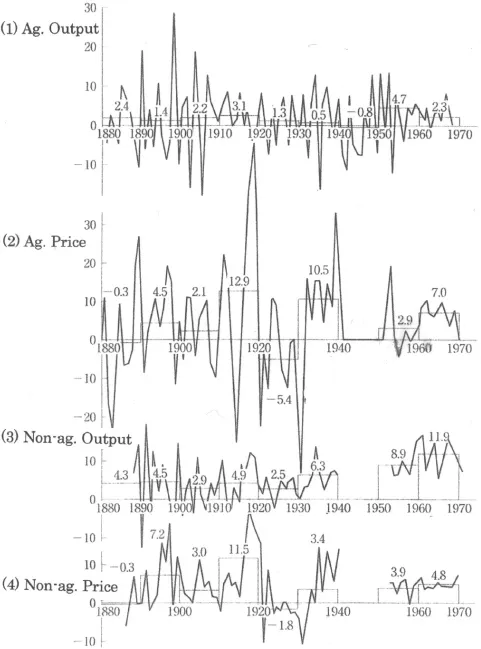
(a) Small income elasticity: Almost all agricultural goods have small income elasticity values, as they constitute necessities of human life. If we look at Engel’s law and the phenomenon of disproportional development between agriculture and non-agriculture, we can see that these phenomena derive from the small income elasticity of agricultural goods. (b) Small price elasticity: Almost all agricultural goods also have small price elasticity values. This creates instability of agricultural prices (see the large fluctuations of agricultural price in Fig. 1-3) and the strange phenomenon of poverty in the case of a good harvest.
(2) Characteristics of supply and production for agricultural goods
(a) Agriculture uses a great amount of land as an input. Therefore, it is easy to have a law of diminishing returns, given land limitations. (b) The production period and working process in agriculture necessarily adhere to the seasons, and they are restricted to a specific natural time. Therefore, it is impossible to rearrange the sequence of production time so as to promote simultaneous production. In other words, those who work in agriculture are compelled to follow the production process of the organic living thing (e.g., plants, vegetables and livestock). Therefore, the demand for labor and agricultural machinery is seasonal, rather than constant. These factors and the law of diminishing returns have traditionally stated, in a straightforward manner, that large-scale production is unprofitable in agriculture. Most Japanese agricultural farms run on a small scale.
Table1-1 Definition, Characteristics and Contribution of Agriculture
| 1. | Definition of Agriculture: |
| Agriculture is defined as an order (or system) of human behavior with the objective of deriving an economically productive organic living. It is also objective behavior which is developed on the order of life extension. |
| 2. | Characteristics of Agriculture: |
| (1) Main characteristics of demand for agricultural goods: (a) Small income elasticity (∵ stomach size is finite) → Engel’s law → The phenomenon of disproportional development between agriculture and non-agriculture. (b) Small price elasticity → Instability of agricultural prices and peculiar phenomena such as poverty during times of a good harvest. |
| (2) Characteristics of supply and production for agricultural goods: (a) Agriculture uses considerable land area as an input, but the limitation of land results in the law of diminishing returns. (b) The production period and working process in agriculture are restricted to a specific natural period → In agriculture, it is impossible to rearrange all sequences of production time to a simultaneous production (because of the organic living) as opposed to the industrial sector → The amount of demand for labor and capital changes from season to season. These factors and the law of diminishing returns mean that large-scale production is unprofitable in agriculture. For example, most of the Japanese farmers work on a small scale. (c) An agricultural good has a long lifecycle and is, hence, vulnerable to the changes of climate. As stated above, agricultural prices fluctuate largely owing to low price elasticity. In addition, as most agricultural goods are perishable, it is not easy to maintain their freshness. Therefore, the price elasticity of agricultural supply is also small. Owing to these supply and demand characteristics, the growth rate, and partial productivity of land, labor productivity, capital productivity, and total productivity in agriculture are lower than in non-agricultural sectors. Therefore, agricultural labor declines relatively and absolutely depending on the time. We can also observe the disproportional development between agriculture and industry. |
| 3. | Contribution of Agriculture to the Economy: |
| (a) Agriculture supplies food and raw materials. (b) Agriculture supplies the source of capital stock through land tax and other taxes which are absorbed from the agricultural sector. (c) Agriculture supplies labor to the non-agricultural sector. (d) Agriculture obtains foreign currencies. (e) Agriculture provides a domestic market for non-agricultural products. Recently, the following three contributions were evaluated in Japan. First is the contribution of agriculture to public wealth, given a large external economy connected with agriculture. Second is the contribution of agriculture in maintaining social balance. Agriculture is a basic industry in the rural areas of Japan → Agriculture keeps people in rural areas and maintains a social balance between urban and rural areas. Third, is the contribution to the ethos of a community, society, and nation. Festivals, temples, and shrines have their origin in agriculture. These three contributions are especially important in the present world, judging from the prevalent environmental problem. |
Figure 1-3 Annual Growth Rates of Sectoral Output and Price
(c) The production of an agricultural good requires a considerable period of time. Usually, a period of several months or years is required to produce a long-term crop. Therefore, production very easily incurs climatic influences. As stated, agricultural prices fluctuate, largely owing to the low price elasticity of agricultural goods, and because so many agricultural goods are perishable. Even when it is possible to maintain the freshness of agricultural goods, it is never easy; as a result, the price elasticity of supply is also small with agricultural goods. Owing to these supply and demand aspects, the growth rate, partial productivity — such as land productivity, labor productivity and capital productivity — and total productivity in agriculture are much smaller than those in non-agriculture. Therefore, the amount of agricultural labor declines relatively and absolutely, in a time-dependent manner. We also see a disproportionate development between agriculture and industry. (See the share of income produced by agriculture λ, the proportion of labor in agriculture l1 and the proportion of capital in agriculture k1, as seen later in Table 2-4 of Chapter 2; all these decrease over time.)
Table 1-2 Definition, Characteristics and Contribution of Population
| 1. | Definition of Population: |
| Population is defined as the total number of people who live in a certain place. |
| 2. | Characteristics of Population: |
| (a) Other than quantitative characteristics, population also has quality dimensions such as age, occupation, and gender. (b) Population shows a social, organic, and reproductive movement, and birth and death rates change the size and structure of population. (c) Population has a very gradual and long-term movement. For example, the gestation period for human beings is nine months, and the minimum age to enter the labor force is 15 years or more. (d) Population is closely related to the economy. |
| 3. | Contribution of Population to Production: |
| (1) Negative contribution of Population to the Economy: (a) Population could decrease per capita income (by definition), other things being equal. (b) Population could change the age structure and decrease the ratio of economically active members in the total population. Therefore, per capita income decreases. (c) Children increase the marginal utility of money and increase consumption. Therefore, household savings would decrease. (d) Per capita public service would decrease. |
| (2) Positive Contribution of Population to the Economy: (a) As labor is drawn from the population, it contributes to production. Moreover, several studies reveal that parents have a tendency to work harder when they have children. In addition, labor contributed by children is important in an agricultural society. (b) The benefits of economies of scale and division of labor appear when there is a large population. |
| (c) Necessity is the mother of invention. (d) With a large population, diversity in knowledge and skill sets allow for the development of novel techniques in using resources. In case of a large population, the number of geniuses is also larger and contributes more to the economy. |
| (3) Contribution of Population to Consumption, Culture, Education, and Miscellaneous Fields: (a) Youths are more flexible and adapt to new occupations with more ease. This results in optimal allocation of labor. In addition, as they produce more than they consume, they save more. (b) Population growth and higher population density makes a positive contribution to the creation of infrastructure, such as roads, transportation, sanitation, and education. Overhead cost becomes relatively cheaper for a large population. A higher population growth rate leads to higher irrigation rates and higher investments in agricultural infrastructure as well. |
1.2.3 Contribution of agriculture to the economy
...