Frontiers In Autism Research: New Horizons For Diagnosis And Treatment
eBook - ePub

Frontiers In Autism Research: New Horizons For Diagnosis And Treatment

New Horizons for Diagnosis and Treatment

  1. 724 pages
  2. English
  3. ePUB (mobile friendly)
  4. Available on iOS & Android
eBook - ePub

Frontiers In Autism Research: New Horizons For Diagnosis And Treatment

New Horizons for Diagnosis and Treatment

About this book

This book focuses on the emerging and expanding areas of research on ASD and their potential to lead to better diagnosis and more effective therapies. These areas include innovative and integrative approaches to genetic/genomic analyses and investigations of epigenetic contributions, including the role of noncoding RNAs, DNA methylation, alternative splicing, RNA editing, and faulty translation in gene regulation and expression, metabolic and immune dysfunction, co-morbidities, as well as hormonal and gene-environment interactions that may increase risk for ASD.

Within each chapter, experts review cutting-edge research as well as provide their perspective on the future of research in their respective areas, including the challenges involved and the types of studies or advances that are necessary to move the field forward to achieve predicted translational goals.

Contributors: Argel Aguilar-Valles, Evdokia Anagnostou, Emma Ashwin, Bonnie Auyeung, Kelly M Bakulski, Simon Baron-Cohen, Margaret L Bauman, Donna Betts, Chad A Bousman, Daniel B Campbell, Manuel F Casanova, Bhismadev Chakrabarti, Gursharan Chana, Abha Chauhan, Ved Chauhan, Jessica DeWitt, Keith W Dunaway, Alal Eran, Ian P Everall, M Daniele Fallin, Richard E Frye, Piers Gillett, Matthew Ginsberg, Christos G Gkogkas, Rhonda J Greenhaw, Simon G Gregory, Elena L Grigorenko, Feng Gu, Rebecca Harmer, Martha Herbert, Valerie W Hu, Karen L Jones, Petra Kern, Arkady Khoutorsky, Rebecca Knickmeyer, Isaac S Kohane, Louis M Kunkel, Janine M LaSalle, Michael V Lombardo, Deepali Mankad, Marvin Natowicz, Laura Nicholls, Christos Pantelis, Natalia Rakhlin, Radhika Ramadas, Daniel A Rossignol, Tewarit Sarachana, Stephen W Scherer, Gabriela Schmulevich, Ayten Shah, Frank R Sharp, Alison B Singer, Efstratios Skafidas, Estate M Sokhadze, Nahum Sonenberg, Boryana Stamova, Zohreh Talebizadeh, Renee Testa, Judy Van de Water, Irina Voineagu, Daniel Williams, Ryan K C Yuen, Daniela Zantomio.

Contents:

  • Dissecting the Genetic Architecture of ASD:
    • Phenotype Definition: A Cornerstone of Autism Research, Diagnosis and Therapy (Valerie W Hu)
    • From Molecular Pathways to ASD Therapy: Insights from Syndromic Forms of Autism (Laura Nicholls, Radhika Ramadas and Irina Voineagu)
    • Language Impairment in Autism Spectrum Disorders (Natalia Rakhlin and Elena L Grigorenko)
    • Whole Genome Sequencing in Autism: Clinical Translation (Ryan K C Yuen and Stephen W Scherer)
    • The Impact of Integrative Unconventional Data Analysis Approaches on Advancing Autism Genetics Research (Zohreh Talebizadeh and Ayten Shah)
    • Construction of a Genetic Classifier for ASD Using Gene Pathway Analysis (Gursharan Chana, Renee Testa, Piers Gillett, Daniel Williams, Chad A Bousman, Daniela Zantomio, Ian P Everall, Christos Pantelis and Efstratios Skafidas)
  • Gene Dysregulation in ASD: From Transcription to Translation:
    • Genome-Wide Expression Studies of Blood and Lymphoblastoid Cell Lines in Autism Spectrum Disorders (Boryana Stamova and Frank R Sharp)
    • Searching in the “Dark” Non-Coding RNA as a New Avenue of Autism Research (Tewarit Sarachana and Valerie W Hu)
    • Targeting Noncoding RNA for Treatment of Autism Spectrum Disorders (Jessica DeWitt and Daniel B Campbell)
    • A-to-I RNA Editing in Autism Spectrum Disorder (Alal Eran, Isaac S Kohane and Louis M Kunkel)
    • Translational Control of Autism and Fragile-X Syndrome (Christos G Gkogkas, Argel Aguilar-Valles, Arkady Khoutorsky and Nahum Sonenberg)
  • Epigenetic, Environmental, and Physiological Contributions to ASD:
    • Epigenetics in Autism (Matthew Ginsberg and Marvin Natowicz)
    • The Epigenetics of Autism — Running Beyond the Bases (Simon G Gregory)
    • Genes and Environment in Autism Spectrum Disorders: An Integrated Perspective (Kelly M Bakulski, Alison B Singer and M Daniele Fallin)
    • The Potential Brain Drain from Environmental Exposures on the Methylome and Genome Across Generations (Janine M LaSalle and Keith W Dunaway)
    • Oxidative Stress and Mitochondrial Dysfunction in ASDs (Feng Gu, Ved Chauhan and Abha Chauhan)
    • Maternal Autoantibodies in Autism Spectrum Disorder (Karen L Jones and Judy Van de Water)
    • Why is Autism More Common in Males? (Simon Baron-Cohen, Michael V Lombardo, Bonnie Auyeung, Emma Ashwin, Bhismadev Chakrabarti and Rebecca Knickmeyer)
  • Moving Towards Personalized Treatment of ASD and Lifespan Issues:
    • Future Directions in Psychopharmacology of Autism Spectrum Disorder (Deepali Mankad and Evdokia Anagnostou)
    • Medical Co-Morbidities in Autism: Clues to Underlying Biological Mechanisms and/or Diagnostic Subtypes? (Margaret L Bauman)
    • Translational Implications of a Whole-Body Approach to Brain Health in Autism: How Transduction Between Metabolism and Electrophysiology Points to Mechanisms for Neuroplasticity (Martha R Herbert)
    • Achieving Optimal Outcomes in Autism: Treating Potentially Reversible Conditions Associated with Autism Spectrum Disorder (Richard E Frye and Daniel A Rossignol)
    • Transcranial Magnetic Stimulation: Application in Autism Treatment (Manuel F Casanova and Estate M Sokhadze)
    • Music Therapy: Personalized Interventions for Individuals with Autism Spectrum Disorder (Petra Kern)
    • The Contributions of Art Therapy in Treatment, Assessment, and Research with People Who have Autism Spectrum Disorders (Donna Betts, Rebecca Harmer and Gabriela Schmulevich)
    • Shifting Paradigms: An Examination of Our Understanding of Adult Autism (Rhonda J Greenhaw)


Readership: Established investigators and students engaged in autism research; also the general population, especially families of individuals affected by ASD and their professional caregivers.
Frequently asked questions

Yes, you can cancel anytime from the Subscription tab in your account settings on the Perlego website. Your subscription will stay active until the end of your current billing period. Learn how to cancel your subscription.
No, books cannot be downloaded as external files, such as PDFs, for use outside of Perlego. However, you can download books within the Perlego app for offline reading on mobile or tablet. Learn more here.
Perlego offers two plans: Essential and Complete
  • Essential is ideal for learners and professionals who enjoy exploring a wide range of subjects. Access the Essential Library with 800,000+ trusted titles and best-sellers across business, personal growth, and the humanities. Includes unlimited reading time and Standard Read Aloud voice.
  • Complete: Perfect for advanced learners and researchers needing full, unrestricted access. Unlock 1.4M+ books across hundreds of subjects, including academic and specialized titles. The Complete Plan also includes advanced features like Premium Read Aloud and Research Assistant.
Both plans are available with monthly, semester, or annual billing cycles.
We are an online textbook subscription service, where you can get access to an entire online library for less than the price of a single book per month. With over 1 million books across 1000+ topics, we’ve got you covered! Learn more here.
Look out for the read-aloud symbol on your next book to see if you can listen to it. The read-aloud tool reads text aloud for you, highlighting the text as it is being read. You can pause it, speed it up and slow it down. Learn more here.
Yes! You can use the Perlego app on both iOS or Android devices to read anytime, anywhere — even offline. Perfect for commutes or when you’re on the go.
Please note we cannot support devices running on iOS 13 and Android 7 or earlier. Learn more about using the app.
Yes, you can access Frontiers In Autism Research: New Horizons For Diagnosis And Treatment by Valerie W Hu in PDF and/or ePUB format, as well as other popular books in Biological Sciences & Science General. We have over one million books available in our catalogue for you to explore.

Information

Epigenetic, Environmental, and Physiological Contributions to ASD

Chapter 12

Epigenetics in Autism

Matthew Ginsberg and Marvin Natowicz*
__________________
*Correspondence to: Cleveland Clinic Lerner College of Medicine, and Pathology & Laboratory Medicine, Genomic Medicine, Neurological and Pediatrics Institutes, Cleveland Clinic, Cleveland, OH 44195. Email: [email protected]
Abstract
Despite many gains in our understanding of genetic aspects of autism, the etiologic basis of autism in most affected individuals is unknown and there is a very incomplete understanding about the downstream biology occurring in the autistic brain. Epigenetics has emerged as a promising field that may explain how some cases of autism arise, both as a result of and independently from monogenic and chromosomal mutations. Here we discuss the emerging evidence of how epigenetic dysregulation may play a role in autism pathophysiology, as well as the challenges and potential strategies in studying possible epigenetic processes in autism.
Keywords: Autism; Epigenetics; DNA methylation; Histone, Genetics.

Introduction

There are a number of single gene disorders, chromosomal abnormalities and teratogenic exposures that cause or are major contributing factors in causation of an autistic phenotype. However, chromosomal abnormalities account for only 5–20% of cases of ASDs and other known causes comprise an even smaller portion.14 The majority of individuals having autism are without an etiological basis and are categorized as idiopathic. Even within this group, there is substantial heterogeneity. For example, the classical triad of symptoms that has historically been used to define the ASDs show only moderate covariance in multiple independent studies.57
Despite this heterogeneity, there is substantial evidence that ASDs are highly heritable. The most convincing evidence comes from twin studies, which show concordance rates of about 90% in monozygotic twins and substantially lower concordance in dizygotic twins, although those numbers are variable depending on whether a broader autistic phenotype is considered in the analysis.812 Yet, despite the discovery of more than 100 monogenic and chromosomal copy number loss/gain risk loci,13 these mutations do not explain a majority of autism risk. Recently, attention has turned to alternative etiological considerations. Noting the high heritability of autism and the failure to identify loci that together account for most of the etiologic basis of autism, Beaudet suggested that epigenetic factors might be major risk factors for autism.2
Epigenetics refers to stable changes of chromatin that affect gene expression, independent of changes in DNA sequence. In this chapter we review basic aspects of epigenetic biology, the role of epigenetic physiology and pathophysiology in the central nervous system, and then discuss evidence for the role of epigenetic factors in autism. We conclude by discussing the implications of current research in autism epigenetics, challenges to the field, and potential pathways forward.

Fundamentals of Epigenetics

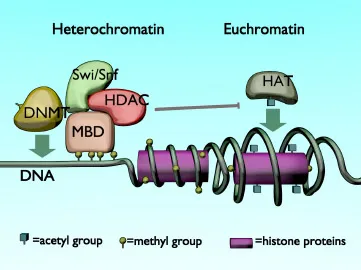
An epigenetic signal refers to a stable non-sequence change to chromatin that affects gene regulation (Figure 1). In essence, the epigenome represents a form of regulatory “clay”, forming a particular state of a region of chromatin in response to inducers that may persist after the inducer is no longer present. These signals establish gene expression patterns that are essential for establishing commitment to cellular differentiation, the inactivation of X chromosomes in females, genetic imprinting (a process of silencing one allele of a gene from a particular parent), and other important tasks.1420
figure
Figure 1. Classical epigenetic mechanisms. DNA forms heterochromatin (repressive) or euchromatin (permissive) in association with histone complexes. DNA methylation by DNA methyltransferases (DNMT) leads to repression of genes by inhibiting binding of transcription factors and promoting binding of Methyl Binding Domain (MBD) proteins such as MECP2. These proteins recruit complexes that include histone deacetylases and chromatin remodeling complexes like Swi/Snf. Euchromatin is associated with lack of methylated DNA and specific histone posttranslational modifications, such as methylation at lysine 4 or acetylation at various residues; HAT = histone acetyltransferase; HDAC = histone deacetylase.
Epigenetic signals can occur as a result of different molecular processes. Epigenetic signals include: (1) direct methylation of cytosine residues in CpG dinucleotides (where a cytosine is directly followed by a guanine); (2) covalent modification of histones; (3) nucleosome positioning/chromosome remodeling (sliding of the histone spools along DNA); and (4) stable, chromatin-associated noncoding RNAs. These signals also require a number of mediators to effectively regulate gene expression, including proteins and non-coding RNAs. Epigenetic marks are often inherited through mitosis; although most of the epigenome is reset during meiosis, there is emerging evidence of inherited epigenomic changes through meiosis as well.21 DNA methylation typically persists through DNA replication by the action of maintenance DNA methyltransferase, DNMT1. Maintenance of histone post-translational modifications and nucleosome positioning are less understood, although they likely rely on complexes of ATP-dependent chromatin remodeling proteins such as SMARCAD1.22
The basic molecular biology of these changes has been reviewed extensively elsewhere.17,23 However, it is worth mentioning a few salient points for the following discussion. First, methylation of cytosine in CpG dinucleotides occurs via the action of enzymes known as DNA methyltransferases. Methylation usually occurs at the 5′ position on cytosines of cytosine-guanosine dinucleotides (CpG) across the genome, but methylation is more variable in regions enriched for CpG dinucleotides known as CpG islands. These islands often occur in promoters or intragenic noncoding regions, where they regulate the expression of associated genes, but are also found in more distant locations.24,25
Histones are proteins that associate with DNA to form chromatin. Octamers of histones H2A, H2B, H3, and H4 associate with DNA in spool-like structures called nucleosomes, and can regulate access of transcription factors and RNA polymerase to this DNA. Covalent modifications of nucleosomal histones cause changes in the structure of the chromatin that can affect methylation and transcription of the associated DNA. Some important modifications include histone methylation and histone acetylation. In general, histone acetylation loosens the association between histones and DNA, allowing for greater transcription. Methylation at particular residues, such as histone 3 lysine 9 (H3K9), is associated with gene repression, while at other sites, such as histone 3 lysine 4 (H3K4), methylation is associated with gene activation.
Chromatin remodeling involves families of ATP-dependent enzymes that act in multi-subunit complexes to position nucleosomes. Although these processes were thought to simply be permissive actions for other regulatory elements such as transcription factors to bind DNA, it is now thought that remodeling complexes are developmentally and tissue specific, and regulate both transcription and chromosomal architecture.26
Epigenetic mechanisms play important and unique roles in the nervous system, especially during its early development.2730 Although only a few imprinted regions have been explored in detail, there is now evidence that, in the brain specifically, there may be sexually dimorphic imprinting of a significant number of both X-linked and autosomal genes.20 This creates a rich and complex developmental regulatory environment with direct relevance for sex-skewed disorders of the nervous ...

Table of contents

  1. Cover Page
  2. Title Page
  3. Copyright Page
  4. Dedication
  5. Contents
  6. Preface
  7. About the Editor
  8. List of Contributors
  9. Dissecting the Genetic Architecture of ASD
  10. Gene Dysregulation in ASD: From Transcription to Translation
  11. Epigenetic, Environmental, and Physiological Contributions to ASD
  12. Moving Towards Personalized Treatment of ASD and Lifespan Issues
  13. Index