![]()
Chapter 1
Introduction and Motivation
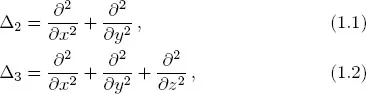
Many important equations in physics involve the Laplace operator, which is given by
in two and three dimensions
1, respectively. We will see later (Proposition 2.1) that the Laplace operator is invariant under a rotation of the coordinate system. Thus, it arises in many physical situations in which there exists spherical symmetry, i.e., where physical quantities depend only on the radial distance
r from some center of symmetry
. For example, the electric potential
V in free space is found by solving the
Laplace equation,
which is rotationally invariant. Also, in quantum mechanics, the wave function ψ of a particle in a central field can be found by solving the time-independent Schrödinger equation,
where ħ is Planck’s constant, m is the mass of the particle, V(r) is its potential energy, and E is its total energy.
We will give a brief introduction to these problems in two and three dimensions to motivate the main subject of this discussion. In doing this, we will get a preview of some of the properties of spherical harmonics — which, for now, we can just think of as some special set of functions — that we will develop later in the general setting of ℝp.
1.1 Separation of Variables
Two-Dimensional Case
Since we are interested in problems with spherical symmetry, let us rewrite the Laplace operator in spherical coordinates, which in ℝ2 are just the ordinary polar coordinates2,
Alternatively,
x = r cos ϕ, y = r sin ϕ.
Using the chain rule, we can rewrite the Laplace operator as
In checking this result, perhaps it is easiest to begin with (1.6) and recover (1.1). First we compute
which implies that
and
which gives
Inserting these into (1.6) gives us back (1.1).
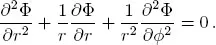
Thus, (1.3) becomes
To solve this equation it is standard to assume that
Φ(r, ϕ) = χ(r) Y(ϕ),
where χ(r) is a function of r alone and Y (ϕ) is a function of ϕ alone. Then
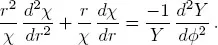
Multiplying by r2/χY and rearranging,
We see that a function of r alone (the left side) is equal to a function of ϕ alone (the right side). Since we can vary r without changing ϕ, i.e., without changing the right side of the above equation, it must be that the left side of the above equation does not vary with r either. This means the left side of the above equation is not really a function of r but a constant. As a consequence, the right side is the same constant. Thus, for some –λ we can write
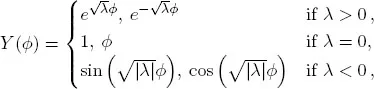
We solve Y′′ = λY to get the linearly independent solutions
but we must reject some of these solutions. Since (
r0,
ϕ0) represents the same point as (
r0,
ϕ0 + 2
πk) for any
k ∈ ℤ, we require
Y (
ϕ) to have period 2
π. Thus, we can only accept the linearly independent periodic solutions 1,
must be an integer. Then, let us replace
λ with −
m2 and write our linearly independent solutions to
Y″ = −
m2Y as
where3 n ∈ ℕ0 and m ∈ ℕ. Notice from (1.6) that ∂2/∂ϕ2 is the angular part of the Laplace operator in two dimensions and that the solutions given in (1.9) are eigenf...