Mobile Service Robotics
eBook - ePub

Mobile Service Robotics

CLAWAR 2014

  1. 740 pages
  2. English
  3. ePUB (mobile friendly)
  4. Available on iOS & Android
eBook - ePub

About this book

Interest in control of climbing and walking robots has remarkably increased over the years. Novel solutions of complex mechanical systems such as climbing, walking, flying and running robots with different kinds of locomotion and the technologies that support them and their applications are the evidence of significant progress in the area of robotics. Supporting technologies include the means by which robots use to sense, model, and navigate through their environments and, of course, actuation and control technologies. Human interaction including exoskeletons, prostheses and orthoses, as well as service robots, are increasingly active important pertinent areas of research. In addition, legged machines and tracked platforms with software architecture seem to be currently the research idea of most interest to the robotics community.


Contents:

  • Plenary Presentations
  • Assistive Robots
  • Autonomous Robots
  • Biologically-Inspired Systems and Solutions
  • Innovative Design of CLAWAR
  • Innovative Sensing and Actuation
  • Locomotion
  • Manipulation and Gripping
  • Manufacturing, Construction and Underwater Robots
  • Medical and Rehabilitation Robots
  • Modelling and Simulation of CLAWAR
  • Perception, Localisation, Planning and Control
  • Service Robots
  • Robot Ethics


Readership: Systems and control engineers, electrical engineers, mechanical engineers in academic, research and industrial settings. Engineers and practitioners in the public services sectors in health care, manufacturing, supply and delivery services.
Key Features:

  • The book will contain extended versions of the conference presentations. Contrary to typical proceedings collections it has an extended form of presentation — particular chapters will contain exhaustive descriptions of the solved problems
  • It is intended that the Conference is the forum of technical discussion and interchange of ideas for people both from universities and industry. Because of this it is addressed to a wide group of readers: researchers, PhD students and practitioners
  • Prominent professors deliver plenary presentations

Frequently asked questions

Yes, you can cancel anytime from the Subscription tab in your account settings on the Perlego website. Your subscription will stay active until the end of your current billing period. Learn how to cancel your subscription.
No, books cannot be downloaded as external files, such as PDFs, for use outside of Perlego. However, you can download books within the Perlego app for offline reading on mobile or tablet. Learn more here.
Perlego offers two plans: Essential and Complete
  • Essential is ideal for learners and professionals who enjoy exploring a wide range of subjects. Access the Essential Library with 800,000+ trusted titles and best-sellers across business, personal growth, and the humanities. Includes unlimited reading time and Standard Read Aloud voice.
  • Complete: Perfect for advanced learners and researchers needing full, unrestricted access. Unlock 1.4M+ books across hundreds of subjects, including academic and specialized titles. The Complete Plan also includes advanced features like Premium Read Aloud and Research Assistant.
Both plans are available with monthly, semester, or annual billing cycles.
We are an online textbook subscription service, where you can get access to an entire online library for less than the price of a single book per month. With over 1 million books across 1000+ topics, we’ve got you covered! Learn more here.
Look out for the read-aloud symbol on your next book to see if you can listen to it. The read-aloud tool reads text aloud for you, highlighting the text as it is being read. You can pause it, speed it up and slow it down. Learn more here.
Yes! You can use the Perlego app on both iOS or Android devices to read anytime, anywhere — even offline. Perfect for commutes or when you’re on the go.
Please note we cannot support devices running on iOS 13 and Android 7 or earlier. Learn more about using the app.
Yes, you can access Mobile Service Robotics by Krzysztof Kozᅤツowski, Mohammad O Tokhi, Gurvinder S Virk in PDF and/or ePUB format, as well as other popular books in Biological Sciences & Science General. We have over one million books available in our catalogue for you to explore.

Information

SECTION–1
PLENARY PRESENTATIONS

ABSTRACTIONS FOR LEGGED LOCOMOTION

GABRIEL A.D. LOPES
Delft Center for Systems and Control,
Delft Robotics Institute,
Delft University of Technology
Mekelweg 2, 2628CD, Delft, The Netherlands
E-mail: G. A. DelgadoLopes@ tudelft. nl
www.dcsc.tudelft.nl:~glopes
The synchronization of legs in many-legged robots is a combinatorial problem that can be very critical for successful climbing or locomotion in very rough terrain. This paper addresses developing gait generation controllers with desirable synchronization properties by introducing a number of abstractions in the traditional modeling approaches. It describes how to use the max-plus algebra as a modeling tool for discrete-event systems and how it can be applied to legged locomotion.
Keywords: Legged locomotion, discrete event systems, max-plus algebra, robotics

1. Introduction

Legged robots offer far more versatile mobility than wheeled or tracked vehicles. The examples are everywhere in nature where animals are capable of negotiating a wide spectrum of terrain properties, such as inclination, viscosity, roughness. In natural human environments, populated with stairs, slopes, and ledges, legged robots have the potential to be the mobility platform of choice for applications such as home robotics, care and cure robots, agriculture, construction work, fire/police. The relevance of legged robots is already recognized in competitions where challenging locomotion environments are present, such as the Darpa Robotics Challenge. For all their virtues legs bring a large set of technological challenges. The most prominent arises from the impacts generated from intermittent interaction of legs with the ground on very dynamic robots. Leg impacts introduce a number of challenges from the mechanical engineering point of view where fatigue play a fundamental role. Recent developments to address impacts include the use of compliant legs13 and novel morphologies.4 From a systems and control perspective the main challenges arise in the complexity of the mathematical models. Systems with impacts result in hybrid dynamical models.5 For the case of legged robots intrinsic instability due to upright posture complicates even further the control design. The main control tasks for legged robots can be categorized as:
(1) Balancing – how to maintain an intrinsically unstable hybrid mechanical system in a stable upright configuration in the presence of disturbances or complex terrain.
(2) Synchronization – when multiple legs are present, in which order/configuration should these interact with the ground.
(3) Planning – deciding where and how to move.
(4) Optimization – how can motion be achieved to minimize cost of transport, maximize speed, etc.
This paper focuses on the 2nd challenge: the synchronization of legs in a many-legged robota. Section 2 briefly describes what is the synchronization problem and how it is traditionally approached in the scientific literature, both from the biology and robotics point of view. Current state-of-the-art control architectures for leg synchronization are presented. In Section 3 a different set of modeling and control tools are presented, called max-plus linear (MPL) systems. It is shown that these models are very suitable for legged locomotion. MPL systems are a class of discrete-event systems driven by the max-plus algebra.6 Using these tools a generic leg synchronization algorithm is presented in Section 4 as the solution to a mixed-integer linear programming problem. Section 5 describes explicit solutions for a class of gaits and Section 6 concludes with a list of extensions for the application of MPL control systems in legged locomotion. A brief description of the max plus algebra is given in Appendix A.

2. Leg synchronization

The term gait means a manner of walking. Human gaits include walking, running, and skipping. Quadrupedal animals exhibit many more gaits, including amble, trot, pace, canter, gallop, bound, etc. In the late eighteen hundreds Muybridge7 did pioneering work in photographing running horses and in the sixties Hildebrand8 presented a classification for gaits in terms of the stance time duty cycle and ph...
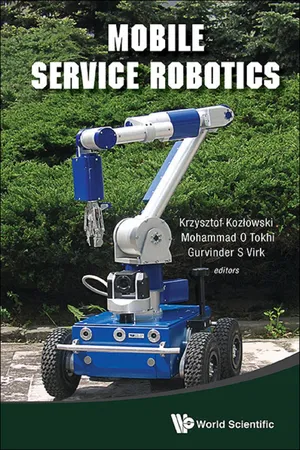
Table of contents

  1. Cover Page
  2. Title Page
  3. Copyright Page
  4. Preface
  5. Conference organisers
  6. Conference committees and chairs
  7. Conference sponsors and co-sponsors
  8. Table of contents
  9. Section–1: Plenary presentations
  10. Section–2: Assistive robots
  11. Section–3: Autonomous robots
  12. Section–4: Biologically-inspired systems and solutions
  13. Section–5: Innovative design of CLAWAR
  14. Section–6: Innovative sensing and actuation
  15. Section–7: Locomotion
  16. Section–8: Manipulation and gripping
  17. Section–9: Manufacturing, construction and underwater robotics
  18. Section–10: Medical and rehabilitation robots
  19. Section–11: Modelling and simulation of CLAWAR
  20. Section–12: Perception, localisation, planning and control
  21. Section–13: Service robots
  22. Section–14: Robot ethics
  23. Author index