Medical Statistics And Computer Experiments (2nd Edition)
eBook - ePub

Medical Statistics And Computer Experiments (2nd Edition)

  1. 1,016 pages
  2. English
  3. ePUB (mobile friendly)
  4. Available on iOS & Android
eBook - ePub

Medical Statistics And Computer Experiments (2nd Edition)

About this book

This volume consists of three parts: Part I comprises 11 chapters on the basic concepts of statistics, Part II consists of 10 chapters on multivariate statistics and Part III contains 12 chapters on design and analysis for medical research. The book is written using basic concepts and commonly used methods of design and analysis in medical statistics, incorporating the operation of statistical package SAS and 100 computer experiments for the important statistical phenomena related to each chapter. All necessary data, including reference answers for the exercises, SAS programs for all computer experiments and part of the examples, and data documents for 12 medical researches are available. The Chinese version of this book has been recommended as a textbook of statistics for postgraduate program by the Office of Education Research, Ministry of Education, People's Republic of China.

Contents:

  • Basic Concepts:
    • Descriptive Statistics
    • Probability and Distribution
    • Sampling Error and Confidence Interval
    • Hypothesis Testing for Continuous Variables
    • Chi-Square Test for Categorical Variable
    • Further Discussion on Hypothesis Test
    • Single-Factor Analysis of Variance
    • Nonparametric Test Based on Ranks
    • Simple Linear Correlation
    • Simple Linear Regression
    • Statistical Principles for Design of Interventional Study
  • Multi-variate Statistics:
    • Multiple Regression and Correlation
    • Measures of Multi-variate Data and Multi-variate Analysis of Variance
    • Discriminant Analysis
    • Logistic Regression
    • Cluster Analysis
    • Principal Component Analysis
    • Factor Analysis
    • Canonical Correlation and Correspondence Analysis
    • Survival Analysis
    • Log-Linear Model for Contingency Table and Poisson Regression
  • Design and Analysis for Medical Research:
    • Multi-Factor Analysis of Variance
    • Analysis of Repeated Continuous-Type Measurements
    • Design and Analysis of Cross-Sectional Studies
    • Design and Analysis of Prospective Studies
    • Designs and Analysis of Case-Control Studies
    • Design and Analysis of Diagnostic and Screening Tests
    • Design and Analysis of Sequential Experiments
    • Systematic Review of Medical Research and Meta-Analysis
    • Comparative Effectiveness Research
    • Statistical Methods in Scale Development
    • Statistical Methods for Data from Genetic Epidemiological Study
    • Statistical Methods in Bioinformatics


Readership: Postgraduate students and researchers in medical, public health and applied statistics.
Key Features:

  • It gives basic guidance on a much broader range of statistical topics than is usually seen in books aimed at non-statisticians
  • It makes the medical students and researchers feel the topic is useful and easy to learn
Frequently asked questions

Yes, you can cancel anytime from the Subscription tab in your account settings on the Perlego website. Your subscription will stay active until the end of your current billing period. Learn how to cancel your subscription.
No, books cannot be downloaded as external files, such as PDFs, for use outside of Perlego. However, you can download books within the Perlego app for offline reading on mobile or tablet. Learn more here.
Perlego offers two plans: Essential and Complete
  • Essential is ideal for learners and professionals who enjoy exploring a wide range of subjects. Access the Essential Library with 800,000+ trusted titles and best-sellers across business, personal growth, and the humanities. Includes unlimited reading time and Standard Read Aloud voice.
  • Complete: Perfect for advanced learners and researchers needing full, unrestricted access. Unlock 1.4M+ books across hundreds of subjects, including academic and specialized titles. The Complete Plan also includes advanced features like Premium Read Aloud and Research Assistant.
Both plans are available with monthly, semester, or annual billing cycles.
We are an online textbook subscription service, where you can get access to an entire online library for less than the price of a single book per month. With over 1 million books across 1000+ topics, we’ve got you covered! Learn more here.
Look out for the read-aloud symbol on your next book to see if you can listen to it. The read-aloud tool reads text aloud for you, highlighting the text as it is being read. You can pause it, speed it up and slow it down. Learn more here.
Yes! You can use the Perlego app on both iOS or Android devices to read anytime, anywhere — even offline. Perfect for commutes or when you’re on the go.
Please note we cannot support devices running on iOS 13 and Android 7 or earlier. Learn more about using the app.
Yes, you can access Medical Statistics And Computer Experiments (2nd Edition) by Ji-Qian Fang in PDF and/or ePUB format, as well as other popular books in Biological Sciences & Science General. We have over one million books available in our catalogue for you to explore.

Information

Part I
Basic Concepts
Chapter 1
Descriptive Statistics
Statistical analyses in practice usually include two parts: statistical description and statistical inference. Statistical description is a kind of fundamental work for statistical inference, which describes the feature of the sample. The main forms for description are tables (such as frequency table), plots (such as block plot, histogram) and numerical indices (such as mean, standard deviation).
1.1Variables and Data
1.1.1Types of variables
Variables are used to describe the properties of individuals in statistics. Different types of variables have different types of distributions and hence the statistical methods being used might be different. It is important to identify the types of variables before dealing with the data.
1.1.1.1Continuous variable
They are the variables whose values can be obtained through measurement such as height, weight, blood pressure, pulse and blood count of the individuals. Limited by the precision of measurement, the variables such as height and weight can take some values of real number but not all indeed, and the variables such as pulse and blood count can take values of integral number only. However, for the convenience in theoretical study, they are regarded as continuous variables taking values in a continuous interval on the axis of real number. Sometimes, the observed values of such kind of variables are called measurement data.
1.1.1.2Discrete variable
Some properties can only be described qualitatively with several mutually excluded categories, such as gender, occupation and effect of medicine (positive or negative). The variable for gender can only take a “value” either “male” or “female”; the variable of occupation may take a “value” among several categories (worker, farmer, salesman and soldier etc.). This kind of variables is called categorical variables or nominal variables.
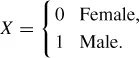
Example 1.1The variable for gender can be defined with a binary variable X.
Image
In general, the variables taking values in a set of countable numbers are called discrete variables. Binary variable is the simplest special case of it.
The number of individuals within a certain category is often counted, and it is called frequency so that the data of discrete variable is sometimes called count data.
Example 1.2In the sample of 108 patients, there are 63 males and 45 females. If a binary variable X is defined for gender as in Example 1.1, the sum of X for the 108 patients is the number of males (63).
In general, the frequency of certain category is equivalent to the sum of a binary variable.
1.1.1.3Ordinal variable
Some measurement can only result in a semi-quantitative outcome. For instance, −, ±, +, ++, +++ are quite often used to indicate different ranks in clinic. For some properties, there naturally exist ranks among different categories. For instance, cure, effective, un-effective and worse are used to describe the level of drug effect. An ordinal variable can be defined for this kind of properties taking values among 1, 2, 3,… for rank, but not for the exact quantitative measurement.
The frequencies of ordinal variable is sometimes called ranked data.
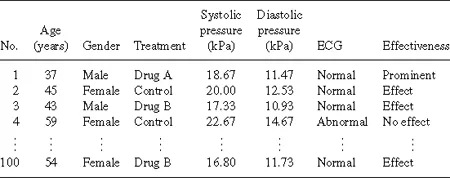
Table 1.1The post-treatment clinical records of 100 hypertension patients.
Image
1.1.2Structure and feature of data
Any outcome of experiment or observation should be expressed with numerical data for statistical analysis. Most outcomes in medical research could be expressed through a data structure similar to Table 1.1, where 7 recorded items of 100 patients are given by a matrix with 100 rows and 7 columns. This is a basic format for data input in most of the statistical software such as SAS, SPSS, etc.
1.1.2.1Basic observed unit
It is the basic unit for data collection determined by the purpose of research. For instance, if the systolic pressure and diastolic pressure are measured at a fixed time after treatment, then a patient is defined as an observed unit; otherwise, if the systolic pressure and diastolic pressure are measured at 3 different times after treatment (say, week 1, week 2 and week 4), then each patient is regarded as 3 observed units since the condition of each patient changes with time.
1.1.2.2Recording item
The recording items used for statistica...

Table of contents

  1. Cover Page
  2. Half title
  3. Title Page
  4. Copyright
  5. Preface
  6. Introduction
  7. Contents
  8. About the Editors
  9. Part I Basic Concepts
  10. Part II Multi-variate Statistics
  11. Part III Design and Analysis for Medical Research
  12. Appendix II. Statistical Tables
  13. Appendix III. Datasets of Some Real Medical Examples