Spanning Tree Results For Graphs And Multigraphs: A Matrix-theoretic Approach
eBook - ePub

Spanning Tree Results For Graphs And Multigraphs: A Matrix-theoretic Approach

A Matrix-Theoretic Approach

  1. 188 pages
  2. English
  3. ePUB (mobile friendly)
  4. Available on iOS & Android
eBook - ePub

Spanning Tree Results For Graphs And Multigraphs: A Matrix-theoretic Approach

A Matrix-Theoretic Approach

About this book

This book is concerned with the optimization problem of maximizing the number of spanning trees of a multigraph. Since a spanning tree is a minimally connected subgraph, graphs and multigraphs having more of these are, in some sense, immune to disconnection by edge failure. We employ a matrix-theoretic approach to the calculation of the number of spanning trees.

The authors envision this as a research aid that is of particular interest to graduate students or advanced undergraduate students and researchers in the area of network reliability theory. This would encompass graph theorists of all stripes, including mathematicians, computer scientists, electrical and computer engineers, and operations researchers.

Contents:

  • An Introduction to Relevant Graph Theory and Matrix Theory
  • Calculating the Number of Spanning Trees: The Algebraic Approach
  • Multigraphs with the Maximum Number of Spanning Trees: An Analytic Approach
  • Threshold Graphs
  • Approaches to the Multigraph Problem
  • Laplacian Integral Graphs and Multigraphs


Readership: Graduate students and researchers in combinatorics and graph theory. Key Features:

  • Unlike this book, very few books cover a significant amount of material about the Laplacian matrix, nor do they contain an extensive treatment of counting or optimizing the number of spanning trees
  • Other works in the field do not devote to multigraphs

Frequently asked questions

Yes, you can cancel anytime from the Subscription tab in your account settings on the Perlego website. Your subscription will stay active until the end of your current billing period. Learn how to cancel your subscription.
No, books cannot be downloaded as external files, such as PDFs, for use outside of Perlego. However, you can download books within the Perlego app for offline reading on mobile or tablet. Learn more here.
Perlego offers two plans: Essential and Complete
  • Essential is ideal for learners and professionals who enjoy exploring a wide range of subjects. Access the Essential Library with 800,000+ trusted titles and best-sellers across business, personal growth, and the humanities. Includes unlimited reading time and Standard Read Aloud voice.
  • Complete: Perfect for advanced learners and researchers needing full, unrestricted access. Unlock 1.4M+ books across hundreds of subjects, including academic and specialized titles. The Complete Plan also includes advanced features like Premium Read Aloud and Research Assistant.
Both plans are available with monthly, semester, or annual billing cycles.
We are an online textbook subscription service, where you can get access to an entire online library for less than the price of a single book per month. With over 1 million books across 1000+ topics, we’ve got you covered! Learn more here.
Look out for the read-aloud symbol on your next book to see if you can listen to it. The read-aloud tool reads text aloud for you, highlighting the text as it is being read. You can pause it, speed it up and slow it down. Learn more here.
Yes! You can use the Perlego app on both iOS or Android devices to read anytime, anywhere — even offline. Perfect for commutes or when you’re on the go.
Please note we cannot support devices running on iOS 13 and Android 7 or earlier. Learn more about using the app.
Yes, you can access Spanning Tree Results For Graphs And Multigraphs: A Matrix-theoretic Approach by Daniel J Gross, John T Saccoman, Charles L Suffel in PDF and/or ePUB format, as well as other popular books in Biological Sciences & Science General. We have over one million books available in our catalogue for you to explore.

Information

Chapter 1
Calculating the Number of Spanning Trees: The Algebraic Approach
In this chapter, we explore the algebraic method of computing t(M), the number of spanning trees of a multigraph M. We then apply these techniques to some special families of graphs.
A formal probabilistic reliability model, All Terminal Reliability (ATR), can be described as follows: the edges of a multigraph M are assumed to have equal and independent probabilities of operation p, and the reliability R(M, p) of a multigraph is defined to be the probability that a spanning connected subgraph operates. If
image
denotes the number of spanning connected subgraphs having i edges, then it is easily verified that
image
For small values of p, the polynomial will be dominated by the
image
term, and since
image
is the number of spanning trees, graphs with a larger number of spanning trees will have greater reliability for such p.
In graph theory, most of the results regarding the number of spanning trees have only been proven for graphs, so in addition to an exposition of results for graphs, we will investigate the problem for the extended class of multigraphs. It should be noted that, while extensions to multigraphs make the optimal solution readily apparent in many problems, this is not the case for the spanning tree problem.
1.1 The Node-Arc Incidence Matrix
Consider a directed multigraph
image
with n nodes, {v1,v2,…, vn}, and e arcs,
image
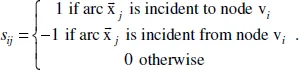
. We define an nƗe matrix, called the node-arc incidence matrix
image
, which uniquely characterizes
image
by
image
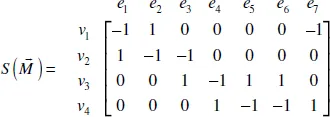
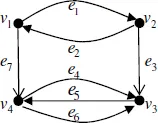
Example 1.1 The directed multigraph depicted in Figure 1.1 has node-arc incidence matrix
image
image
Figure 1.1: A directed multigraph.
Since each arc has exactly two end-nodes, the sum of the row vectors of S is
image
. Clearly, any single row can be deleted from S without losing any information about
image
. The matrix resulting from the deletion of the ith row is called a reduced node-arc incidence matrix, and is denoted
image
, i.e., in terms of the notation ...

Table of contents

  1. Cover page
  2. Halftitle page
  3. Title page
  4. Copyright page
  5. Dedication page
  6. Preface
  7. Contents
  8. 0Ā Ā Ā An Introduction to Relevant Graph Theory and Matrix Theory
  9. 1Ā Ā Ā Calculating the Number of Spanning Trees: The Algebraic Approach
  10. 2Ā Ā Ā Multigraphs with the Maximum Number of Spanning Trees: An Analytic Approach
  11. 3Ā Ā Ā Threshold Graphs
  12. 4Ā Ā Ā Approaches to the Multigraph Problem
  13. 5Ā Ā Ā Laplacian Integral Graphs and Multigraphs
  14. Bibliography
  15. Index