![]()
Chapter 1
The Physics of Quantum Computation
Giuseppe Falci* and Elisabette Paladino†
Dipartimento di Fisica e Astronomia, Università degli Studi Catania & CNR-IMM MATIS, Consiglio Nazionale delle Ricerche &
Istituto Nazionale di Fisica Nucleare, Sezione di Catania
Via Santa Sofia 64, 95123 Catania, Italy
Quantum Computation has emerged in the past decades as a consequence of down-scaling of electronic devices to the mesoscopic regime and of advances in the ability of controlling and measuring microscopic quantum systems. QC has many interdisciplinary aspects, ranging from physics and chemistry to mathematics and computer science. In these lecture notes we focus on physical hardware, present day challenges and future directions for design of quantum architectures.
1.Preliminary concepts
The field of quantum computation1 has emerged in the past decades as a consequence of down-scaling of electronic devices to the mesoscopic regime and of advances in the ability of controlling and measuring microscopic quantum systems. The question emerges whether there is any fundamental gain in resorting to new computational paradigms where quantum mechanical properties of physical objects are fully exploited. Positive answers came from Richard Feynman2 who showed that quantum systems may be efficiently simulated only by other quantum systems, i.e. an analog Quantum Computer (QC), and from the Shor’s breakthrough discovery of an efficient factoring algorithm on a digital QC.3 This has motivated theoretical and experimental investigation on the implementation of Digital QCs, which will be mainly addressed in this article, although the scenario of Quantum Information is much wider, and present efforts are mainly focused on analog QCs.4
QC has many interdisciplinary aspects, ranging from physics and chemistry to mathematics and computer science. It also plays, in our opinion, a central role in the field of foundations of Quantum Mechanics (QM). However for the sake of clarity we will adopt here a totally different point of view, presenting QC as an application of QM and addressing the topic of quantum hardware. On the other hand, quite often people use the Copenhagen interpretation as an efficient tool to teach the how-to of QM. Despite of our choice it is worth stressing that ultimate answers on fundamental questions may critically depend on subtle hardware problems, as in the case of the violation of Bell inequalities.5 Improvement in hardware as sources and detectors, and in the ability of faithful production of highly entangled states, belong indeed to the realm of Quantum Information and certainly will trigger new insight and provide new tools for fundamental physics studies.
In these lecture notes we focus on physical hardware, present day challenges and future directions for design of quantum architectures. An exhaustive but condensed review on the subject has been published by Ladd et al. few years ago.6 We will first describe the main issues of digital QCa from which naturally emerges a set of requirements a quantum system should satisfy to be a good candidate for the implementation of a quantum computer, known as Di Vincenzo criteria.7 Recent experimental progresses have dealt with the central problem of decoherence, showing that it can be challenged to a certain extent. Also it emerged that a key concept for quantum computation is scaling, which is referred to several aspects of the problem as quantum algorithms, fabrication of “fault tolerant” (protected from decoherence/defects and reliable) hardware, number of elementary control pulses required for preparation, manipulation and interaction of quantum bits. This has lead to a more mature reformulation of the physical criteria for the implementation of quantum architectures.6,8
1.1.From miniaturization to quantum technologies
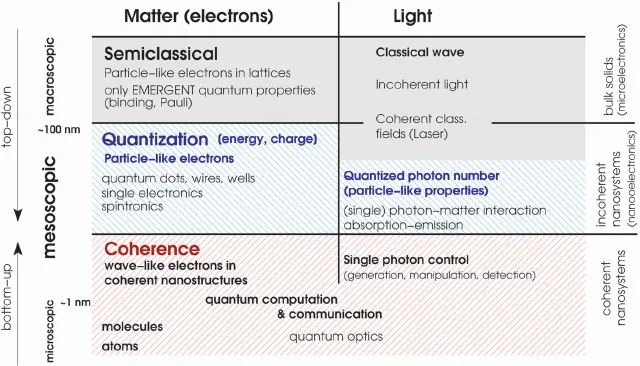
Although microscopic systems are a natural hardware for Quantum Information, the strong motivation triggering this field comes from the quest for faster and low consuming “classical” computers (ClC), which is achieved by using smaller and smaller devices in the mesoscopic regime.9 As for the technological roadmap to down-scaling, also fundamental studies in Condensed Matter Physics follow a “top-down” approach for the description of solid-state phenomena. This approach is sort of “adaptive”: The underlying quantum nature is introduced judiciously, starting from phenomena related to quantization and then to coherence, which appears as long as macroscopic (semiclassical) physical systems shrink to become mesoscopic (see Fig. 1).
1.1.1.Semiclassical electrons in electronic devices
The golden era of semiconductor electronics started about sixty years ago with the invention of the bipolar transistor, and then with the discovery that also resistors and capacitors can be made out of silicon, yielding the integrated circuit. The development of planar technology has allowed to reach integration levels from several thousands of transistor per unit chip area since 1970 to several billions nowadays. This trend has been empirically described by the Moore’s lawb (1965), which states that the number of transistor on a chip doubles roughly every two years. Scaling down the size of integrated circuits, keeping a much slower increase of costs per unit area, has been the main subject of microelectronics technologies in the last two decades, and has required enormous progresses in manufacturing.9 Ideally it would allow to build larger and faster computers, with the same volume and price. However even in this scenario there are fundamental limitations to miniaturization. One of these is related to the so called Landauer principle10 (see Sec. 1.2), other limitations being due to stray quantum effects coming into play, leading to malfunctioning of standard logic devices.9 As we will see quantum computation leverages on these two issues to propose a new paradigm for information processing.
Fig. 1. Synoptic scheme of the roadmap from semiclassical to quantum coherent regimes in solid-state systems. New phenomena related to the quantum nature, in particular quantization and coherence, appear as long as macroscopic (semiclassical) physical systems shrink to become microscopic. In the intermediate mesoscopic regime, explored by Nanophysics, effects as quantum coherence in atoms survive on much larger time and space scales.
From the point of view of transport the regime of microelectronics is referred as semiclassical since, even if QM properties are crucial in explaining thermodynamics and even the very existence of solids, electrons move as classical particles, with a number of peculiarities which do not prevent the use of classical Boltzmann equation as the main investigation tool for computational electronics. Also electromagnetic fields used to address optoelectronic microdevices are semiclassical. In particular laser light, is a phase coherent classical radiation, i.e. containing many many photons, even if phenomena involved in the physics of laser sources is exquisitely “quantum incoherent”.
1.1.2.Incoherent nanophysics
The quantum signature appearing when devices are do...