![]()
Part 1
Global Conflict
![]()
Chapter 1
War and Disintegration, 1914–1950
Jari Eloranta and Mark Harrison
Introduction
Between 1914 and 1945 Europe’s economic development and integration were interrupted and set back by two world wars, and its regional patterns were brutally distorted by combat, exterminations, migrations, and the redrawing of borders.1 World War I (the “Great War” of 1914–1918) set more than thirty countries into conflict with each other and led to ten million premature deaths. It was dwarfed only by World War II (1939–1945), in which more than sixty countries waged war and the war prematurely ended the lives of more than 55 million people (Broadberry and Harrison, 2005b). As for who fought whom, there were limited continuities: in both wars, Germany, Austria, and Hungary fought Britain, France, and Russia for much of the time. Other allegiances changed. For ease of reference, Table 1 lists the European countries that were in or out of each war and, if in, on what side.
Although punctuated by an “interwar period,” the two wars can be understood as a single historical process. The process was global but the European dimension was fundamental to it. Thus, Europe was the main theatre of a vast thirty-year conflict of empires and nationalisms. The first war was fought primarily by European powers in Europe; some non-European participants and colonial polities played a minor role while others intervened late in the process. It produced a fragmented continent that had spent vast amounts of physical and human capital, the countries at its centre ensnared in reparations and debts, and incapable of returning to political and economic stability. The second began in Asia but quickly spread across the world to Europe, and most participants understood that the conflict in Europe would be decisive for the outcome. The German historian Ernst Nolte (1965) was the first to define these three decades as a European “civil war”. He saw it as a war launched from Russia in 1917 by communist terror and aggression, to which German National Socialism and racial genocide were a defensive response. This is not our view; if any country launched the war it was Germany, first in 1914 and again in 1939, for a variety of reasons. Undoubtedly, however, it makes sense to view the two wars and the interwar period as a continuous process — and we also find the destruction of moral limits that Thucydides first associated with civil strife.
Table 1. Taking Sides: Belligerents and Neutrals in Two World Wars.
| | World War I | World War II |
Albania | Neutral | Anti-Comintern Axis |
Austria (AH) | Central Powers | Annexed to Germany |
Belgium | Occupied by Germany | Occupied by Germany |
Bulgaria | Province of Austro-Hungarian Empire | Anti-Comintern Axis |
Czechoslovakia | Province of Austro-Hungarian Empire | Occupied by Germany |
Denmark | Neutral | Occupied by Germany |
Estonia | Province of Russian Empire | Occupied by USSR |
Finland | Province of Russian Empire | Anti-Comintern Axis |
France | Entente | Occupied by Germany |
Germany | Central Powers | Anti-Comintern Axis |
Greece | Entente | Occupied by Italy |
Hungary (AH) | Central Powers | Anti-Comintern Axis |
Ireland | Province of United Kingdom | Neutral |
Italy | Entente | Anti-Comintern Axis |
Latvia | Province of Russian Empire | Occupied by USSR |
Lithuania | Province of Russian Empire | Occupied by USSR |
Netherlands | Neutral | United Nations |
Norway | Neutral | Occupied by Germany |
Poland | Province of Russian Empire | Occupied by Germany and USSR |
Portugal | Neutral | Neutral |
Romania | Province of Austro-Hungarian Empire | Anti-Comintern Axis |
Russia (R)/USSR | Entente | United Nations |
Serbia/Yugoslavia | Province of Austro-Hungarian Empire | Occupied by Germany |
Spain | Neutral | Neutral |
Sweden | Neutral | Neutral |
Switzerland | Neutral | Neutral |
Ottoman Empire/Turkey | Central Powers | Neutral |
United Kingdom (UK) | Entente | United Nations |
Our period was one of economic and political instability. The average growth rates of most European states were modest compared with their performance before 1914 or after 1950 (Maddison, 1995); Angus Maddison (2001) describes these years as “a complex and dismal period, marked deeply by the shock of the two world wars and an intervening depression”. Eric Hobsbawm (1996) viewed the extreme political and military outcomes of this period as characteristic of the decadence and economic failures of the twentieth century. But this is not the whole story. Bradford DeLong (2000) and Alex Field (2003; 2006) have stressed that the massive increases in living standards in the second half of the twentieth century were enabled by technological advances that continued in an unbroken stream through the most dismal episodes of the first half. In Europe as elsewhere, the rate of technological improvement remained high throughout our period and exceeded nineteenth century benchmarks in spite of military, economic, and demographic disaster (Ferguson, 2006). In short, whatever it was that came to an end in 1914, it was not the forces underlying economic growth.
Globalization, Empire, and War
In the nineteenth century globalization and empires were inextricably linked. None other than the Russian revolutionary leader Lenin, writing in 1916 (reprint, 1963), noted the association between the rise of global markets, global enterprises, and global colonial empires.
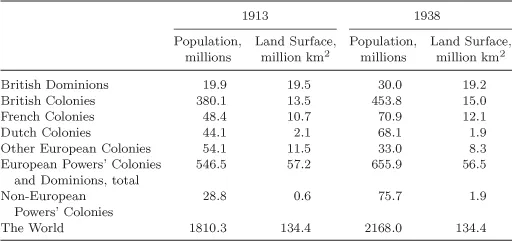
In the early twentieth century the great powers all regarded colonial empire as an entirely legitimate national pursuit. For illustration, Table 2 shows the world’s colonial dependencies. In 1913, Europeans were the greatest imperialists in the history of the world, with 30 per cent of the world’s population living in European colonies outside Europe that spread across more than two fifths of the world’s land surface. In the same year Britain alone, which accounted by itself for one fortieth of the world’s population and one five hundredth of its land surface, claimed sovereignty over 400 million people and 33 million square kilometres of Africa, Asia, America, and Australasia. Its Empire, including both self-governing dominions such as Canada and Australia, and colonial dependencies such as India and Nigeria, embraced almost one quarter of the world’s population and a quarter of its land surface. Other European powers, chiefly France and the Netherlands, and after them Belgium, Germany, Italy, Portugal, and Turkey lagged far behind. Outside Europe, the United States administered some neighbouring islands, as did Japan, in addition to its Korean colony (see also Huntington, 1996).
Table 2. Colonial Dependencies in 1913 and 1938: Populations and Land Surfaces.
Sources: Harrison (1998) and Broadberry and Harrison (2005a).
In 1938, a quarter century later, almost nothing had changed. Germany and Turkey had lost their little empires as a result of the peace treaties that followed World War I. Italy and Japan were in the first stages of their expansion across the Mediterranean and the Pacific respectively. But these are barely apparent in the figures. Indeed, looking at the world from Berlin, Rome, and Tokyo, the lack of change in the balance of the world’s colonial possessions was the problem: the old colonial powers had failed to give way to the aspirations of the new imperialists.
In fact, the pursuit of colonies by the rising powers, combined with the defense of their colonies by the established ones, contributed to repeated crises in the global equilibrium among the powers and was perceived to a large extent to be responsible for the two world wars. In the process the very idea of empire lost its legitimacy. The legitimacy of empire had never been strong among the colonial populations, and its decline became marked within the United States, the foreign policy of which became decidedly anti-colonialist. By 1950 wholesale decolonization, by consent or by force, was already under way within the British, French, and Dutch empires, the only ones of any significance that remained. This is another sense in which the two world wars formed a single historical process that began in 1914 and ended in 1945 (Modelski and Thompson, 1996).
Since Lenin it has been fashionable to link world trade and world empires with the causes of the two world wars. The truth is more complex, however. Neither globalization nor imperialism directly caused the war to break out in 1914. Norman Angell had argued in his 1909 bestseller The Great Illusion (reprint, 1972) that the increased economic interdependence of the great powers would make any major international conflict an impossibility, or at least bring it to a quick conclusion. Globalization had increased the interdependency of regional and global players, thereby increasing the costs of the war. Specifically, increased openness had made the European states more vulnerable to the interdiction of imported supplies of food and materials. By raising wages, economic growth had made the maintenance of standing armies more expensive. Businessmen across Europe were not pushing for war and its outbreak came as a shock (Ferguson, 1999). But there were also countervailing factors. One was the industrialization of warfare, which increased the destructive efficiency of military equipment and gave industrialized states a bigger bang for their bucks (Ferguson, 2001; McNeill, 1982). Finally, the very fact of increased vulnerability to economic disruption probably heightened the propensity of the likely participants to gamble on a rapid offensive, once war became probable (Rowe, 2005).
John Hobson (1993) has shown that both the United Kingdom and Germany spent less on their armed forces than most great powers. John Keegan (1999) describes a Europe thrust into war by communication failures and irreversible war plans based on tit-for-tat responses that were designed for the ‘age-old quest for security in military superiority.’ World War I was no accident, however. Historians have tended to hold Germany particularly accountable for the pre-1914 arms race and the subsequent diplomatic breakdown (e.g. Berghahn, 1973). Niall Ferguson (1999, 2001) has noted that, having started the arms race, Germany was unable to compete against its rivals, and was led therefore to gamble on a pre-emptive strike in 1914. Thus, the prewar arms race, stimulated by the competition for colonies, was a principal cause, whereas the industrialization of armaments production contributed mainly to the length and destructiveness of the war.
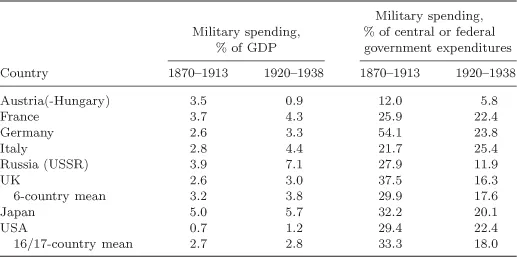
Table 3. Military Spending of the Great Powers in Peacetime, 1870–1913 and 1920–1938.
Sources: See Eloranta (2002b: 110) for details.
Notes: The 16-country mean for 1870–1913 includes Austria(-Hungary), Belgium, Denmark, France, Germany, Italy, Japan, Netherlands, Norway, Portugal, Russia, Spain, Sweden, Switzerland, UK, and USA; the 17-country mean for 1920–1938 adds Finland.
The arms race that led towards war in 1914 is not remarkable for its economic dimension. The industrial revolution, combined with the fiscal reforms of the nineteenth century, enabled Western states to increase military spending without excessively burdening their economies. We provide two standardized measures of defense spending: the “military burden” on national resources (per cent of GDP) and the “defense share” of budgetary means (per cent of central government expenditure). In the period before 1914 most countries carried heavier military burdens than in the early nineteenth century. Within Europe, as Table 3 suggests, the great powers carried somewhat heavier burdens than others; the average military burden on the GDPs of the six great powers was 3.2 per cent, compared with 2.7 per cent for the others in the sample. Notably the United States, the emerging economic leader, devoted less than one per cent of GDP to its armed forces (Eloranta, 2003).
The arms race was fuelled by both rivalry and restraint. While some countries pushed up military spending to keep abreast of their rivals’ efforts, others did the same to exploit the relative restraint of the British and American economic giants. The origins of the Great War are often seen in the consolidation of two confrontational alliances; however, when the statistical evidence is inspected for evidence of strategic interaction we find that the alliances themselves were ultimately inefficient and almost irrelevant in the spending decisions (Eloranta, 2007).
A different picture emerges when we turn to the causes of World War II. In the interwar period, military burdens were on average higher than before 1914 but, as Table 3 suggests, military spending was overtaken everywhere (except Italy) by other spending categories. As a result budgetary defense shares were almost uniformly lower, often much lower. Not reflected in the table are national variations in the timing of rearmament; the So...