Oscillator And Pendulum With A Random Mass
eBook - ePub

Oscillator And Pendulum With A Random Mass

  1. 160 pages
  2. English
  3. ePUB (mobile friendly)
  4. Available on iOS & Android
eBook - ePub

Oscillator And Pendulum With A Random Mass

About this book

Stochastic descriptions of a harmonic oscillator can be obtained by adding additive noise, or/and three types of multiplicative noise: random frequency, random damping and random mass. The first three types of noise were intensively studied in many published articles. In this book the fourth case, that of random mass, is considered in the context of the harmonic oscillator and its immediate nonlinear generalization — the pendulum. To our knowledge it is the first book fully dedicated to this problem.

Two interrelated methods, the Langevin equation and the Fokker–Planck equations, as well as the Lyapunov stability method are used for the mathematical analysis. After a short introduction, the two main parts of the book describe the different properties of the random harmonic oscillator and the random pendulum with random masses. As an example, the stochastic resonance is studied, where the noise plays an unusual role, increasing the applied weak periodic signal, and also the vibration resonance in dynamic systems, where the role of noise is played by the second high-frequency periodic signal.

First and second averaged moments have been calculated for a system with different types of additive and multiplicative noises, which define the stability of a system. The calculations have been extended to two multiplicative noises and to quadratic noise. This book is useful for students and scientists working in different fields of statistical physics.

Contents:

  • Introduction
  • Oscillator with Random Mass
  • Pendulum with a Random Mass


Readership: Students and researchers working in statistical physics.
Key Features:

  • The first book dedicated specially to this new field
  • Provides pedagogical presentation
  • Contains applications to many different problems

Frequently asked questions

Yes, you can cancel anytime from the Subscription tab in your account settings on the Perlego website. Your subscription will stay active until the end of your current billing period. Learn how to cancel your subscription.
No, books cannot be downloaded as external files, such as PDFs, for use outside of Perlego. However, you can download books within the Perlego app for offline reading on mobile or tablet. Learn more here.
Perlego offers two plans: Essential and Complete
  • Essential is ideal for learners and professionals who enjoy exploring a wide range of subjects. Access the Essential Library with 800,000+ trusted titles and best-sellers across business, personal growth, and the humanities. Includes unlimited reading time and Standard Read Aloud voice.
  • Complete: Perfect for advanced learners and researchers needing full, unrestricted access. Unlock 1.4M+ books across hundreds of subjects, including academic and specialized titles. The Complete Plan also includes advanced features like Premium Read Aloud and Research Assistant.
Both plans are available with monthly, semester, or annual billing cycles.
We are an online textbook subscription service, where you can get access to an entire online library for less than the price of a single book per month. With over 1 million books across 1000+ topics, we’ve got you covered! Learn more here.
Look out for the read-aloud symbol on your next book to see if you can listen to it. The read-aloud tool reads text aloud for you, highlighting the text as it is being read. You can pause it, speed it up and slow it down. Learn more here.
Yes! You can use the Perlego app on both iOS or Android devices to read anytime, anywhere — even offline. Perfect for commutes or when you’re on the go.
Please note we cannot support devices running on iOS 13 and Android 7 or earlier. Learn more about using the app.
Yes, you can access Oscillator And Pendulum With A Random Mass by Moshe Gitterman in PDF and/or ePUB format, as well as other popular books in Biological Sciences & Science General. We have over one million books available in our catalogue for you to explore.

Information

Chapter 1

Introduction

A particle of mass m which is displaced from its equilibrium position at x = 0 is subject to a restoring attractive force and a viscous force which, in first approximation, are proportional to the displacement and velocity, respectively. Thus, for an one-dimensional system, Newton’s law gives
figure
where 2γ/m is the damping rate and ω/m1/2 is the intrinsic frequency. The solution of this equation is
figure
where
figure
If the harmonic oscillator is subject to an external periodic force A exp(it),
figure
then the complete solution of this equation consists of solution (2) of the homogeneous equation (1) and the following solution of the non-homogeneous equation,
figure
The last equation indicates the possibility of a (dynamic) resonance, when the external frequency Ω approaches the intrinsic frequency ω/m1/2.

1.1Harmonic oscillator with external noise

In the foregoing we considered a pure mechanical system (zero temperature). For non-zero temperatures, the dynamic equation (1) has to be supplemented by the thermal noise
figure
where η(t) is the random variable with zero mean, 〈η(t)〉 = 0, and variance 〈η2(t)〉, which for thermal noise satisfies the fluctuation-dissipation theorem 〈η2(t)〉 = 4γκT, where κ is the Boltzmann constant [2]. The latter simply means that the power entering the system from the external force must be entirely dissipated and given off to the thermostat in order that the equilibrium state of the system not be disturbed. Another way to justify the validity of Eq. (6) is as follows: in considering only one (slow) mode x(t) of a complex system, one may take into account the influence of other (fast) modes by introducing a random force into dynamic equation with no special requirements for the value of 〈η2(t)〉.
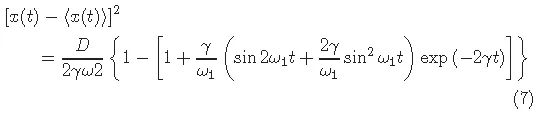
Upon averaging Eq. (6), one finds that the first moment is given by Eq. (2) while the second moment 〈x2(t)〉 for white noise 〈η2(t)〉 = D is defined by the variance,
figure
For m = 1, dichotomous noise of strength σ2 and inverse correlation length λ, the variance reaches the following stationary (t) value
figure
which for white noise is reduced to
figure
Both equations (7) and (8) were obtained already in 1945 [3].

1.2Ito-Stratonovich dilemma

In spite of the fact that the stochastic differential equations were introduced more than a hundred years ago, there are still many interesting problems concerning these equations. We consider here the Ito-Stratonovich dilemma, using the generalized Schlogl model as an example [4], which is described by the following equation,
figure
where ν is an arbitrary number and ξ(t) is white noise with the correlator
figure
The Langevin equation (10) is not completely defined due to the Ito–Stratonovich dilemma, namely, it is not clear which value of t one has to insert in the δ-function (11) and afterwards in the probability distribution. The two possibilities are: before the jump (Ito) or the averaged of before and after the jump (Stratonovich). This choice is very important since it leads to different Fokker-Planck equation for the probability distribution P(x, t) [5]. The first is described by the dynamic equation of the form
figure
and the second by the equation
figure
Another important factor which defines the behavior of a system is the value of ν.
1.For ν = 0, there are three steady states for β > 0, namely, x0 = 0 (unstable) and
figure
(stable), and one stable state for β < 0, namely, x0 = 0.
2.For ν > 0, multiplicative noise has an attractive effect, i.e., it attracts the probability P(r, t) to unstable steady state, whereas for ν < 0, the noise term makes system more stable.
3.The stationary probability distribution P(x) (at t) is defined by the competition between the noise and the damping terms in Eq. (10), which define in going and outgoing energy, respectively, i.e., by three numbers, ν, β and D. In the Stratonovich approach [4] P (x) = C exp ...

Table of contents

  1. Cover Page
  2. Title
  3. Copyright
  4. Preface
  5. 1. Introduction
  6. 2. Oscillator with a Random Mass
  7. 3. Pendulum with a Random Mass
  8. References
  9. Index