Measure Theory and Functional Analysis
eBook - ePub

Measure Theory and Functional Analysis

  1. 212 pages
  2. English
  3. ePUB (mobile friendly)
  4. Available on iOS & Android
eBook - ePub

Measure Theory and Functional Analysis

About this book

This book provides an introduction to measure theory and functional analysis suitable for a beginning graduate course, and is based on notes the author had developed over several years of teaching such a course. It is unique in placing special emphasis on the separable setting, which allows for a simultaneously more detailed and more elementary exposition, and for its rapid progression into advanced topics in the spectral theory of families of self-adjoint operators. The author's notion of measurable Hilbert bundles is used to give the spectral theorem a particularly elegant formulation not to be found in other textbooks on the subject.

Request Inspection Copy


Contents:

  • Topological Spaces
  • Measure and Integration
  • Banach Spaces
  • Dual Banach Spaces
  • Spectral Theory


Readership: Graduates students in mathematics (pure and applied) in their first or second year, graduate students in physics or engineering, and economics.
Key Features:

  • A very readable and thorough treatment of the core material in measure theory and functional analysis which cuts a clear path to advanced results in the spectral theory of families of commuting self-adjoint operators, avoiding side topics of lesser importance
  • Presents the author's elegant formulation of the spectral theorem in terms of his notion of Hilbert bundles, not available in comparable textbooks
  • Uniquely firm emphasis on the separable case allows for a simultaneously more detailed and more elementary exposition
  • Includes over 150 exercises

Frequently asked questions

Yes, you can cancel anytime from the Subscription tab in your account settings on the Perlego website. Your subscription will stay active until the end of your current billing period. Learn how to cancel your subscription.
No, books cannot be downloaded as external files, such as PDFs, for use outside of Perlego. However, you can download books within the Perlego app for offline reading on mobile or tablet. Learn more here.
Perlego offers two plans: Essential and Complete
  • Essential is ideal for learners and professionals who enjoy exploring a wide range of subjects. Access the Essential Library with 800,000+ trusted titles and best-sellers across business, personal growth, and the humanities. Includes unlimited reading time and Standard Read Aloud voice.
  • Complete: Perfect for advanced learners and researchers needing full, unrestricted access. Unlock 1.4M+ books across hundreds of subjects, including academic and specialized titles. The Complete Plan also includes advanced features like Premium Read Aloud and Research Assistant.
Both plans are available with monthly, semester, or annual billing cycles.
We are an online textbook subscription service, where you can get access to an entire online library for less than the price of a single book per month. With over 1 million books across 1000+ topics, we’ve got you covered! Learn more here.
Look out for the read-aloud symbol on your next book to see if you can listen to it. The read-aloud tool reads text aloud for you, highlighting the text as it is being read. You can pause it, speed it up and slow it down. Learn more here.
Yes! You can use the Perlego app on both iOS or Android devices to read anytime, anywhere — even offline. Perfect for commutes or when you’re on the go.
Please note we cannot support devices running on iOS 13 and Android 7 or earlier. Learn more about using the app.
Yes, you can access Measure Theory and Functional Analysis by Nik Weaver in PDF and/or ePUB format, as well as other popular books in Mathematics & Differential Equations. We have over one million books available in our catalogue for you to explore.

Information

Chapter 1
Topological Spaces
1.1 Countability
We adopt the convention that 0 is not a natural number; thus N = {1, 2, 3, …}.
Definition 1.1. A set is countably infinite if there is a bijection between it and N. It is countable if it is either finite or countably infinite. It is uncountable if it is not countable.
Countability conditions of various types will be assumed liberally throughout this book. Assuming that a set is countable can be very convenient because this means that its elements can be indexed as (an), with n ranging either from 1 to N for some N or from 1 to ∞, in either case giving us the ability to deal with them sequentially. Actually, the hypotheses we impose usually will not assert that the main set of interest is itself countable, but rather that in some way its structure is determined by a countable amount of information. This informal comment might make more sense after we discuss separability and second countability in Section 1.4.
Clearly N is countably infinite, since it is trivially in bijection with itself. The set of even natural numbers is also countably infinite via the bijection n
images
2n, and as the set of odd natural numbers is obviously in bijection with the set of even natural numbers, it is countably infinite too.
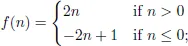
This shows that a countably infinite set (the natural numbers) can be split up into two countably infinite subsets (the even numbers and the odd numbers). Conversely, with a moment’s thought it also shows that the union of two disjoint countably infinite sets will again be countably infinite: we can put one set in bijection with the even numbers and the other in bijection with the odd numbers, and then combine the two maps to establish a bijection between the union of the two sets and N. For instance, we can use this idea to show that the set of integers Z is countably infinite. Define f : ZN by
images
this is a bijection that matches the positive integers with the even natural numbers and the negative integers and zero with the odd natural numbers.
Next we observe that subsets and images of countable sets are always countable.
Proposition 1.2. Let A be a countable set.
(a) Any subset of A is countable.
(b) Any surjective image of A is countable.
Proof. (a) We take it as known that any subset of a finite set is finite, so assume A is countably infinite. Let f : NA be a bijection and let B be any subset of A. If B is finite we are done, so assume B is infinite. Then f–1(B) must be an infinite subset of N, so it has a smallest element, a second smallest element, etc. Let n1 be the smallest element of f–1(B), n2 the next smallest, and so on; then the map k
images
f(nk) is a bijection between N and B. So B is countably infinite.
(b) Suppose f : AB is a surjection. Create a map g : BA by, for each bB, letting g(b) be an arbitrary element of f–1(b). Then g is a bijection between B and a subset of A, and it follows from part (a) that B must be countable.
images
This proposition illustrates why it is helpful to have a special term (“countable”) for sets which are either finite or countably infinite. It is not true that any subset of a countably infinite set is countably infinite, nor is it true that any surjective image is countably infinite.
Having said that, in analysis the unqualified word “sequence” usually means “infinite sequence”, i.e., a sequence indexed by N...
Table of contents

  1. Cover Page
  2. Title Page
  3. Copyright Page
  4. Contents
  5. Preface
  6. 1. Topological Spaces
  7. 2. Measure and Integration
  8. 3. Banach Spaces
  9. 4. Dual Banach Spaces
  10. 5. Spectral Theory
  11. Notation Index
  12. Subject Index