![]()
Chapter 1
Watching Benoit at work
Aliette Mandelbrot
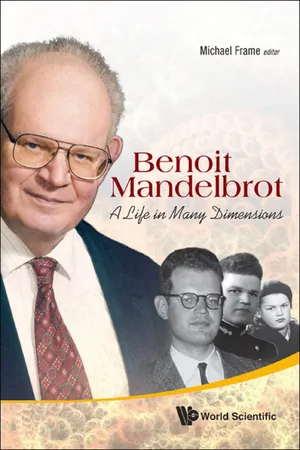
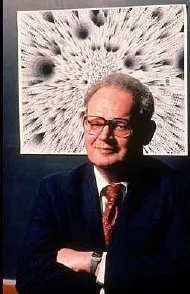
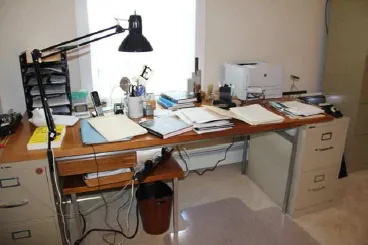
I remember Benoit (Fig. 1.1) always sitting at his desk (Fig. 1.2), years of sitting for many long hours, writing, crossing out, rewriting, cutting, pasting. While writing, he would often check one of his many dictionaries. It was important for him to use words with their exact meanings.
He would then give a long draft to his secretary for retyping. When he got back the clean copy, he repeated the exact same process on the clean copy. In no time, the copy was barely readable. This process went back and forth many times. Benoit was highly demanding of himself. He felt that the writing improved with each passage back from the secretary, and he did so until he was satisfied that his text was written as well as it could be.
He may have been one of the last rare scientists not using the computer ever, but writing by hand, and having assistants and programmers doing the computer rendering of his algorithms under his direction. He understood the possibilities of the computer very well, but said he was bad at and unwilling to follow precise instructions. He also had an uncanny eye for seeing results in pictures that no one else saw.
Figure 1.1Benoit.
Figure 1.2Benoit’s desk.
He always said that it was so hard for him to write articles or books, because he did not know who he was writing for. Mathematicians, physicists, astronomers, hydrologists, economists, or others. He did not know the language of each field, and could not use one language for all.
When he did not write, but still sitting at his desk, he would read. Many journals, many requests, colleagues’ books, papers, numerous letters from all over the world, including letters from fans. He tried to answer them all.
He also used the telephone a great deal to communicate with people, still sitting at the same desk. The telephone bills were from many countries in the world, and for many hours of conversation. He loved to have information on science, on people, on politics. However, he always said that he was not a politician for his own affairs, and that fact did cost him a lot of good will.
To conclude, I will say that Benoit loved Science above everything else, was immensely happy when he thought of an interesting new fact, and was frustrated that he could not get results faster on a number of problems. He always felt that there are still many more questions waiting to be tackled.
![]()
Chapter 2
Benoit Mandelbrot:
nor does lightning travel
in a straight line
Michael Frame
“There were in those days giants in the earth.”
Genesis vi:4
Benoit and I had one discussion about mortality (well, two, but the first, soon after we met, was humorous), though we never discussed religion. So why do I start my chapter with a Genesis quote? I want to try to sketch a picture of the brilliant, complex, and in an important way, very playful person who, for reasons I’ll never understand, included me in his world, and who was for twenty years — a long time, but not nearly long enough — a dear friend. But about the Genesis quote I’ll say this: the reference is to Rölvaag’s novel Giants in the Earth, about pioneers in the Dakotas. I believe Benoit is better described as “pioneer” than as “explorer.” Yes, he explored many new ideas, clearly saw vistas of whole worlds unnoticed by others. But he did not simply mark the territory and move on. In each new area he stayed a while, looked carefully all over the place. He built things, surveyed the land for hordes of others, including the contributors to this volume. So pioneer it is.
Every life is intricate, layers upon layers, dreams, fears, quiet places where the mind goes alone in the emptiness of the night. What a preposterous claim that we can know anyone; maybe important aspects of even our own lives are unknowable to each of us. Walled off by a guarded nature, some people are hard to know. A few others show the opposite problem: the reach of their interests is so vast that a complete picture is far too complex. Benoit was of the latter kind, more than anyone else I’ve known, or even imagined. I saw only the tiniest fraction of Benoit’s remarkable mind. But what I did see, I am happy to try to share.
The most immediate expression of the breadth of Benoit’s interests is the table of contents of the memorial in your hands now. Other memorials will cast different nets, but what you have here shows the perspectives of people in architecture, art, biology, chemical engineering, comedy, economics, education, electrical engineering, film, finance, journalism, mathematics, music, physics, and publishing, and this is only a tiny shadow of the fields Benoit influenced. Some contributions are quite technical, others are stories told by people recounting their work with Benoit or their work inspired by Benoit. As an editor of this collection, I decided that a straight line through Benoit’s scientific work would not capture enough of his infectious curiosity. Rather, we take a more complicated path. The range of topics presented here, and the range of levels of personal interactions recounted, hint at the kinds of work Benoit did, at the ways in which he worked.
There were giants in the earth, still are some giants in the earth. One has fallen now. Come, look at the size of his footprint.
2.1Work
I won’t try to sketch the details of Benoit’s life; his memoirs [1], and the memorials of the National Academy of Sciences [2] and of the American Mathematical Society [3], are good sources for this information. However, the first two sentences of the epilogue of [1],
You have now heard my story. Does not the distribution of my personal experiences remind one of the central topic of my scientific work, namely, extreme fractal unevenness?
hint at the zigs and zags of his life. For some, complicated lives do not much perturb the simple arc of their work. Benoit was not such a person. His life was complex; his work was complex, squared. Even a very rough list of topics he introduced or extended is dizzying in its breadth: word frequencies and thermodynamics of language; fractional Brownian motion; Lévy flights; self-similar and self-affine sets; approximating dimensions of physical objects by scaling; multifractals and turbulence; computer-generated images of Julia sets; the first pictures of, the connectivity, boundary dimension =2, and hyperbolicity conjectures for, the Mandelbrot set; fast generation of circle inversion and Kleinian group limit sets; statistics of large DLA clusters; Brownian bridges and the 4/3 conjecture; multifractal finance cartoons, the trading time theorem; lacunarity; and negative dimensions. And these are just the main points of his work that Benoit and I discussed. Benoit did so much more.
I’ll comment a bit more extensively on a few areas. In addition to many, many papers, ...