Data Envelopment Analysis (DEA) is often overlooked in empirical work such as diagnostic tests to determine whether the data conform with technology which, in turn, is important in identifying technical change, or finding which types of DEA models allow data transformations, including dealing with ordinal data.
Advances in Data Envelopment Analysis focuses on both theoretical developments and their applications into the measurement of productive efficiency and productivity growth, such as its application to the modelling of time substitution, i.e. the problem of how to allocate resources over time, and estimating the "value" of a Decision Making Unit (DMU).
Contents:
Acknowledgements
Preface
Introduction:
The DEA Technology and Its Representation
(Axiomatic) Properties of the DEA Model
Appendix
Looking at the Data in DEA:
Data Diagnostics
Technical Change
Data Translation
Appendix: Distance Functions
DEA and Intensity Variables:
On Shephard's Duality Theory
Adjoint Transformations in DEA
The Diet Problem
Pricing Decision Making Units
DEA and Directional Distance Functions:
Directional Vectors
Aggregation and Directional Vectors
Endogenizing the Directional Vector
Appendix
DEA and Time Substitution:
Theoretical Underpinning
Reassessing the EU Stability and Growth Pact
Method
Some Limitations of Two DEA Models:
The Non-Archimedean and DEA
Super-Efficiency and Zeros
References
Advanced postgraduate students and researchers in operations research and economics with a particular interest in production theory and operations management.

Frequently asked questions
Yes, you can cancel anytime from the Subscription tab in your account settings on the Perlego website. Your subscription will stay active until the end of your current billing period. Learn how to cancel your subscription.
No, books cannot be downloaded as external files, such as PDFs, for use outside of Perlego. However, you can download books within the Perlego app for offline reading on mobile or tablet. Learn more here.
Perlego offers two plans: Essential and Complete
Essential is ideal for learners and professionals who enjoy exploring a wide range of subjects. Access the Essential Library with 800,000+ trusted titles and best-sellers across business, personal growth, and the humanities. Includes unlimited reading time and Standard Read Aloud voice.
Complete: Perfect for advanced learners and researchers needing full, unrestricted access. Unlock 1.4M+ books across hundreds of subjects, including academic and specialized titles. The Complete Plan also includes advanced features like Premium Read Aloud and Research Assistant.
Both plans are available with monthly, semester, or annual billing cycles.
We are an online textbook subscription service, where you can get access to an entire online library for less than the price of a single book per month. With over 1 million books across 1000+ topics, we’ve got you covered! Learn more here.
Look out for the read-aloud symbol on your next book to see if you can listen to it. The read-aloud tool reads text aloud for you, highlighting the text as it is being read. You can pause it, speed it up and slow it down. Learn more here.
Yes! You can use the Perlego app on both iOS or Android devices to read anytime, anywhere — even offline. Perfect for commutes or when you’re on the go. Please note we cannot support devices running on iOS 13 and Android 7 or earlier. Learn more about using the app.
Yes, you can access Advances In Data Envelopment Analysis by Rolf Färe, Shawna Grosskopf, Dimitris Margaritis in PDF and/or ePUB format, as well as other popular books in Ciencias biológicas & Ciencias en general. We have over one million books available in our catalogue for you to explore.
The purpose of our first chapter is to review the basic building blocks used as the foundation for the rest of this monograph. These will be familiar to the Data Envelopment Analysis (DEA) audience, although our notation and orientation toward axiomatic production theory may be less familiar.
We begin with the DEA technology constructed from data generated by activities of DMUs (Decision Making Units). To transform sample data points into a technology set, intensity variables, familiar from Activity Analysis are introduced. These allow us to form the basic DEA technology satisfying strong disposability of inputs and outputs as well as constant returns to scale (CRS). We start with three variations of the technology: (i) the (input–output) technology set, (ii) the output sets, and (iii) the input sets. These three equivalent representations allow us to highlight or focus on various features of production such as returns to scale, or substitution among outputs or inputs.
To provide a more direct link to the early work using Activity Analysis Models and linear programming associated with Koopmans (1951), Dorfman, Samuelson and Solow (1958), we also introduce a technology matrix M, and show how this is linked to the DEA framework.
In Section 2 we discuss properties satisfied by the DEA technology. We also show how the conditions proposed by Kemeny, Morgenstern and Thompson (1956) are essential to prove some fundamental economic and mathematical properties: (i) no free lunch, (ii) scarcity, and (iii) closedness.
An appendix of proofs concludes the chapter.
1.1The DEA Technology and Its Representation
In this section we introduce the different formulations of the DEA technology we use in this monograph. In terms of notation we assume that there are
inputs used to produce
outputs. Each input and output is a nonnegative real number; thus we are assuming that inputs and outputs are divisible.1 This is a simplifying assumption which may be modified if required. For example, it is difficult to think of producing π number of cars.
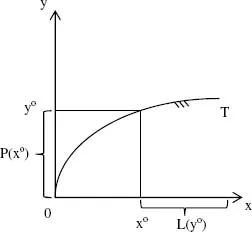
Our three basic specifications of the technology are
•T = {(x, y) : x can produce y} Technology Set
•P(x) = {y : x can produce y} Output Set
•L(y) = {x : x can produce y} Input Set
The equivalence relationship among the sets may be summarized as Lemma 1:1 (x, y) ∈ T ⇔ y ∈ P(x) ⇔ x ∈ L(y).2
To provide some intuition concerning the relationships among these three representations of technology assume that we have one input employed to produce one output. Our three sets are illustrated in Figure 1.1.