Random Matrices And Random Partitions: Normal Convergence
eBook - ePub

Random Matrices And Random Partitions: Normal Convergence

Normal Convergence

  1. 284 pages
  2. English
  3. ePUB (mobile friendly)
  4. Available on iOS & Android
eBook - ePub

Random Matrices And Random Partitions: Normal Convergence

Normal Convergence

About this book

This book is aimed at graduate students and researchers who are interested in the probability limit theory of random matrices and random partitions. It mainly consists of three parts. Part I is a brief review of classical central limit theorems for sums of independent random variables, martingale differences sequences and Markov chains, etc. These classical theorems are frequently used in the study of random matrices and random partitions. Part II concentrates on the asymptotic distribution theory of Circular Unitary Ensemble and Gaussian Unitary Ensemble, which are prototypes of random matrix theory. It turns out that the classical central limit theorems and methods are applicable in describing asymptotic distributions of various eigenvalue statistics. This is attributed to the nice algebraic structures of models. This part also studies the Circular β Ensembles and Hermitian β Ensembles. Part III is devoted to the study of random uniform and Plancherel partitions. There is a surprising similarity between random matrices and random integer partitions from the viewpoint of asymptotic distribution theory, though it is difficult to find any direct link between the two finite models. A remarkable point is the conditioning argument in each model. Through enlarging the probability space, we run into independent geometric random variables as well as determinantal point processes with discrete Bessel kernels.

This book treats only second-order normal fluctuations for primary random variables from two classes of special random models. It is written in a clear, concise and pedagogical way. It may be read as an introductory text to further study probability theory of general random matrices, random partitions and even random point processes.

This book is aimed at graduate students and researchers who are interested in the probability limit theory of random matrices and random partitions. It mainly consists of three parts. Part I is a brief review of classical central limit theorems for sums of independent random variables, martingale differences sequences and Markov chains, etc. These classical theorems are frequently used in the study of random matrices and random partitions. Part II concentrates on the asymptotic distribution theory of Circular Unitary Ensemble and Gaussian Unitary Ensemble, which are prototypes of random matrix theory. It turns out that the classical central limit theorems and methods are applicable in describing asymptotic distributions of various eigenvalue statistics. This is attributed to the nice algebraic structures of models. This part also studies the Circular β Ensembles and Hermitian β Ensembles. Part III is devoted to the study of random uniform and Plancherel partitions. There is a surprising similarity between random matrices and random integer partitions from the viewpoint of asymptotic distribution theory, though it is difficult to find any direct link between the two finite models. A remarkable point is the conditioning argument in each model. Through enlarging the probability space, we run into independent geometric random variables as well as determinantal point processes with discrete Bessel kernels.

This book treats only second-order normal fluctuations for primary random variables from two classes of special random models. It is written in a clear, concise and pedagogical way. It may be read as an introductory text to further study probability theory of general random matrices, random partitions and even random point processes.

Contents:

  • Normal Convergence
  • Circular Unitary Ensemble
  • Gaussian Unitary Ensemble
  • Random Uniform Partitions
  • Random Plancherel Partitions


Key Features:

  • The book treats only two special models of random matrices, that is, Circular and Gaussian Unitary Ensembles, and the focus is on second-order fluctuations of primary eigenvalue statistics. So all theorems and propositions can be stated and proved in a clear and concise language
  • In a companion part, the book also treats two special models of random integerpartitions, namely, random uniform and Plancherel partitions. It exhibits a surprising similarity between random matrices and random partitions from the viewpoint of asymptotic distribution theory, though there is no direct link between finite models
  • The limit distributions of most statistics of interest are obtained by reducing to classical central limit theorems for sums of independent random variables, martingale sequences and Markov chains. So the book is easily accessible to readers that are familiar with a standard probability theory textbook

Frequently asked questions

Yes, you can cancel anytime from the Subscription tab in your account settings on the Perlego website. Your subscription will stay active until the end of your current billing period. Learn how to cancel your subscription.
No, books cannot be downloaded as external files, such as PDFs, for use outside of Perlego. However, you can download books within the Perlego app for offline reading on mobile or tablet. Learn more here.
Perlego offers two plans: Essential and Complete
  • Essential is ideal for learners and professionals who enjoy exploring a wide range of subjects. Access the Essential Library with 800,000+ trusted titles and best-sellers across business, personal growth, and the humanities. Includes unlimited reading time and Standard Read Aloud voice.
  • Complete: Perfect for advanced learners and researchers needing full, unrestricted access. Unlock 1.4M+ books across hundreds of subjects, including academic and specialized titles. The Complete Plan also includes advanced features like Premium Read Aloud and Research Assistant.
Both plans are available with monthly, semester, or annual billing cycles.
We are an online textbook subscription service, where you can get access to an entire online library for less than the price of a single book per month. With over 1 million books across 1000+ topics, we’ve got you covered! Learn more here.
Look out for the read-aloud symbol on your next book to see if you can listen to it. The read-aloud tool reads text aloud for you, highlighting the text as it is being read. You can pause it, speed it up and slow it down. Learn more here.
Yes! You can use the Perlego app on both iOS or Android devices to read anytime, anywhere — even offline. Perfect for commutes or when you’re on the go.
Please note we cannot support devices running on iOS 13 and Android 7 or earlier. Learn more about using the app.
Yes, you can access Random Matrices And Random Partitions: Normal Convergence by Zhonggen Su in PDF and/or ePUB format, as well as other popular books in Biological Sciences & Science General. We have over one million books available in our catalogue for you to explore.

Information

Chapter 1

Normal Convergence

1.1Classical central limit theorems

Throughout the book, unless otherwise specified, we assume that (Ω,
images
, P) is a large enough probability space to support all random variables of study. E will denote mathematical expectation with respect to P.
Let us begin with Bernoulli’s law, which is widely recognized as the first mathematical theorem in the history of probability theory. In modern terminology, the Bernoulli law reads as follows. Assume that ξn, n ≥ 1 is a sequence of independent and identically distributed (i.i.d.) random variables, P(ξn = 1) = p and P(ξn = 0) = 1 − p, where 0 < p < 1. Denote
images
. Then we have
images
In other words, for any ε > 0,
images
It is this law that first provide a mathematically rigorous interpretation about the meaning of probability p that an event A occurs in a random experiment. To get a feeling of the true value p (unknown), what we need to do is to repeat independently a trial n times (n large enough) and to count the number of A occurring. According to the law, the larger n is, the higher the precision is.
Having the Bernoulli law, it is natural to ask how accurate the frequency Sn/n can approximate the probability p, how many times one should repeat the trial to attain the specified precision, that is, how big n should be.
With this problem in mind, De Moivre considered the case p = 1/2 and proved the following statement:
images
Later on, Laplace further extended the work of De Moivre to the case p ≠ 1/2 to obtain
images
Formulas (1.2) and (1.3) are now known as De Moivre-Laplace central limit theorem (CLT).
Note ESn = np, Var(Sn) = np(1 − p). So (Snnp)/
images
is a normalized random variable with mean zero and variance one. Denote
images
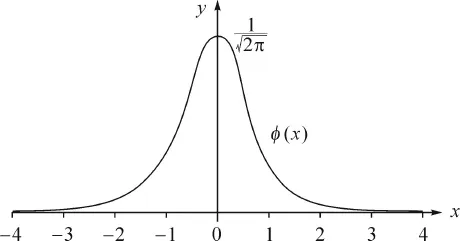
. This is a very nice function from the viewpoint of function analysis. It is sometimes called bell curve since its graph looks like a bell, as shown in Figure 1.1.
images
Fig. 1.1 Bell curve
The...

Table of contents

  1. Cover Page
  2. Title Page
  3. Copyright Page
  4. Dedication Page
  5. Contents
  6. Preface
  7. 1. Normal Convergence
  8. 2. Circular Unitary Ensemble
  9. 3. Gaussian Unitary Ensemble
  10. 4. Random Uniform Partitions
  11. 5. Random Plancherel Partitions
  12. Bibliography
  13. Index