Topics in Modern Physics
eBook - ePub

Topics in Modern Physics

Solutions to Problems

  1. 284 pages
  2. English
  3. ePUB (mobile friendly)
  4. Available on iOS & Android
eBook - ePub

Topics in Modern Physics

Solutions to Problems

About this book

Our understanding of the physical world was revolutionized in the twentieth century — the era of "modern physics". Two books by the second author entitled Introduction to Modern Physics: Theoretical Foundations and Advanced Modern Physics: Theoretical Foundations, aimed at the very best students, present the foundations and frontiers of today's physics. Many problems are included in these texts. A previous book by the current authors provides solutions to the over 175 problems in the first volume.

A third volume Topics in Modern Physics: Theoretical Foundations has recently appeared, which covers several subjects omitted in the essentially linear progression in the previous two. This book has three parts: part 1 is on quantum mechanics, part 2 is on applications of quantum mechanics, and part 3 covers some selected topics in relativistic quantum field theory. Parts 1 and 2 follow naturally from the initial volume. The present book provides solutions to the over 135 problems in this third volume.

The three volumes in this series, together with the solutions manuals, provide a clear, logical, self-contained, and comprehensive base from which students can learn modern physics. When finished, readers should have an elementary working knowledge in the principal areas of theoretical physics of the twentieth century.

Contents:

  • Introduction
  • Quantum Mechanics:
    • Solutions to the Schrödinger Equation
    • Formal Developments
  • Applications of Quantum Mechanics 83:
    • Approximation Methods for Bound States
    • Scattering Theory
    • Time-Dependent Perturbation Theory
    • Electromagnetic Radiation and Quantum Electrodynamics
  • Relativistic Quantum Field Theory:
    • Discrete Symmetries
    • Heisenberg Picture
    • Feynman Rules for QCD 231
  • Problems and Appendices:
    • The Two-Body Problem
    • Charged Particle in External Electromagnetic Field
    • Advanced undergraduate and graduate students in physics, science and engineering, researchers and engineers. Key Features:
      • The three volumes in this modern physics series provide a clear, logical, self-contained, and comprehensive base from which readers can obtain an elementary working knowledge in the principal areas of theoretical physics of the twentieth century
      • The solutions manuals provide a teaching aid for instructors and a learning aid for students

Frequently asked questions

Yes, you can cancel anytime from the Subscription tab in your account settings on the Perlego website. Your subscription will stay active until the end of your current billing period. Learn how to cancel your subscription.
At the moment all of our mobile-responsive ePub books are available to download via the app. Most of our PDFs are also available to download and we're working on making the final remaining ones downloadable now. Learn more here.
Perlego offers two plans: Essential and Complete
  • Essential is ideal for learners and professionals who enjoy exploring a wide range of subjects. Access the Essential Library with 800,000+ trusted titles and best-sellers across business, personal growth, and the humanities. Includes unlimited reading time and Standard Read Aloud voice.
  • Complete: Perfect for advanced learners and researchers needing full, unrestricted access. Unlock 1.4M+ books across hundreds of subjects, including academic and specialized titles. The Complete Plan also includes advanced features like Premium Read Aloud and Research Assistant.
Both plans are available with monthly, semester, or annual billing cycles.
We are an online textbook subscription service, where you can get access to an entire online library for less than the price of a single book per month. With over 1 million books across 1000+ topics, we’ve got you covered! Learn more here.
Look out for the read-aloud symbol on your next book to see if you can listen to it. The read-aloud tool reads text aloud for you, highlighting the text as it is being read. You can pause it, speed it up and slow it down. Learn more here.
Yes! You can use the Perlego app on both iOS or Android devices to read anytime, anywhere — even offline. Perfect for commutes or when you’re on the go.
Please note we cannot support devices running on iOS 13 and Android 7 or earlier. Learn more about using the app.
Yes, you can access Topics in Modern Physics by Paolo Amore, John Dirk Walecka in PDF and/or ePUB format, as well as other popular books in Physical Sciences & Electromagnetism. We have over one million books available in our catalogue for you to explore.

Information

Publisher
WSPC
Year
2014
eBook ISBN
9789814618977

PART 2

Applications of Quantum Mechanics

Chapter 4

Approximation Methods for Bound States

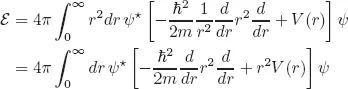
Problem 4.1 (a) Write the energy functional in the first of Eqs. (4.32) in spherical coordinates with a ψ(r) as
figure
Now partially integrate the first term with the wave function in Eq. (4.30) to verify the second of Eqs. (4.32)
figure
(b) Verify the numerical results in Fig. 4.3 and Eqs. (4.36).
Solution to Problem 4.1
(a) We are to evaluate the energy functional
figure
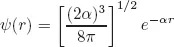
with the normalized wave function
figure
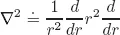
The radial part of the laplacian is
figure
Substitute this into the energy functional
figure
Now carry out a partial integration on the kinetic-energy term
figure
The first term explicitly vanishes at both limits, and therefore
figure
(b) Done in text.
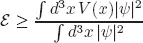
Problem 4.2 Assume the potential is bounded from below. Show the energy functional satisfies Ɛ ≥Vmin where Vmin is the minimum value of V.
Solution to Problem 4.2
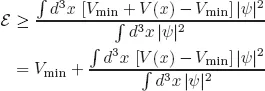
The energy functional is given by
figure
As in Eq. (4.32), the hermiticity of p = (ħ/i)∇ allows this to be written as
figure
The kinetic energy term is evidently positive definite, and hence
figure
Now write this as
figure
Since the last term in the second line is again positive definite, we have the desired inequality
Ɛ ≥Vmin
Problem 4.3 Show through order H′ that the wave functions
figure
in non-degenerate perturbation theory with an hermitian H′ form an orthonormal system
figure
Solution to Problem 4.3
The wave function in first-order non-degenerate perturbation theory is given in Eq. (4.58) as
figure
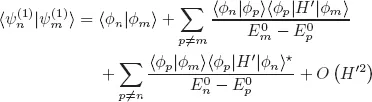
Now compute the inner product
figure
figure
The orthonormality of the unperturbed wave functions 〈φnm〉 = δmn, and the hermiticity of H′, then yield
figure
The second and third terms cancel identically,1 and this is the desired result
figure
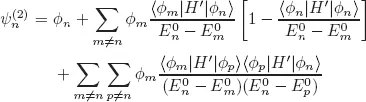
Problem 4.4 (a) Show the second-order wave function in non-degenerate perturbation theory is given by
figure
(b) Verify that this expression is well-defined if the system is non-degenerate [see Eq. (4.59)].
Solution to Problem 4.4
(a) The second-order expression for the wave function
figure
in non-degenerate perturbation theory can be obtained from Eqs. (4.56) in two steps:
(1) Use the first-order expression for the wave function in Eqs. (4.58)2 in the matrix...

Table of contents

  1. Cover Page
  2. Title page
  3. Copyright
  4. Preface
  5. Quantum Mechanics
  6. Applications of Quantum Mechanics
  7. Relativistic Quantum Field Theory
  8. Problems and Appendices
  9. Appendix A The Two-Body Problem
  10. Appendix B Charged Particle in External Electromagnetic Field
  11. Bibliography
  12. Index