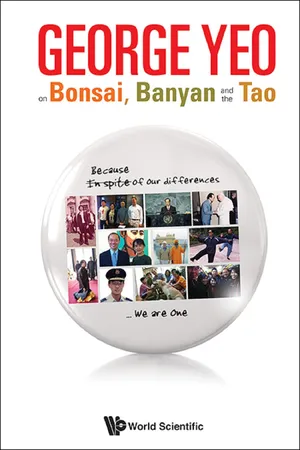
George Yeo on Bonsai, Banyan and the Tao
eBook - ePub

George Yeo on Bonsai, Banyan and the Tao

  1. 812 pages
  2. English
  3. ePUB (mobile friendly)
  4. Available on iOS & Android
eBook - ePub

George Yeo on Bonsai, Banyan and the Tao

About this book

Since his undergraduate days in Cambridge, George Yeo has spoken and written much in and out of government. Many remember the things which he said or wrote years ago. This book is a compilation of some of his best speeches and writings which were selected by Asad Latif and Lee Huay Leng in consultation with him.

The book has a rather unusual title because there are many aspects to George Yeo which makes him difficult to classify. As a student leader, he was radical but conciliatory. In the Singapore Armed Forces, he was atypical, moving from the Army to the Air Force before becoming Director of Joint Operations and Planning. In politics, he is fondly remembered by artists, journalists, doctors, businessmen and foreign diplomats, and by his colleagues and constituents. His own staff said he had a curious mind. They complained that he rarely used the drafts which they had prepared for him.

George Yeo describes himself as a Taoist even though he is a Roman Catholic and is now on the Papal staff. Buddhists are surprised he championed the revival of Nalanda University as an international project. He remains close to Singaporeans of different races and religions even though he has a deep sense of his own ancestral roots and religion. In politics, he has been described both as a liberal and a conservative. In his Parliamentary maiden speech, he spoke of the importance of democracy but has repeated many times that democracy is only a means and not an end in itself. He has a deep interest in history which partly explains his seeing the re-emergence of China and India earlier than most others.

The bonsai and the banyan are metaphors he uses for Singapore. Singapore is a city-state and must never have an inflated view of itself. The bonsai describes Singapore modestly, but he adds that the bonsai can be intensely interesting and valuable. The banyan provides shade and we are grateful for it, but too much makes us weak. As for the Tao, that perhaps is what gives unity to his many interests.

Since his undergraduate days in Cambridge, George Yeo has spoken and written much in and out of government. Many remember the things which he said or wrote years ago. This book is a compilation of some of his best speeches and writings which were selected by Asad Latif and Lee Huay Leng in consultation with him.

The book has a rather unusual title because there are many aspects to George Yeo which makes him difficult to classify. As a student leader, he was radical but conciliatory. In the Singapore Armed Forces, he was atypical, moving from the Army to the Air Force before becoming Director of Joint Operations and Planning. In politics, he is fondly remembered by artists, journalists, doctors, businessmen and foreign diplomats, and by his colleagues and constituents. His own staff said he had a curious mind. They complained that he rarely used the drafts which they had prepared for him.

George Yeo describes himself as a Taoist even though he is a Roman Catholic and is now on the Papal staff. Buddhists are surprised he championed the revival of Nalanda University as an international project. He remains close to Singaporeans of different races and religions even though he has a deep sense of his own ancestral roots and religion. In politics, he has been described both as a liberal and a conservative. In his Parliamentary maiden speech, he spoke of the importance of democracy but has repeated many times that democracy is only a means and not an end in itself. He has a deep interest in history which partly explains his seeing the re-emergence of China and India earlier than most others.

The bonsai and the banyan are metaphors he uses for Singapore. Singapore is a city-state and must never have an inflated view of itself. The bonsai describes Singapore modestly, but he adds that the bonsai can be intensely interesting and valuable. The banyan provides shade and we are grateful for it, but too much makes us weak. As for the Tao, that perhaps is what gives unity to his many interests.

Readership: The general public, policy-makers and academics keen on Asian politics and international relations.

Trusted by 375,005 students

Access to over 1.5 million titles for a fair monthly price.

Study more efficiently using our study tools.

Information

INDEX

Note: Page numbers in boldface refer to photos and text in the photo captions.
A
Abdullah Badawi, 54, 309, 493–494, 513
ABN bank, 216
ACU. See Asian Currency Unit
African culture, 249, 342, 412
ageing, of population, 127, 152, 194, 363, 400
agriculture:
China and, 462
history and, 4, 56, 109, 167
Singapore and, 111, 136, 421, 443
technology and, 109, 355
urbanisation and, 434–435, 470
WTO and, 374
Yeo and, 184, 658
Ahluwalia, Montek Singh, 610
Alexandra Hospital, 122
Ali Alatas, 166
altruism, 56, 58, 62–63
Amazon.com, 134
AMP. See Association of Muslim Professionals
Ang, Richard, 91
Ang Yong Guan, 89
Anifah Aman, 67
Annan, Kofi, 314
APEC. See Asia-Pacific Economic Cooperation
Aquino, Benigno, 128
Arts Centre, 238, 296, 297, 422
ASEAN. See Association of Southeast Asian Nations
Asia-Europe Foundation, 68
Asian Currency Unit (ACU), 470
Asian financial crisis, 154, 278, 290, 358, 464, 479, 494, 544, 594
Asia-Pacific Economic Cooperation (APEC), 100, 115, 428, 429, 436, 457, 591
Association of Muslim Professionals (AMP), 138, 226, 228, 229, 230, 232
Association of Southeast Asian Nations (ASEAN), 100, 131, 249, 429, 495
Bali Concord II and, 512
Business Club, 595, 597
China and, 542, 572, 594, 595
China-India relations, 598–601
Associati...

Table of contents

  1. Cover Page
  2. Title Page
  3. Copyright Page
  4. Dedication Page
  5. Contents
  6. Foreword by Amartya Sen
  7. Foreword by Wang Gungwu
  8. Foreword by Nicolas Berggruen
  9. Acknowledgements
  10. Commentary by Asad-ul Iqbal Latif
  11. Commentary by Lee Huay Leng
  12. Introduction
  13. Singapore and Politics
  14. Culture and Values
  15. Media and Social Media
  16. Geopolitics
  17. Appendix
  18. Timeline of George Yeo
  19. Index

Frequently asked questions

Yes, you can cancel anytime from the Subscription tab in your account settings on the Perlego website. Your subscription will stay active until the end of your current billing period. Learn how to cancel your subscription
No, books cannot be downloaded as external files, such as PDFs, for use outside of Perlego. However, you can download books within the Perlego app for offline reading on mobile or tablet. Learn how to download books offline
Perlego offers two plans: Essential and Complete
  • Essential is ideal for learners and professionals who enjoy exploring a wide range of subjects. Access the Essential Library with 800,000+ trusted titles and best-sellers across business, personal growth, and the humanities. Includes unlimited reading time and Standard Read Aloud voice.
  • Complete: Perfect for advanced learners and researchers needing full, unrestricted access. Unlock 1.5M+ books across hundreds of subjects, including academic and specialized titles. The Complete Plan also includes advanced features like Premium Read Aloud and Research Assistant.
Both plans are available with monthly, semester, or annual billing cycles.
We are an online textbook subscription service, where you can get access to an entire online library for less than the price of a single book per month. With over 1.5 million books across 990+ topics, we’ve got you covered! Learn about our mission
Look out for the read-aloud symbol on your next book to see if you can listen to it. The read-aloud tool reads text aloud for you, highlighting the text as it is being read. You can pause it, speed it up and slow it down. Learn more about Read Aloud
Yes! You can use the Perlego app on both iOS and Android devices to read anytime, anywhere — even offline. Perfect for commutes or when you’re on the go.
Please note we cannot support devices running on iOS 13 and Android 7 or earlier. Learn more about using the app
Yes, you can access George Yeo on Bonsai, Banyan and the Tao by Asad-ul Iqbal Latif, Huay Leng Lee in PDF and/or ePUB format, as well as other popular books in Politics & International Relations & Political Biographies. We have over 1.5 million books available in our catalogue for you to explore.