![]()
Chapter 1
Introduction
1.1Introduction
A traditional computing environment requires organisations to purchase and install expensive on-site upfront computing resources, such as a platform (e.g. an operating system, a development platform) and infrastructure (e.g. network, storage, processing and memory devices) for the development, testing, deployment and maintenance of software applications (e.g. financial, supply chain). Organisations are under enormous pressure and are increasingly becoming interested in adopting technological innovations in order to deliver agile, economical and quality solutions to meet the ever-changing requirements of their customers. Organisations are seeking on-demand and less expensive application development and management alternatives to avoid upfront investments and unpredictable returns (Hai and Sakoda 2009).
The emergence of on-demand cloud computing allows organisations to quickly source, develop, test and deploy X as a Service (XaaS) to meet the dynamic business needs of their customers (Salesforce 2008; Armbrust et al. 2009). The character ‘X’ can refer to a range of computing resources such as software, platform, infrastructure etc. Organisations have shown a significant interest in the adoption of economical and shared cloud computing environment. Although cloud computing seems to offer several advantages (e.g. scalability, pay-as-you-go), it also poses a number of new challenges. Before jumping on the cloud bandwagon, organisations need to understand the fundamental differences between the traditional and cloud computing environment. Instead of a silo or ad-hoc cloud technology adoption, they may need a strategic adaptive or agile cloud enterprise architecture capability to guide the strategic business-driven organisation-wide effective and less risky cloud technology adoption.
This book discusses the application of the adaptive enterprise service system (AESS) metamodel and lifecycle management approach (ADOMS) from The Gill Framework® to adapting, defining, operating, managing and supporting the adaptive cloud enterprise architecture capability. The adaptive cloud enterprise architecture provides a platform for creating a cloud service-centric agile or adaptive enterprise. Before discussing cloud architecture, this chapter discusses the following basic cloud computing concepts, evolution and constructs.
•Cloud computing
•Cloud evolution
•Cloud characteristics
•Cloud service models
•Cloud deployment models
•Cloud stakeholders
•Cloud adoption benefits
•Cloud adoption challenges
1.2Cloud Computing
Cloud computing is continuously evolving. There is no single globally agreed definition of cloud computing. There are a number of definitions which attempt to describe cloud computing characteristics. The 2010 European Commission (EC) report defines cloud computing as “an elastic execution environment of resources involving multiple stakeholders and providing a metered service at multiple granularities for a specified level of quality (of service)”.
This definition of cloud computing highlights that the cloud is not only concerned with the use of computing resources over the network, it is an elastic or scalable environment that has the ability to cope with the dynamic high and low capacity demands of metered computing resources over the Internet, based on an agreed service quality or service level agreement. Similar to the EC report, Gartner (Plummer et al. 2008) describes cloud computing as “a style of computing where massively scalable IT-enabled capabilities are delivered ‘as a service’ to external customers using Internet technologies”.
The Open Cloud Manifesto (2009) explains the characteristics of cloud computing from a technological perspective and defines cloud computing as “a culmination of many technologies, such as grid computing, utility computing, SOA, Web 2.0, and other technologies”, but it also states that “a precise definition is often debated”. Similar to the Open Cloud Manifesto, Forrester (2015) describes cloud computing as a standardised IT environment in which “a standardized IT capability (services, software, or infrastructure) is delivered in a pay-per-use, selfservice way.” This definition highlights the important pay-per-use and self-service mechanisms of provisioning IT services without human intervention (different from traditional IT service provisioning). As indicated in this section, there is no precise standard definition of cloud computing. In 2011, the National Institute of Standards and Technology (NIST), a body which describes technology standards, provided a more comprehensive and acceptable definition of cloud computing, as follows:
“a model for enabling ubiquitous, convenient, on-demand network access to a shared pool of configurable computing resources (e.g., networks, servers, storage, applications, and services) that can be rapidly provisioned and released with minimal management effort or service provider interaction. This cloud model is composed of five essential characteristics, three service models, and four deployment models”.
This book is focused on adaptive cloud enterprise architecture. To complement this widely accepted NIST definition of cloud computing, this book provides the following architecture-driven (based on ISO/IEC/IEEE 42010) definition of the cloud:
“The fundamental concepts or properties of an adaptive cloud service system in its environment embodied in its elements, relationships, and in the principles of its design and evolution”.
This book defines the cloud as an adaptive service system that offers services. Fundamental to an adaptive cloud service system is its design and evolution principles, external (e.g. local, national and international) and internal relationships, and on-demand self-service configurable software and hardware (physical or virtual) computing resources or elements that can be rapidly provisioned and released as secure adaptive services with minimal management effort or service provider interaction.
1.3Cloud Evolution
Cloud computing provides an environment for offering services over the Internet. The concept of the “Internet” or the “Cloud” is not new; new, if anything, is the ability to access and use the on-demand pay-as-you-go shared multi-tenant cloud services over the public network. The history of cloud computing can be traced back to the 1950s’ mainframe and utility computing. The term mainframe refers to large computing and storage resources housed in large cabinets or frames. The UNIVAC Ia, the first mainframe computer which was about the size of a car garage, was used by the U.S. Census Bureau. The concept of utility computing, similar to other utility services such as telephone and electricity utility services, refers to the use of computing, network and storage resources as metered services on a pay-as-you-go basis instead of a flat rate. John McCarthy mentioned at the MIT Centennial in 1961 (Garfinkel 1999):
“If computers of the kind I have advocated become the computers of the future, then computing may someday be organized as a public utility just as the telephone system is a public utility”.
The term Internet refers to the large global public network of computers. The origin of the Internet can be traced back to the 1960s US government research project ARPANET, which developed an advanced resilient computer network and communication environment. This work evolved in the shape of a global computer network over a period of time and was fully available for public commercial use in the mid-1990s (that is, the final restrictions on commercial traffic were removed), which is now known as the “Internet”. Concepts such as mainframe, utility computing and the Internet are the fundamental building blocks of cloud computing. The origin of the modern constructs of cloud computing can be attributed to the Salesforce.com platform in the late 1990s and the Amazon Web Services platform in early 2000. Since the late 1990s, a number of new ways of offering cloud computing services (e.g. SaaS, PaaS, IaaS) and deployment models (e.g. public, private, community and hybrid) have emerged to deal with the complex computing requirements of the 21st century. This section discusses cloud evolution from software development, hosting and provisioning perspectives.
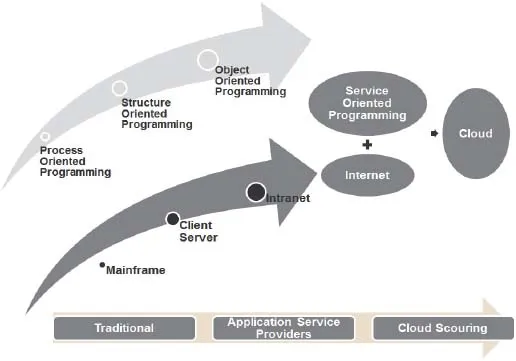
Fig. 1.1. Cloud evolution.
1.3.1Development
The software application development process involves analysing, architecting, designing, coding, testing, and deploying software programs by using an abstraction model or design paradigm (Berzins et al. 1986; Theodorakis et al. 1999). Software development is supported by the appropriate development platform, including programming languages and tools. An abstraction model is a logical view and representation of real world entities or problems and their solution in terms of software programs, such as process-oriented, structure or data oriented, and object-oriented (Burback 1998). There are four key software application development abstraction models (see Fig. 1.1), namely process, data, object and service.
1.3.1.1Process
A process abstraction is a logical view or representation of activities of an organisation or business area that can be supported or realised in terms of software system functions, procedures or features (Hammer 1996). These software system functions are captured and modeled during the analysis, architecture and design phases of software development. Thus, process-abstraction-focused software is essentially a collection or a set of functions. The examples of a simple software system functions are: create product file, add product, and search product. There are a number of programming languages and tools (O’Reilly 2004) that have been proposed over a period of time to allow developers to write process-oriented software programs, such as FORTRAN in 1954 and COBOL in 1959.
The key benefit of process abstraction is that the internal details of the softw...