![]()
Chapter 1
Introduction to Asian Political Behavior
1.1 Introduction
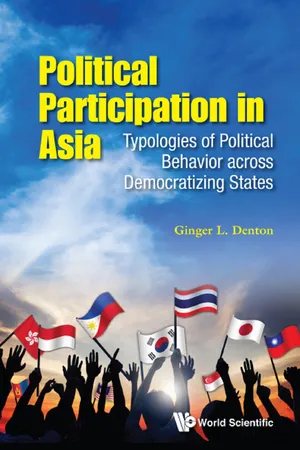
When I began work on this book, many political scientists were deeply concerned about the outlook for participatory democracy in several parts of the Asian region. For instance, when I was in Thailand in 2010, Bangkok experienced violent protests and rallies between civilians and military. The sound of gunfire, the tremble of explosions, and the smoke pluming through the air were constant reminders of the struggle between Thais seeking to exercise a form of political participation, and the military used to counterbalance their acts. Seeing the political protesters in Thailand, and the measures used against them by the government, made me consider “who” might feel so strongly about the politics of their country that they would risk their own personal safety to exercise their right to protest against a sitting government? Were young individuals or those of a certain socioeconomic class more likely to participate? Questions like these have fueled my interest in Asian political behavior and are the catalysts for this book. Furthermore, can one theory help explain political participation in several countries? While every country of the world has its own often unique institutions and cultures, is there something so fundamental about the political self that it can transcend country boundaries? This book attempts to answer these questions by analyzing different modes of political participation in Asia and the types of individuals that participate in them. The purpose of this research includes helping scholars of democracy understand why some citizens participate in certain activities while others do not. Knowing this could help improve countries’ democratic processes via citizen participation, help politicians understand which methods of campaigning resonates with distinct segments of society, and explain whether particular political behavior actions will encourage democratic consolidation.
One of the challenges to answering these types of questions is trying to develop or test theories that transcend individual countries. Much of the behavioral literature is based on European and to a greater extent, American perspectives. When limited to the United States (US), these theories are not general in their scope. The question raised in this research concerns whether the theories generated within the US are applicable elsewhere in the world. This research assays to apply some very important theories of political behavior in the Asian context. Some of these theories include the Resource Model1 and Socioeconomic Status ( SES) Model of political behavior. The latter argues that individuals with higher income levels and higher education levels will be more active in politics. The SES model is helpful in explaining individual level behavior and hypothesizes that higher SES levels lead to skills that produce higher participation levels. Verba, Schlozman, and Brady [1995] expand the SES model in the development of the Resource Model. Their theory describes how an individual’s resources are most important when predicting participation. The authors assert that different resources link SES to political participation. According to their model, resources include not only knowledge stemming from education, income (associated with money), and time linked to age, but also other civic skills such as religiosity.
The most penetrating of the theories of political behavior include Verba and Nie’s [1972] analysis of participation in the US. The authors delineate between various forms of participation instead of treating political behavior as one all-encompassing concept. This research will analyze the puzzle of whether these theories of political behavior including the Resource Model, SES Model, as well as Verba and Nie’s treatment of different modes of participation transpose to fundamentally different cultures such as Asia.
1.2 What is Political Participation?
One of the enigmas to the study of politics and more specifically, political behavior has been low levels of political participation by many segments of society throughout the world. The US has experienced lower levels of voter turnout in the past few decades than ever before. However, voting is not the only type of participation that has decreased in the US. Even though societies like the US have modernized and have higher education levels than in past years, these similar patterns of participation are evident. Because of this, scholars have attempted to investigate a variety of questions related to participation. Questions related to particular characteristics that individuals or groups of individuals may possess have entered into many research agendas in the field of political science. Not only are unique social characteristics analyzed but whether or not the characteristics help predict political behavior has been studied as well. Questions that ask “who votes” or “who participates” in politics have flooded the political behavior literature for years. Why do individuals participate? Why might they participate in certain ways and not in others?
Going to the voting booth and choosing a candidate one wishes to be elected into a particular office is clearly influenced by much more than the types of structural electoral characteristics present in a given society. Although some countries might set minimum age requirements for the right to vote, not all youth participate in the electoral process. Various attitudes, values, motivations, and backgrounds influence participation. This can be in effect when simply choosing to register to vote, actually voting in an election, or participating in political demonstrations in large numbers such as during the 1989 June Fourth Incident in Tiananmen Square.
Voting is simply one form of political participation and distinct from all other types of participation. Those living in a stable, industrial, Western democracy often automatically equate elections, campaigning, and voting with “participation”, but this is not the case everywhere. In some areas, going to a place of religious worship in a society that is officially atheistic might have certain political connotations. Those in the Western world are used to accepting public speeches, boycotts, and persuading others to vote in a certain way as a type of political participation. In general, although those in Western democracies might view voting as the main measure in which to access participation, one must remember that participation as a variable may include other actions.
When analyzing political participation in this book, it is referred to as being a behavior that citizens exert when seeking to alter the policies of government or influence the makeup of a country’s political candidates. This mixture of actions could be either sympathetic or hostile to the current regime. Political participation also comprises more inactive types of behaviors, for instance, going to group meetings or maintaining an interest in local or national government affairs. Being interested in politics and thus following the news and paying attention to the policy decisions of one’s elected officials can be categorized as passive modes of political participation. Although they may not be as active as other methods of participation, they are still classified as “participation” and will be included as a part of this broader study of political participation.
Scholars have examined the sources and causes of a broad array of political actions. “Conventional” participation such as voting, getting in touch with officials, or campaigning for candidates or political parties is distinguished from unconventional types of behaviors like protesting, using physical violence or force, etc. With regards to these broad categories of political participation, some researchers have investigated the social characteristics of individuals that take part in various participation activities as well as their motivation for participation.
Several examinations of political participation note that just a small percentage of individuals are very politically involved. Milbrath [1965] established what he called a hierarchy of various types of political involvement. He demonstrated that most Americans typically just engage in “spectator activities” including voting and discussing politics. On the other hand, Milbrath states that a very small number of citizens participated in not only these low-cost types of activities but also higher-cost activities, such as running for political office or fundraising for a particular political party [Milbrath, 1965: 21].
With regards to many countries experiencing low levels of participation, Dahl has remarked that scholars should not try to justify why citizens are not participating but that the focus should rather be on why the citizens that do participate are actually involved [Dahl, 1961: 279]. His statement though is really clarifying voter turnout and in the end, a broader definition of political participation (not just voting) could result in higher levels of participation than what voter turnout would indicate.
Other research proposes that participation is modeled around types of actions and that individuals tend to be engaged in discrete types of participation [Parry et al.,1992]. Some argue that political participation encompasses several facets and that individuals take part in a particular action or actions. For example, one individual might vote and/or campaign while another might contact a government official and sign petitions related to a political cause. This line of thought is not in line with Milbrath’s hypothesis and believes that there are various kinds of participation instead of participation being one all-encompassing phenomenon.
Verba and Nie [1972] postulate there are six different kinds of participation. The authors also studied which groups in society participated in these different modes of participation. They discovered that these different participation types did exist in America and were divided up among the public in unique ways. First, they found that about a quarter of the American population was inactive and did not participate in politics at all and around one tenth was complete activists who engaged in all the various ways one can participate politically. They demonstrated that other members of society were classified as voters (roughly 44%), parochial participants (those who contact officials about specific issues), communalists (individuals involved in groups and organizations that affect the community), and campaigners (15%). Verba and Nie maintain that all of these types of participation are noticeably different from one another and that individuals are inclined to be a member of one participation group. The authors maintained that political participation was not inevitably a collective concept but that separate modes exist.
Identifying the extent and patterns of participation however, does not explain why people participate. Only some approaches are useful in explaining individual level behavior, such as the decision to join a political party. Some authors emphasize the importance of socioeconomic factors as an explanation for participation: High SES leads to a distinct set of skills and attitudes, including civic duty and efficacy, thus producing higher levels of participation among these socioeconomic types [Barnes and Kasses, 1979; Verba and Nie, 1972; Verba et al., 1978; Verba et al., 1995]. Parry, Moyser, and Day [1992: 16] defined participation as “taking part in the process of formulation, passage and implementation of public policies.” These authors believe that crucial resources such as gender, age, and class help explain why a person participates politically.
The Civic Voluntarism Model, as developed by Verba, Schlozman, and Brady [1995] is one of the more influential models in explaining political participation. In their book, Voice and Equality, Verba, Scholzman, and Brady note that few Americans take part in any political activity outside of voting and those that do are mostly white males. The authors contend that participation can take many forms other than the act of voting but that many actors are constrained by resources or other means. After examining the SES Model which holds that people with a higher SES are more active in politics, the authors examine the Rational Choice Model. Both models are seen as either being weak in their linkages or in their predictive power. To alleviate this problem, the Civic Voluntarism Model is put forth, describing how actors’ resources are the most important aspect to analyze participation because resources can link backwards to SES and forward to political activity. They claim that resources can take the form of time, money, and civic skills. Importance is also placed on psychological engagement as well as institutional recruitment networks. In the end, the authors find that all three parts of their model are important in explaining political participation.
Another popular account for changes in political participation over time comes from modernization theories proposed by scholars like Inglehart [1997] and Dalton [2008]. They maintain that social and economic development, evident in the industrialized countries, can create a different type of individual involvement in the policymaking process. These scholars argue that with these developments comes more political participation in various forms (not just voting), but that modernization diminishes involvement in community groups, churches, etc.
In comparison, institutional explanations stress the manners in which the institutions of a given country can affect political participation among its citizens. These scholars suggest that constitutions, electoral systems, and party systems can create differences among voter turnout in different countries [Jackman, 1987]. Yet another way in which tendencies in citizen behavior can be explained is examining the so-called rules of the game. Scholars like Rosenstone and Hansen [1993] or Putnam [1995; 2000] concentrate on civil society and what function organizations have within society with regards to mass mobilization. Variables such as political parties or religious organizations are analyzed to see their effects on getting citizens to participate in politics. While such approaches highlight many important variables associated with participation, they are weaker at explaining possible incentives for participation. As a result, this research will include several variables from various approaches to form a more all-encompassing theory and therefore yield more robust results.
1.3 Book Design
Much research regarding political participation has been conducted in the US and elsewhere in other developed democracies but relatively little has been investigated with regards to Asia. This study will research the features and degree of political participation in Asia and present an account for the types of participation. This book is designed to apply the general theories of political participation, often originating within the American politics literature, to Asian societies. Data has recently emerged from the Asian Barometer Survey that makes this possible and thus, this book will be able to further examine participation in Asia. But first, an overview of political participation and its theories oftentimes originating in the American politics literature is necessary when trying to apply these same theories and ideas to other countries or regions of the world. This research will first examine the general theory of political participation, using the American literature as a case study before moving on to the examination of participation in an Asian context.
Do politically participating individuals have a role in any given society? The traditional democratic theory presumes that individuals living in a democracy have an interest in politics, take part in politics, and are well-informed about governmental processes. Democratic theory also asserts that these citizens vote in line with their own set of values and standards [Dahl, 1989]. However, research regarding citizens in particular democracies suggests that these notions are improbable. When analyzing the US, for instance, one finds that many people are just not very interested in politics. It is no secret that voter turnout is comparatively low and a very small percentage of America’s citizens are familiar with and understand the institutions of the government. Oftentimes, it is found that individuals are even uninformed or oblivious to the key policy issues being deliberated by the government.
This scholarly pursuit will examine political participation theories in American politics in Chapter 2. An analysis of factors that influence individual level participation will also be conducted. Chapter 3 will then focus on political participation in Asia. Previous research on Asian political behavior will be included. Chapter 4 will lay out the design of the first empirical analysis of the book. It will explain the various methods utilized in the pooled dataset of six countries and formulate hypotheses that will be tested with regards to a set of key independent variables and their effect on participation in Asia. Chapter 5 will then delineate between all 10 countries examined in Asia. Definitions of democracy and political participation will be specified as well as the formulation of the same hypotheses to be used in each individual country. This chapter will attempt to show that the same techniques used in the pooled Asian data are also relevant and useful in each individual country. The last chapter, Chapter 6, will draw conclusions from the empirical findings of Chapters 4 and 5.
![]()
Chapter 2
Literature Review
2.1 Introduction
Questions concerning mass citizen participation in democracies are longstanding. Before even discussing participation, it is important, however, to define “ democracy”. Tilly [2007] states that when trying to explain any variation in political systems, one must have a definition of democracy so that one can understand to what they are referring. Rousseau [1762] began by stating that having a firm grasp on the way the political system works is key for theories of participatory democracy.
The Social Contract’s theory ...