![]()
Chapter 1
Introduction
1.1What is an NMR Probe?
Any kind of physical investigation usually needs a suitable sensor in order to interface the physical phenomenon to the final display of the results. The task is complicated if the studies are concerning the molecular or atomic level, even the sub-atomic range nowadays. The principal problem arising when dealing with quantum experiments is how to measure the physical properties at sub-atomic level without the investigating system being perturbed by even the measuring process or by the probe we use.
This is precisely the case with a Nuclear Magnetic Resonance (NMR) experiment, which is based on picking up the signal generated by the assemblies of nuclei having a nonzero spin number. The nuclear spins, denoted as
s, like hydrogen (
s = 1/2), phosphorus (
s = 1/2), carbon 13 (
s = 1/2), sodium (
s = 3/2) are involved in the molecular or ionic constitution of a large number of materials (liquids, solids, or living heterogeneous systems).
1 The spin assembly defines the sample which is observed by the NMR approach. The sample contains a very large number of magnetic moments associated with the spin properties of the considered nuclei. When the spins of the protons and neutrons comprising these nuclei are not paired, the overall spin of the charged nucleus generates a magnetic dipole along the spin axis; the intrinsic magnitude of this dipole is the fundamental nuclear property called the
nuclear magnetic moment. Consequently, the nuclear magnetic moment of a collection of nuclei can align with an externally applied static magnetic field
in (2
s + 1) ways, either in the same direction or opposed to
, thus generating a macroscopic magnetization
of the whole sample proportional to
. This property is a characteristic of paramagnetic substances for which the magnetization is proportional to the static magnetic field and inversely proportional to the temperature.
With common thermal polarization, this magnetization is governed by the Boltzmann equilibrium law
where
N is the number of nuclei present in the sample,
γ is the gyromagnetic ratio of the nuclei,
ħ is the Planck constant divided by 2
π,
kB is the Boltzmann constant and
T the spin temperature, which is equal to the sample temperature at thermal equilibrium between spins and the thermostat made by the sample itself (known also as the lattice). The SI unit to express the amplitude of
is labelled as
ampere · meter2 (notation: A m
2).
The aim of the NMR technique is to quantify the nuclear magnetization of a sample, which is generally a rather small and very specific physical property that cannot be measured by conventional means. For this purpose, a resonance approach was developed in 1946 by research groups at Stanford and MIT, in the USA [Bloch
et al., 1946; Purcell
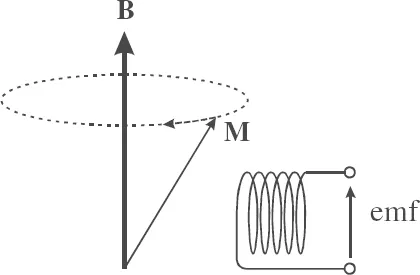
et al., 1946]. The radar technology developed during World War II made many of the electronic aspects of the NMR experiment possible and thus the observation and determination of the predicted nuclear magnetization. The principle of the most popular method is based on the detection of magnetic variable flux provided by the sample, similarly to the light signal given by a bicycle alternator. This is possible once the magnetization is tilted from its equilibrium position along and in the sense of the external applied magnetic field
. After being tilted, the magnetization gets a precession motion around the static magnetic field
direction, generally represented by the “vertical” direction on pictures (
Fig. 1.1). In this particular case, and in this case only, one may consider that the behavior of the magnetization is comparable to a magnet getting precession around an axis (here the axis is given by the static field direction). Then, if a conducting loop is set in a vertical plane, an Electromotive Force (emf) will appear between the two extremities of the wire as shown in
Fig. 1.1. The angular frequency of precession is given by
where γ is the “gyromagnetic” ratio of the considered nuclei; this parameter must be expressed in radian/second/tesla (notation: rad s–1 T–1
Fig. 1.1 Precession motion of nuclear magnetization around the applied magnetic field
and generation of an electromotive force in a “radiofrequency coil” due to the time variation of the magnetic flux.
Typical values for static fields in NMR experiments are presently in the 1 to 23 teslas range, giving frequencies from 42 to 1000 MHz for hydrogen. Such frequencies are typically Radio Frequency (RF) and the NMR devices (probes, amplifiers, electronic detectors, etc.) must operate accordingly.
It is clear from
Eq. (1.2) that the larger the static magnetic field, the larger the emf is since the angular frequency is proportional to
for any nuclei observed by NMR. It clearly appears that the sensitivity of the NMR experiment will increase when increasing
, and this explains the expensive efforts towards high static field magnets to perform NMR.
Nevertheless, even with the largest magnetic fields presently available (approximately 23 teslas), the NMR signal may still be too poor due to the smallness of the sample volume or to the weakness of the gyromagnetic ratio of the observed nuclei. The signal weakness is also due to the fact that, in parallel, manufacturers, biochemists and biologists try to observe smaller and smaller samples. Consequently, one efficient way to improve the nuclear magnetic signal generated at the sensor output is to pick it up using a resonant device. Practically, as will be demonstrated in the following chapters, matching a resonant circuit to the NMR spectrometer means constructing a resonator by tuning its receiving loop with good quality components such as capacitors to avoid losses. In this case, if Q is the quality coefficient of the receiving coil, the emf induced in the coil will be multiplied by a factor proportional to Q at the resonator output. The voltage thus obtained will be a superposition of signal and noise, both multiplied by the same factor. The advantage brought by this configuration in terms of the Signal-to-Noise Ratio (SNR) could be the reduction of the pass-band of the system (the SNR is inversely proportional to the pass-band square root). In order to take into account ...