Path Integrals for Pedestrians
eBook - ePub

Path Integrals for Pedestrians

  1. 156 pages
  2. English
  3. ePUB (mobile friendly)
  4. Available on iOS & Android
eBook - ePub

Path Integrals for Pedestrians

About this book

This is a book on path integrals which provides a quick and swift description of the topic. It contains original material that never before has appeared in a book. The new topics include the path integrals for the Wigner functions and for Classical Mechanics.

Request Inspection Copy

This is a book on path integrals which provides a quick and swift description of the topic. It contains original material that never before has appeared in a book. The new topics include the path integrals for the Wigner functions and for Classical Mechanics.

Request Inspection Copy


Readership: Student and professional in quantum and classical mechanics.
Key Features:

  • Work-out problems for students
  • Path integral for classical mechanics
  • Path integral for Wigner functions

Trusted by 375,005 students

Access to over 1 million titles for a fair monthly price.

Study more efficiently using our study tools.

Chapter 1
The Basic Ideas
1.1Quantum mechanics and summing up amplitudes
The path integral approach to quantum mechanics was developed by R. F. Feynman in his Ph.D. thesis of 1942. It was later published (1948) in Rev. Mod. Phys. with the title “Space-time approach to non-relativistic Quantum Mechanics” [Feynman (1948)].
Feynman wanted a formulation of quantum mechanics in which “space-time” played a role and not just the Hilbert space, like in the traditional version of quantum mechanics. His approach is very helpful in “visualizing” many quantum mechanical phenomena and in developing various techniques, like the Feynman diagrams, the non-perturbative methods (
image
→ 0, N → ∞), etc. Somehow, Dirac [Dirac (1933)] had got close to the Feynman formulation of quantum mechanics in a paper in which he asked himself what is the role of the Lagrangian in quantum mechanics.
Let us first review the concept of action which everybody has learned in classical mechanics. Its definition is
image
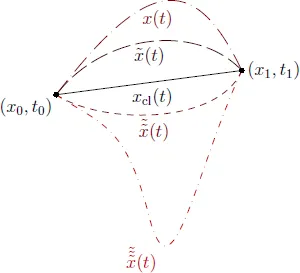
where x(t) is any trajectory between (x0 , t0) and (x1 , t1), not necessarily the classical one, and
image
is the Lagrangian of the system. The action S[x(t)] is what in mathematical terms is known as a functional. Remember that a functional is a map between a space of functions x(t) and a set of numbers (the real or complex numbers). From Eqn.(1.1) one sees that S[x(t)] is a functional because, once we insert the function x(t) on the right-hand side of Eqn.(1.1) (and perform the integration), we get a real number which is the value of the action on that trajectory. If we change the trajectory, we get a different number.
image
Fig. 1.1
A functional is indicated with square brackets, S[x(t)], differently from a function whose argument is indicated with round brackets: f(x). A function f(x) is a map between the set of numbers (real, complex, etc.) and another set of numbers (real, complex, etc.). So, if we restrict to the real numbers, we can say that:
image
Given these definitions, let us now see what the path integral formulation of quantum mechanics given by Feynman is.
We know that in quantum mechanics a central element is the transition kernel to go from (x0 , t0) to (x1, t1) which is defined as
image
What Feynman proved is the following formula:
image
where, on the right-hand side of Eqn.(1.3), the symbol
image
indicates a functional integration which “roughly” consists of the sum over all trajectories between (x0 , t0) and (x1, t1).
So, in Eqn.(1.3) we insert a trajectory in
image
calculate this quantity and “sum” it to the same expression with a different trajectory and so on for all trajectories between (x0, t0) and (x1, t1). This is the reason why this method is called path integral. Note that all trajectories enter Eqn.(1.3) and not just the classical one.
1.2Double slit experiment
We shall give a rigorous derivation of Eqn.(1.3) but for the moment let us try to grasp a “more physical” reason of why trajectories enter the expression of the quantum transition kernel. This part is taken from the book [Feynman and Hibbs (1965)].
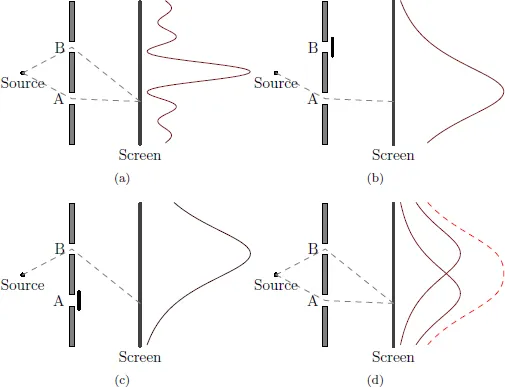
Let us recall the double slit experiment, see Fig. 1.2.
image
Fig. 1.2 (a) The probability PAB with both slits open. (b) The probability PA obtained with only the slit A open. (c) The probability PB obtained keeping only the slit B open. (d) Note that PAB ≠ PA + PB.
In Fig. 1.2(a) both slits A and B are open while in the other two figures, 1.2(b) and 1.2(c) only one is open. It is well known that the probabilities PAB , PA, PB satisfy the inequality
image
while for the probability amplitudes ψAB , ψA , ψB we have
image
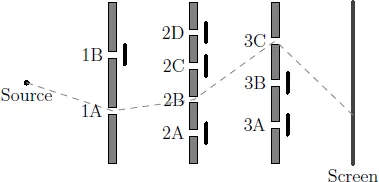
Let us now put more screens with different openings, like in Fig. 1.3.
image
Fig. 1.3 More screens with different openings.
Let us suppose we close the slits 1B, 2A, 2C, 2D, 3A, 3B and let us call the associated wave function as
image
where we have indicated with a subindex in the wave functions the slits which are open. For example for the wave function above only the slits 1A, 2B and 3C are open as shown in Fig. 1.3.
We can “associate” this amplitude with the path...
Table of contents

  1. Cover
  2. Halftitle
  3. Title Page
  4. Copyright
  5. Dedication
  6. Preface
  7. Contents
  8. 1.  The Basic Ideas
  9. 2  The Path Integral for Quantum Mechanics
  10. 3.  Introduction to the Semiclassical Approximation
  11. 4  Wigner Functions and its associated Path Integral
  12. 5  Classical Mechanics and its associated Path Integral
  13. Appendix A  Asynchronous variation of the action
  14. Appendix B  The equation for the function f (t2, t1) introduced in Section 2.6
  15. Appendix C  Variational calculus in the discrete formalism
  16. Appendix D  Brief review of Grassmann variables
  17. Appendix E  Dimensional analysis of θ and θ
  18. Appendix F  SchrÜdinger and Heisenberg picture in θ and θ
  19. Appendix G  Classical path integral in the momentum representation
  20. Appendix H  Classical path integral via the Trotter formula
  21. Appendix I  Ordering problems in the classical path integral
  22. Bibliography

Frequently asked questions

Yes, you can cancel anytime from the Subscription tab in your account settings on the Perlego website. Your subscription will stay active until the end of your current billing period. Learn how to cancel your subscription
No, books cannot be downloaded as external files, such as PDFs, for use outside of Perlego. However, you can download books within the Perlego app for offline reading on mobile or tablet. Learn how to download books offline
Perlego offers two plans: Essential and Complete
  • Essential is ideal for learners and professionals who enjoy exploring a wide range of subjects. Access the Essential Library with 800,000+ trusted titles and best-sellers across business, personal growth, and the humanities. Includes unlimited reading time and Standard Read Aloud voice.
  • Complete: Perfect for advanced learners and researchers needing full, unrestricted access. Unlock 1.4M+ books across hundreds of subjects, including academic and specialized titles. The Complete Plan also includes advanced features like Premium Read Aloud and Research Assistant.
Both plans are available with monthly, semester, or annual billing cycles.
We are an online textbook subscription service, where you can get access to an entire online library for less than the price of a single book per month. With over 1 million books across 990+ topics, we’ve got you covered! Learn about our mission
Look out for the read-aloud symbol on your next book to see if you can listen to it. The read-aloud tool reads text aloud for you, highlighting the text as it is being read. You can pause it, speed it up and slow it down. Learn more about Read Aloud
Yes! You can use the Perlego app on both iOS and Android devices to read anytime, anywhere — even offline. Perfect for commutes or when you’re on the go.
Please note we cannot support devices running on iOS 13 and Android 7 or earlier. Learn more about using the app
Yes, you can access Path Integrals for Pedestrians by Ennio Gozzi, Enrico Cattaruzza, Carlo Pagani in PDF and/or ePUB format, as well as other popular books in Physical Sciences & Mathematical & Computational Physics. We have over one million books available in our catalogue for you to explore.