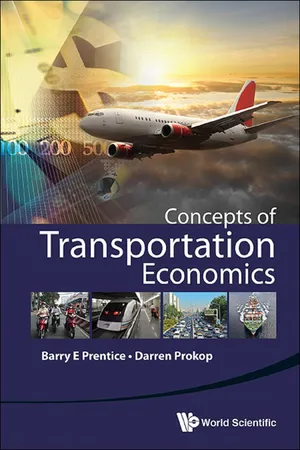
Concepts of Transportation Economics
eBook - ePub

Concepts of Transportation Economics

  1. 332 pages
  2. English
  3. ePUB (mobile friendly)
  4. Available on iOS & Android
eBook - ePub

Concepts of Transportation Economics

About this book

Transportation is the world's largest invisible industry. Modern society is completely dependent on transportation to sustain its way of life, and it is all around us constantly. Yet the economics of transportation is a mystery to most people. Why do air fares rise and fall? Why do urban transit systems struggle to survive and require such large public subsidies? Why does freight transport cost more to move in one direction than an equal distance in another? Why is the government so heavily involved in transportation? Concepts of Transportation Economics provides explanations to these queries and many more, as well-renowned experts in the field, Barry E Prentice and Darren Prokop interpret the unique dynamics underlying transportation through the lens of applied economics, and demonstrate that the operations of transportation are completely logical and obvious once the concepts that underlie business decisions and consumer reactions are explained.

Request Inspection Copy

Transportation is the world's largest invisible industry. Modern society is completely dependent on transportation to sustain its way of life, and it is all around us constantly. Yet the economics of transportation is a mystery to most people. Why do air fares rise and fall? Why do urban transit systems struggle to survive and require such large public subsidies? Why does freight transport cost more to move in one direction than an equal distance in another? Why is the government so heavily involved in transportation? Concepts of Transportation Economics provides explanations to these queries and many more, as well-renowned experts in the field, Barry E Prentice and Darren Prokop interpret the unique dynamics underlying transportation through the lens of applied economics, and demonstrate that the operations of transportation are completely logical and obvious once the concepts that underlie business decisions and consumer reactions are explained.

Request Inspection Copy


Contents:

  • About the Authors
  • Structure of the Text
  • Transportation and Economic Theory
  • Transportation, Logistics and Technology
  • The Demand for Transportation
  • Trade and Transportation Costs
  • Laws of Variable Proportions and Scale
  • Cost Economies and Traceability
  • Modal Supply Characteristics
  • Markets and Competition in Transportation
  • Externalities, Public Supply and Marginal Cost Pricing
  • Spatial and Temporal Pricing in Transportation
  • Product Pricing in Transportation
  • Transportation, Investment and Generalized Cost
  • Location and Land Settlement
  • Transportation and Government Policy
  • Regulatory Enforcement and Compliance


Key Features:

  • The concepts are presented in a graphical form, making the book accessible to students with nothing more than an introductory knowledge of economics, not requiring readers to have any mathematical background
  • The scope of the concepts explained is global and holistic. While some mode-specific treatment is necessary to explain differences in the reaction of different means of transport, the purpose is to introduce applications of modern economic theory in order to understand how the world works around us
  • Succinct and concise writing, allowing the entire text to be covered in a single semester, with the added feature of exercises and examples at the end of every chapter

Frequently asked questions

Yes, you can cancel anytime from the Subscription tab in your account settings on the Perlego website. Your subscription will stay active until the end of your current billing period. Learn how to cancel your subscription.
At the moment all of our mobile-responsive ePub books are available to download via the app. Most of our PDFs are also available to download and we're working on making the final remaining ones downloadable now. Learn more here.
Perlego offers two plans: Essential and Complete
  • Essential is ideal for learners and professionals who enjoy exploring a wide range of subjects. Access the Essential Library with 800,000+ trusted titles and best-sellers across business, personal growth, and the humanities. Includes unlimited reading time and Standard Read Aloud voice.
  • Complete: Perfect for advanced learners and researchers needing full, unrestricted access. Unlock 1.4M+ books across hundreds of subjects, including academic and specialized titles. The Complete Plan also includes advanced features like Premium Read Aloud and Research Assistant.
Both plans are available with monthly, semester, or annual billing cycles.
We are an online textbook subscription service, where you can get access to an entire online library for less than the price of a single book per month. With over 1 million books across 1000+ topics, we’ve got you covered! Learn more here.
Look out for the read-aloud symbol on your next book to see if you can listen to it. The read-aloud tool reads text aloud for you, highlighting the text as it is being read. You can pause it, speed it up and slow it down. Learn more here.
Yes! You can use the Perlego app on both iOS or Android devices to read anytime, anywhere — even offline. Perfect for commutes or when you’re on the go.
Please note we cannot support devices running on iOS 13 and Android 7 or earlier. Learn more about using the app.
Yes, you can access Concepts of Transportation Economics by Barry E Prentice, Darren Prokop in PDF and/or ePUB format, as well as other popular books in Business & Operations. We have over one million books available in our catalogue for you to explore.

Information

Publisher
WSPC
Year
2015
eBook ISBN
9789814656184
Subtopic
Operations

Table of contents

  1. Cover
  2. Halftitle
  3. Title
  4. Copyright
  5. Contents
  6. About the Authors
  7. Structure of the Text
  8. Transportation and Economic Theory
  9. Chapter 1: Transportation, Logistics and Technology
  10. Chapter 2: The Demand for Transportation
  11. Chapter 3: Trade and Transportation Costs
  12. Chapter 4: Laws of Variable Proportions and Scale
  13. Chapter 5: Cost Economies and Traceability
  14. Chapter 6: Modal Supply Characteristics
  15. Chapter 7: Markets and Competition in Transportation
  16. Chapter 8: Externalities, Public Supply and Marginal Cost Pricing
  17. Chapter 9: Spatial and Temporal Pricing in Transportation
  18. Chapter 10: Product Pricing in Transportation
  19. Chapter 11: Transportation, Investment and Generalized Cost
  20. Chapter 12: Location and Land Settlement
  21. Chapter 13: Transportation and Government Policy
  22. Chapter 14: Regulatory Enforcement and Compliance
  23. Glossary
  24. Glossary and Index Items