This book aims to present the history and developments of particle physics from the introduction of the notion of particles by the Ionian school until the discovery of the Higgs boson at LHC in 2012. Neutrino experiments and particle accelerators where different particles have been discovered are reviewed. In particular, details about the CERN accelerators are presented. This book also discusses the future developments of the field and the work to popularize high energy physics. A short presentation of some features of astrophysics and its connection to particle physics is also included. At the end of the book, some useful tools in the research of particle physics are given for the advanced readers.
Quantum electrodynamics (QED)1 is the theory of the electron and photon quantum fields. It is the prototype of the quantum field and gauge theories and is a quantum and relativistic version of classical electromagnetism.
•Abelian U (1) group and gauge invariance
QED is described by the Abelian U (1) rotation group on a circle.
— It remains invariant by multiplying the electron field ψ(x, t) by a phase exp [iθ(x)] where θ(x) is the rotation angle as in Fig. 3.2 but depends on the position x of the particle.
— It is also invariant by changing the electromagnetic field Aµ(x) (called gauge field) by a new field: Aµ(x) = Aµ(x) − ∂µθ(x) where ∂µ
∂/∂xµ is the derivative (small variation) of θ(x) in the space–time.
— These transformations are called gauge transformations.
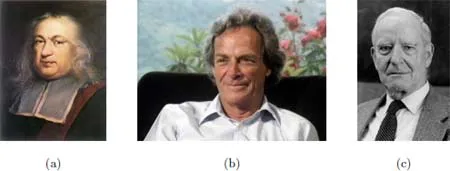
Figure 4.1: (a) P. de Fermat, (b) R.P. Feynman, (c) F. Villars.
4.2 Path Integral and Feynman Diagrams
Principle of Least Action
In 1948, Feynman (Fig. 4.1) pointed out that if light is a wave and hence a field, principle of Fermat (1603/1608–1665) (Fig. 4.1) (the light path is the minimum optical path) can be deduced from the more general principle of Huygens (Fig. 1.5), which stipulates that the amplitude of a field is the sum of the contributions of all the field waves that depart from a source S and arrive at the observer
after reflection on the mirror. Waves will then browse multiple paths, the sum allows light to choose one that minimizes its time of travel. In the case of very low wavelengths (geometrical optics), this minimum path is that of the so-called distance of Fermat. By applying this summation to the motion of the particles considered as quanta of the field, Feynman gets, in the classical limit (the reduced Planck constant ħ = 0), the principle of least action corresponding to Fermat’s principle in geometrical optics. He thus managed to unify the wave and the particle.
Amplitudes (S-Matrix) and Path Integral
In the approach of least action, to calculate the transition amplitude
(or S-matrix) to go from initial point A at the time ti to a final point B at the time tf, must be considered the sum of all paths that meet the initial and final conditions. Each path is characterized by its weight that is the exponential of the classical action
with respect to the variation of the Lagrangian L (difference between kinetic Ec and potential energy V) in 3-dimensional space multiplied by (i/ħ). In terms of an equation, it means that:
= (i/ħ) ∫ dt L (see more in Appendix D). The complete path or functional integral corresponds to the summation over an infinite number of complex weights (infinite number of variables of integration). Then, it permits to calculate the transition amplitude
.
Perturbation Theory
However, the summation for getting the transition amplitude
is, in principle, infinite and, then, it is impossible in practice to extract the transition amplitude. In order to circumvent this problem, one proceeds by approximation series in terms of a small parameter expansion. In the case of QED, this small parameter is the square of the electric charge e (in natural units: ħ = c = 1):
where α = 1/137 is the fine structure constant. It enters via the tree level (lowest order) interaction Lagrangian
between the electron ψ and photon Aµ fields (see more in Appendix D), where the index zero indicates that the interaction is at the lowest order (tree level) of the perturbation theory. Here we have introduced the normal ordered product notation : : which means that the annihilation operators are to the right of the creation operators (see Appendix B). Therefore, in natural units, the amplitude
can be written as a sum of amplitudes evaluated at each order of the perturbation theory:
when expressed in terms of the interaction Lagrangian
is called chronological ordering or time ordered product which ...
Table of contents
Cover
Halftitle
Title
Copyright
Dedication
Foreword
Outline
Contents
I General Introduction
II Modern Theories of Forces
III Higgs Boson Discovery and Beyond
IV Experiments to Go Back in Time
V A Brief Cosmos Tour
VI Fundamental Researches and Society
VII Epilogue
VIII Appendix: Useful Notes for Advanced Readers
IX Annex
X Bibliography and Index
XI About the Author
Stephan Narison
Trusted by 375,005 students
Access to over 1.5 million titles for a fair monthly price.
Study more efficiently using our study tools.
Frequently asked questions
Yes, you can cancel anytime from the Subscription tab in your account settings on the Perlego website. Your subscription will stay active until the end of your current billing period. Learn how to cancel your subscription
No, books cannot be downloaded as external files, such as PDFs, for use outside of Perlego. However, you can download books within the Perlego app for offline reading on mobile or tablet. Learn how to download books offline
Perlego offers two plans: Essential and Complete
Essential is ideal for learners and professionals who enjoy exploring a wide range of subjects. Access the Essential Library with 800,000+ trusted titles and best-sellers across business, personal growth, and the humanities. Includes unlimited reading time and Standard Read Aloud voice.
Complete: Perfect for advanced learners and researchers needing full, unrestricted access. Unlock 1.5M+ books across hundreds of subjects, including academic and specialized titles. The Complete Plan also includes advanced features like Premium Read Aloud and Research Assistant.
Both plans are available with monthly, semester, or annual billing cycles.
We are an online textbook subscription service, where you can get access to an entire online library for less than the price of a single book per month. With over 1.5 million books across 990+ topics, we’ve got you covered! Learn about our mission
Look out for the read-aloud symbol on your next book to see if you can listen to it. The read-aloud tool reads text aloud for you, highlighting the text as it is being read. You can pause it, speed it up and slow it down. Learn more about Read Aloud
Yes! You can use the Perlego app on both iOS and Android devices to read anytime, anywhere — even offline. Perfect for commutes or when you’re on the go. Please note we cannot support devices running on iOS 13 and Android 7 or earlier. Learn more about using the app
Yes, you can access Particles and the Universe by Stephan Narison in PDF and/or ePUB format, as well as other popular books in Physical Sciences & Science History. We have over 1.5 million books available in our catalogue for you to explore.