Plain Plane Geometry
eBook - ePub

Plain Plane Geometry

  1. 288 pages
  2. English
  3. ePUB (mobile friendly)
  4. Available on iOS & Android
eBook - ePub

Plain Plane Geometry

About this book

The book constitutes an elementary course on Plane Euclidean Geometry, pitched at pre-university or at advanced high school level. It is a concise book treating the subject axiomatically, but since it is meant to be a first introduction to the subject, excessive rigour is avoided, making it appealing to a younger audience as well. The aim is to cover the basics of the subject, while keeping the subject lively by means of challenging and interesting exercises. This makes it relevant also for students participating in mathematics circles and in mathematics olympiads.

Each section contains several problems, which are not purely drill exercises, but are intended to introduce a sense of "play" in mathematics, and inculcate appreciation of the elegance and beauty of geometric results. There is an abundance of colour pictures illustrating results and their proofs. A section on hints and a further section on detailed solutions to all the exercises appear at the end of the book, making the book ideal also for self-study.

Request Inspection Copy

The book constitutes an elementary course on Plane Euclidean Geometry, pitched at pre-university or at advanced high school level. It is a concise book treating the subject axiomatically, but since it is meant to be a first introduction to the subject, excessive rigour is avoided, making it appealing to a younger audience as well. The aim is to cover the basics of the subject, while keeping the subject lively by means of challenging and interesting exercises. This makes it relevant also for students participating in mathematics circles and in mathematics olympiads.

Each section contains several problems, which are not purely drill exercises, but are intended to introduce a sense of "play" in mathematics, and inculcate appreciation of the elegance and beauty of geometric results. There is an abundance of colour pictures illustrating results and their proofs. A section on hints and a further section on detailed solutions to all the exercises appear at the end of the book, making the book ideal also for self-study.

Request Inspection Copy


Readership: Undergraduate students in mathematics.
Key Features:

  • While there are many splendid books that cover planar Euclidean geometry at a more advanced level using higher, university-level mathematics, this book is elementary and is accessible even to high-school students
  • This book is meant to be a fun read, quick, but at the same time aims at showing the uninitiated reader the wonderful world of plane Euclidean geometry without excessive detail or a too superficial coverage
Frequently asked questions

Yes, you can cancel anytime from the Subscription tab in your account settings on the Perlego website. Your subscription will stay active until the end of your current billing period. Learn how to cancel your subscription.
At the moment all of our mobile-responsive ePub books are available to download via the app. Most of our PDFs are also available to download and we're working on making the final remaining ones downloadable now. Learn more here.
Perlego offers two plans: Essential and Complete
  • Essential is ideal for learners and professionals who enjoy exploring a wide range of subjects. Access the Essential Library with 800,000+ trusted titles and best-sellers across business, personal growth, and the humanities. Includes unlimited reading time and Standard Read Aloud voice.
  • Complete: Perfect for advanced learners and researchers needing full, unrestricted access. Unlock 1.4M+ books across hundreds of subjects, including academic and specialized titles. The Complete Plan also includes advanced features like Premium Read Aloud and Research Assistant.
Both plans are available with monthly, semester, or annual billing cycles.
We are an online textbook subscription service, where you can get access to an entire online library for less than the price of a single book per month. With over 1 million books across 1000+ topics, we’ve got you covered! Learn more here.
Look out for the read-aloud symbol on your next book to see if you can listen to it. The read-aloud tool reads text aloud for you, highlighting the text as it is being read. You can pause it, speed it up and slow it down. Learn more here.
Yes! You can use the Perlego app on both iOS or Android devices to read anytime, anywhere — even offline. Perfect for commutes or when you’re on the go.
Please note we cannot support devices running on iOS 13 and Android 7 or earlier. Learn more about using the app.
Yes, you can access Plain Plane Geometry by Amol Sasane in PDF and/or ePUB format, as well as other popular books in Mathematics & Teaching Mathematics. We have over one million books available in our catalogue for you to explore.

Information

Chapter 1

Geometric figures

In this chapter, we will introduce some of the basic geometric characters in our geometric “play” to follow in this book. In some sense, this is the most boring chapter of the book, as it does not have much “action”. The real fun in geometry begins when things start interacting. So a certain amount of patience is required. But this is true when learning any new game. One needs to know how the chess pieces move before one can start playing the game, and that part of learning the rules is not very exciting. It is the same with geometry.
We also mention that we will appeal to our intuitive notions of plane geometry, but we will try to be efficient in this. The aim is to start with evident basic truths and rules, and set up new derived rules from these, eventually leading to a body of results and techniques which aren’t currently evident. We will see what we mean by this along the way.

1.1Points, lines, rays, line segments and length

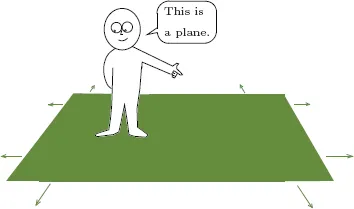
All our action takes place in the plane, and the picture we have in mind is that of an infinite flat perfect surface in space, which has no height.
figure
Thus we can talk about objects in the plane which are flat, and have no height, but do possess breadth and length. We usually won’t bother depicting the plane in our pictures, and it is assumed that the surface of the page of this book is taken as the plane for our geometrical pictures.
A point in the plane is something which has no length or breadth. Imagine making a tiny “dot” on a piece of paper with a pencil. The smaller the dot, the closer it is to representing the geometrical entity of a point in the plane. We will denote points typically by capital letters such as A, P, X, etc. Ideally a point has no “dimensions”, and so it is challenging to depict it. Often we will get around this by showing it as a tiny circle.
figure
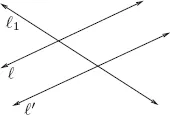
A line is something that has no breadth. We imagine our lines to extend on both sides indefinitely, and usually one denotes this by drawing arrows on both sides. Lines will be denoted by small letters such as , ′, 1 etc.
figure
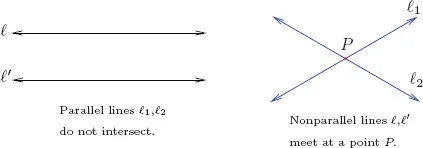
If distinct lines 1, 2 in the plane do not intersect, then they are said to be parallel, and we write 1 || 2. (If 1 = 2, then the two lines are coincident, and strictly speaking, we will consider them parallel too1, although our default stance will be to consider parallel lines as distinct, unless stated otherwise.)
figure
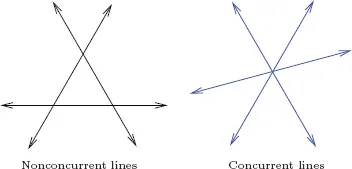
Three or more lines in the plane needn’t have a point in common, but if they do, then we call the set of lines concurrent.
figure
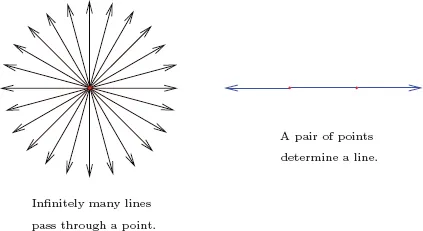
Infinitely many lines pass through any point in the plane, but given two distinct points in the plane, there is a unique line which passes through them. A line passing through distinct points A, B in the plane will be denoted by
figure
figure
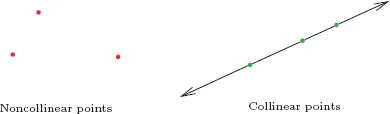
Three or more points in the plane needn’t all lie on a line, but when they do, the set of points are said to be collinear.
figure
A ray is part of a line which extends indefinitely in only one direction. If O is the starting point of the ray, and P is another point on the ray, then we denote the ray by
figure
figure
A line segment is the part of line between two points. We denote the line segment with endpoints A and B by AB or (just as well) by BA. It has finite length, which is measured as a multiple of a fixed, but arbitrarily chosen, “unit length”. Ideally one needs different notation to distinguish between the line segment (a geometrical object) ...

Table of contents

  1. Cover Page
  2. Title
  3. Copyright
  4. Preface
  5. Contents
  6. 1. Geometric figures
  7. 2. Congruent triangles
  8. 3. Quadrilaterals
  9. 4. Similar triangles
  10. 5. Circles
  11. Epilogue
  12. Hints
  13. Solutions
  14. Bibliography
  15. Index