![]()
PART 1
Research
![]()
Chapter 1.1
Materials Aspects of Bi-2223
Jun-ichi Shimoyama
Department of Physics and Mathematics, Aoyama Gakuin University,
5-10-1 Fuchinobe, Chuo-ku, Sagamihara 252-5258, Japan
[email protected] Among a large number of cuprate superconductors, Bi-2223 is one of the well-developed one as superconducting tapes because of its high Tc, chemical stability and many other reasons. In this chapter, characteristic features of Bi-2223 are summarized and its superconducting properties as practical materials are compared with other superconductors. Furthermore, potentials of Bi-2223 materials are discussed from a viewpoint of controlling chemical composition.
1.Introduction
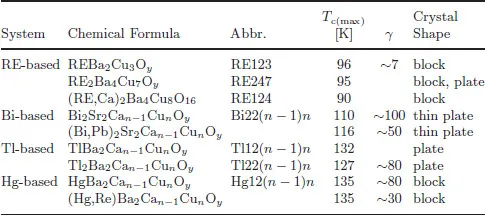
The successive discoveries of cuprate superconductors with high critical temperature Tc up to 135 K in 1986–1993 had opened possibility of applications of superconducting technologies at high temperatures, such as the boiling point of liquid nitrogen 77 K. Although metallic superconductors, such as Nb–Ti, Nb3Sn, and Nb, have been extensively used as wires, tapes, films, and other materials thus far, they are applicable only at very low temperatures, liquid helium temperature 4.2 K or lower, due to their low Tc, which limited application fields of superconducting technologies. In particular, robust cryostats equipped with high performance heat-insulating layers have been always indispensable. Cuprate superconductors, however, have layered crystal structure composed of superconducting and blocking (=non-superconducting) layers, resulting in various anisotropic properties. Characteristic features of superconducting cuprates, which can be synthesized as sintered bulks by solid-state reaction under ambient pressure and/or below 1 MPa, with higher Tc than 90 K are listed in Table 1.
Table 1. High-Tc cuprate superconductors, which can be candidate materials applicable at 77 K.
*γ values are typical values at carrier optimally-doped state.
For practical applications at higher temperature, Hg- and Tl-based superconductors are attractive because of their high Tcs. In fact, developments of superconducting materials had been attempted for these compounds for a decade after their discoveries. However, studies for developing these materials are almost stopped at the present stage, because any advantageous points were not found in critical current properties of their polycrystalline materials compared to those of RE- and Bi-based superconductors. This is partly due to containing highly volatile components at synthesis temperatures, Hg- or Tl-based superconductor, which is considered to deteriorate grain coupling, and poor cleavability, that will be mentioned later. Although, the Bi-based superconductors also contain volatile components, Bi and/or Pb, their equilibrium vapor pressures at synthesis temperature are much lower than those of Hg- and Tl-based superconductors. In addition, the Bi-based superconductors do not contain Ba, while it is included in other high-Tc compounds. Impurity phases and grain boundaries of cuprate superconductors containing Ba as a constituent element are quite sensitive to moisture and carbon dioxide in air even at room temperature, leading to partial decomposition of superconducting phase. In particular, degradation of superconducting grain coupling is fatal for current carrying applications. From this viewpoint, the Bi-based superconductors are desirable for achieving strong grain coupling by the conventional synthesis process for ceramic materials.
2.General Features of Bi-based Superconductors
2.1. Crystal structures of Bi-based superconductors and related physical properties
The ideal chemical compositions of a homologous series of Bi-based superconductors are expressed as Bi2Sr2Can–1CunOy with n = 1, 2, 3, … and these are called as “Bi22(n – 1)n”. Bi-2201 discovered in 19871,2 got less attention due to its low Tc, ~22 K, however, discoveries of Bi-2212 and Bi-22233 had triggered eager studies for development of these materials. Crystal structures of Bi-2212 (n = 2) and Bi-2223 (n = 3) are shown in Fig. 1. As clearly seen, n corresponds to the number of CuO2 planes, which is responsible for high-Tc superconductivity, in their half unit cell. Similar to the other layered cuprate superconductors, crystal structures of the Bi-based superconductors can be regarded as alternate stacking of superconducting layers and blocking layers as illustrated in the right side of Fig. 1. In general, the blocking layer has an important role to appearance of superconductivity by providing sufficient carriers to the CuO2 plane. In the case of the Bi-based superconductors, excess oxygen is located in between double BiO planes. Since the amount of the excess oxygen continuously varies as a function of temperature and partial pressure of oxygen4,5, carrier concentration of the Bi-based superconductors is controlled by post-annealing and/or cooling conditions. Such non-stoichiometric oxygen composition is the common feature of the layered cuprates.
The blocking layer of the Bi-based superconductor consists of a stacking of SrO–BiO–BiO–SrO planes and its thickness is approximately 1.2 nm, which is longer than other cuprate superconductors. In addition, the blocking layer of Bi-based superconductor is almost insulating, resulting in quite large electromagnetic anisotropy in both normal and superconducting states. The electromagnetic anisotropy parameter,
γ, is defined as (
mc∗ /
mab∗)
1/2 ~
Hc2(H//c)/
Hc2(H//ab) =
(
Hc2: upper critical field,
ξ: superconducting coherence length), which is roughly estimated to be 100 for the Bi-based superconductors as shown in
Table 1. Although
γ can be controlled by changing carrier doping levels and element substitution,
γ of the Bi-based superconductors are intrinsically much larger than that of famous cuprate superconductors REBa
2Cu
3O
y (RE123: RE = rare earth elements) with
γ ~7 at carrier optimally-doped state.
ξ in the
ab-plane direction,
ξab, at far below...