![]()
Chapter 1
Sustainable Agriculture
Chinese cabbage infected by Plasmodiophora brassicae was first identified in Changde, China
J. Du, X.W. Luo, J. Peng and L.F. Wu
College of Plant Protection, Hunan Agricultural University, Changsha 410128, China
S.B. Zhang, D.Y. Zhang and Y. Liu
Key Laboratory of Integrate Diseases and Pests Management in Horticultural Crops in
Hunan, Hunan Plant Protection Institute, Changsha 410125, China
E-mail: [email protected]
Z.B. Zhao
Shaoyang University, Shaoyang 422000, China
The pathogen of Chinese cabbage from Changde city, Hunan province, China with swell root was identified as Plasmodiophora brassicae based on symptoms, characteristics of hypnosporangium, and specific PCR detection. The homologous analysis of partial 18S rRNA gene hinted this population may be a novel physiological race of P. brassicae. The clubroot is a serious threaten to many import crops of Cruciferae, and it is difficult to prevent highly infectious, quick spreading, diverse dissemination ways. So the concern on monitoring, taking precaution and preventing should be increasing.
Keywords: Chinese cabbage; Clubroot; Identification; Changde.
1. Introduction
Clubroot, caused by the soil borne obligate parasite Plasmodiophora brassicae Woronin, is a destructive disease of brassica crops, such as Chinese cabbage in many regions of China. Clubroot is general results in a 20%-30% reduction in yields, and over 60% up to whole reduction when it is outbreaking in China (Dixon 2009; Howard et al. 2010). Clubroot was spread by multiple ways, such as soil, infected plant debris. In addition, the hypnosporangium could survive over twenty years and bound in soil and plant debris (Kageyama & Asano 2009; Castlebury & Domier 1998), so it is extremely difficult to prevent (Yang et al. 2009).
Clubroot was first observed in Europe, and till now, was wide spreading over Europe, North America, Japan and several provinces of China, partly because of variety of Cruciferae increasing, growth area enlarging and commercial seeds exchanging (Bulman et al. 2001; Sharma et al. 2011) There was only one publication of certainly damage of Chinese cabbage by clubroot in Changsha city, Hunan province, China in 1990s (Yang et al. 1992). After that, no publications of infection of plant in the Brassicaceae family in Hunan, China were issued.
Suspected clubroot of Chinese cabbage was found in Changde city, Hunan province, China in Aug 2012, and following identification tests were carried out.
2. Materials and Methods
2.1. Sampling
Infected Chinese cabbage was sampling in Aug 2012 in Changde city, Hunan province, China. Two infected and two healthy samples were sampled and stored at 4 °C.
2.2. Morphology of hypnosporangium
Transverse section of swelling root of infected Chinese cabbage was observed in optical microscope (BX13, Olympus, Japan) (Kobelt et al. 2000 & Sharma et al. 2011). Briefly, the root of sampled chinese cabbage was washed and placed in a fixative solution (1:1, 95% acetic acid: 95% ethanol). Samples were cut in transverse sections of 0.5-cm-long root segments from the top 0 to 1cm of the main taproot. The tissue was dehydrated through through an ethanol series and then embedded in paraffin. Cross-sections (6-µm thick) were cut with a microtome, then was observed in optical microscope.
2.3. Specific PCR detection and sequence analysis
Total DNA of root of Chinese cabbage was extracted by TRIzolR reagent according to manufacturer’s inductions (Life Technologies, CA, USA). Specific PCR primers (TC1F: 5’-GTGGTC GAACTTCATTAAATTTGGGCTCTT-3’, TC1R: 5’-TTCACCTACGGAACGTATATGTGCATG TGA-3’ and TC2F: 5’-AAACAACGAGTCAGCT TGAATGCTAGTGTG-3’, TC2R: 5’-CTTTAGT TGTGTTTCGGCTAGGATGGTTCG-3’) was synthesized by BGI Incorporated (Beijing, China) according to previous publication (Rennie et al. 2007). All PCR amplifications were conducted using a StepOne rapid PCR System (Applied Biosystems) in a 20 µL volume containing 0.5 µL template DNA solution, 0.5 µL of each of a 10 mM TC1F/TC1R or TC2F/TC2R, and 10 µL 2×Reaction mix, 1 µL Enzyme mix. Reaction conditions consisted of an initial heat denaturation step at 95 °C for 2 min, followed by 35 cycles of 95 °C for 15 s and 60 °C for 60 s and 72 °C for 1 min, finally with 72 °C for 10 min (Schnerr et al., 2001; Etebu & Osborn, 2010).
The target bands of PCR were sequencing by BGI Incorporated (Beijing, China), and the homology was analyzed by nblast in GenBank (http://blast.ncbi.nlm.nih.gov/).
3. Results and Discussion
3.1. Occurrence area and symptoms
The infected Chinese cabbages were collected from Changde city, Hunan Province, China. There was about 1.5 ha was infected, and no infected samples was found in Chinese cabbage and others crops of brassica in adjacent city with following survey.
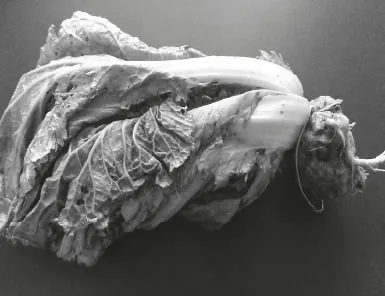
The symptoms of infected Chinese cabbage were shown as Figure 1. There are typical symptoms of clubroot with infected Chinese cabbage, including club-shaped root, and wilting, yellowing of whole plant.
Figure 1. Symptom of infected Chinese cabbage.
3.2. Morphology of hypnosporangium
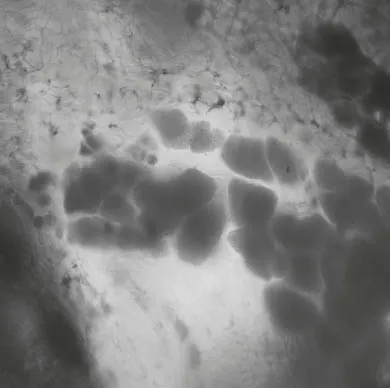
As shown in Figure 2, there are aggregating hypnosporangium in the infected cells of root of Chinese cabbage. And hypnosporangium was circular or approximately circular. It is typical characteristics of hypnosporangium of Plasmodiophora brassicae Woronin (Hwang et al. 2012; Williams 1996).
Figure 2. Characteristics of hypnosporangium in swelling root of infected Chinese cabbage (×100)
3.3. Specific PCR detection
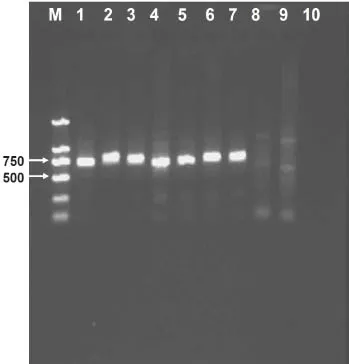
From the infected Chinese cabbage samples, there are special target bands in line with expectations by both specific PCR primers in agarose gel, and not from healthy Chinese cabbage sample (Figure 3). Together with the symptoms (Figure 1) and microscopic hypnosporangium (Figure 2), the pathogen of infected Chinese cabbage sampled from Changde city, Hunan province, China, was identified as Plasmodiophora brassicae Woronin (Cavalier-Smith & Chao 2003). This pathogen could infect most of crops of Cruciferae, and hardly to preventing by conventional fungicides (Cao et al. 2009, Diederichsen et al. 2009), so it is the potential threat to importantly commercial crops of Cruciferae, such as rape, field mustard and Chinese flowering cabbage in Hunan province, China.
Figure 3. Specific PCR detection of infected Chinese cabbage. (M: DL2000 Marker; 1-3: PCR products of infected samples by primer TC1F/TC1R; 4-7: PCR products of infected samples by primer TC2F/TC2R; 8: PCR of healthy Chinese cabbage by primer TC1F/TC1R; 9: PCR of healthy Chinese cabbage by primer TC2F/TC2R; 10: CK)
3.4. Sequence homology
The partial 18S rRNA gene of Plasmodiophora brassicae Woronin of infected Chinese cabbage in Changde city (named as strain CD-1), which amplified by PCR with primer TC1F/TC1R was sequenced (GenBank accessing number: KF129413), and only 92% and 93% homologous to corresponding sequences of P. brassicae isolates from United Kingdom (Ward & Adams 1998) and Switzerland, respectively, 93% homologous to corresponding sequences of isolates from Asia, including Japan (GenBank accessing number: AB0949983 and AB094977) and Korea (GenBank accessing number: AF353998). All of these suggested that the P. brassicae population (strain CD-1) from Changde city, Hunan province, China may be from the different evolutionary origin as those from above districts, and also hints it is possible a novel physiological race. It was well-understanding that there is significant difference of pathogenicity to different crops infected by different physiological races of P. brassicae (Cao et al. 2007, Hwang et al. 2012). Hence, it is of great concern to identify the physiological race and distribution of P. brassicae strain CD-1.
Acknowledgement
This work was supported by the Agriculture Research System of China (CARS-25-B-05).
References
1.Bulman, S. R. Kuhn, S.F. Marshall, J.W. & Schnepf, E. 2001. A phylogenetic analysis of the SSU rRNA from members of the Plasmodiophorida and Phagomyxida. Protist 152: 43-51.
2.Cao, T. Manolii, V.P. Hwang, S.F. Howard, R.J. & Strelkov, S.E. 2009. Virulence and spread of Plasmodiophora brassicae [clubroot] in Alberta, Canada. Canadian Journal of Plant Pathology 31: 321-329.
3.Cao, T.S. Tewari, J & Strelkov, S.E. 2007. Molecular detection of Plasmodiophora brassicae, causal agent of Clubroot of Crucifers, in plant...