![]() Session 1: Nutrition and Food Hygiene
Session 1: Nutrition and Food Hygiene![]()
Research on construction of the quality and safety of agricultural products traceability based on multisided platform-taking beef quality and safety traceability in Xinjiang as an example
Shihong Liu and Tao Ma
Agricultural Information Institute, Chinese Academy of Agricultural Sciences; Agricultural
Information Services Laboratory, Beijing
E-mail: [email protected]
China has carried out of a lot of useful exploration in the quality and safety of agricultural products traceability, and developed a number of management platforms, but there are still many problems, for example supply and demand sides of information asymmetry, transaction costs and risks are too high, poor circulation products and other regulatory agencies and other parties can’t effectively participate. This article from the perspective of the theory of the multisided platforms (MSPs), in the analysis of the important features of the MSPs on the basis of the theory, combined with the quality and safety of agricultural products traceability features, discussed on quality safety of agricultural products traceable method of constructing a multisided platform, particularly designed of the path multi-stakeholder participation, and analyzed its characteristics. It is of great significance for agricultural traceability information sharing to achieve symmetry, reduce transaction costs and risks, and the realization of smooth flow products.
Keywords: Multisided Platform; Traceability; Quality and Safety; Platform Designing
1.Introduction
MSPs theory developed and extended from the bilateral market theory. This is different from traditional markets, which simply analyze the buyer and the seller. MSP is “platform” as the core, and provides a platform for participants to interact with a variety of customer connection to a profit.
Currently, domestic seen in newspapers MSP articles rare, and they are only in the theoretical stage, related article which is positive barely seen. Meanwhile, most of the agricultural markets are the single market, Multisided market almost nothing, bilateral market is also very rare.
China’s agriculture MSP is still in its infancy, there are only a few examples of bilateral platform, such as the Chinese food network, Chinese chili network, and Chinese apple net. However, most of these platforms are for the same merchandise category providing services. In addition many provinces and cities have set up a special website for the local agricultural information, but the functionality of these platforms have significant limitations, Tend to specialize in publishing products [1], and lack of appropriate support services, such as legal advice, professional logistics and distribution, and so on. Most farmers also lack of size, or lack of incentives to participate, and the threshold is too high to registered, they abandon the platform services. Therefore, a successful example of regional units agriculture MSP is rare.
Situation of China’s current agricultural multisided market mainly as follows: First, agricultural products accounted for a large share of the market, but almost no platform; Second, there is no third-party platform to ensure quality; Third, the vast majority of suppliers are individuals and small organizations, few large supply organization; Fourth, there is no single market technical standards, management structure, methods of payment, etc. [2].
Foreign MSP theory developed rapidly. The main reason is that the entity MSP has achieved rapid development in recent years, and the scale expanded rapidly. Most of them have taken the lead in their industry. Successful MSPs create tremendous value by reducing search costs or transaction costs, and achieve dominance by economies of scale [3]. Currently MSPs theory research, mostly focus on information products, IT applications, such as the media industry, terms of credit cards and other payment systems.
2.The Theory of MSPs
2.1.The Theory of MSPs
Through technology, products or services provide direct interaction for two or more customer groups thus create value, this characteristic mainly displays in “cross-side network effects”.
Cross-side network effects (also be known as indirect network effect) is an important characteristic of MSPs, that is, the value which obtained by one of the platform participants expand dramatically along with the surge of other participants. Such as different kinds of electronic commerce. The more buyers they have, the more value sellers will get. However, MSPs has its duality. On the one hand, It is hard to join in the platform when one participant ignore the entrance from the other side. This is the hardest difficulty to overcome. On the other hand, the establishment of such a platform often can obtain high barriers, that is why so many MSPs occupied a great advantage in their respective fields. But the Cross-side network effects cannot serve as a good guarantee to access barriers. The platform, only by charging a certain percentage cost, higher cost to the one who need to transfer can keep high barriers, and resist new competitors. In addition, to serve customer or participant, each marginal transaction cost and the marginal cost will reduce along with the increase of the cost amount. Scale economy is the characteristic of most MSPs, Therefore, The barriers will be heightened obviously by the economies of scale.
2.2.The Conditions of MSPs
If an organization wants to develop itself into platform enterprises, they need to have the following four conditions:
Firstly, they should have an open platform for carrying supply operating entity and demand operating entity.
Secondly, the platform operator must have the ability, resources and money to gather both supply side and demand side or many industry chain parties. In most cases, they can rely on the core value of this opening platform, the core resources, or special policy of this enterprise, they must have one advantage as three mentioned above. But no matter how, strong financial and brand strength is a must.
Thirdly, the platform operator must have a set of scientific operation and management mechanism. This is a complex system to some extent, it is a “virtual government” which corresponds to the real society, but has stronger uncertainty and more emerging affairs.
Finally, the enterprise itself must find a sustainable way to make profit so that to ensure sustainable development of the platform.
2.3.The difference between the MSPs trade framework and traditional trade framework
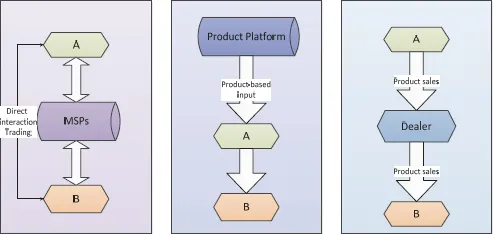
Picture 1 MSPs trade framework and traditional trade framework have fundamental differences (Pic.1). First, in a sense, every party in the platform is a customer of this MSP, the information publishing and sharing right is equal. Second, the MSP can provide the “edge” direct connection. The product platform mode was shown in picture1 (middle) missing the first demand, that is the end user is not the object of product platform service, so the product package which provided by product platform still exist errors to meet end customers’ actual demands. Agency pattern (as shown in picture1the right pattern) is missing the second requirement: both sides have no direct connection, for the product supplier, the demand of the market reaction speed is low, it caused more difficulties to improve product timely according to the need of the end user.
Fig. 1Multisided trading framework platform compared with traditional trading framework
3.Platform Design
3.1.Participants Design
Participants design platform, the platform is the most important issue to establish encountered. In general, participants better. However, increasing the number of participants will also have to coordinate different demands, restrict innovation MSP and other issues. But most of the platform at the beginning will choose as few participants, and then gradually developed, gradually extended to more participants in order for them to provide more services.
In this the “unilateral” to “multisided” process, the most important point is to find a new party (or parties), so that you can, and one that already exists to create a strong indirect network effects. This is primarily in two steps: First, the function first. Identify new participants existing business, we are able to “be served by” providing new services. Second, the benefits first. Benefits in the expansion process of the MSP, the new party must give the existing parties, this can be accepted. For daily trading conditions currently existing “are service groups”, the new service participants, whether to reduce costs and increase revenue. And to strengthen the indirect network effects, such as increased effectiveness and efficiency of existing parties.
Quality and safety of agricultural products traceability MSP of information sharing system using a typical platform model, in the form of membership or alliance will produce suppliers, brokers, consumers, government regulators and other contact advertisers to the platform around the quality and safety of agricultural products traceability system, information sharing principle, to establish a database group. On agricultural information, transaction information, quality information, traceability information, updated in real time by the parties and sharing, increase user viscosity by increasing the frequency of specific measures to deal, firmly dominant MSP, to create a strong cross-network effects.
The original main platform middlemen and suppliers, to ensure orderly service, government regulators must be involved in this transaction. Also, because of the partici...