![]()
Section 1
Classical Gravity and GR Extensions
Accretion disks around a mass with quadrupole
M. Abishev, K. Boshkayev, H. Quevedo and S. Toktarbay*
Physical-Technical Faculty, Al-Farabi Kazakh National Universityr,
Al Farabi av. 71, 050040 Almaty, Kazakhstan
Instituto de Ciencias Nucleares, Universidad Nacional Autónoma de México,
AP 70543, México, DF 04510, Mexico
*E-mail: [email protected]
We consider the stability properties of circular orbits of test particles moving around a mass with quadrupole. We show that the quadrupole modifies drastically the properties of an accretion disk made of such test particles.
Keywords: Quadrupole; compact objects; geodesics.
The simplest generalization of the Schwarzschild metric which contains a quadrupole parameter q is given by
This solution is known as the
δ−metric or as the
γ−metric and was first obtained by Zipoy and Voorhees.
1 We propose to use the term quadrupole metric (
q−metric) to emphasize the role of the parameter
q. The
q−metric is an axially symmetric exact vacuum solution, and reduces to the Schwarzschild metric for
q → 0. It is asymptotically flat with a central curvature singularity at
r = 0 and an outer singularity at
r = 2
m which is naked. According to the Geroch definition, the independent multipole moments are the monopole
M0 =
m(1 +
q) and the quadrupole
. For more details, see
Ref. 2.
As a first approximation, an accretion disk can be considered as a set of test particles moving along circular orbits around the central mass. In this case, the geodesic equations on the equatorial plane are equivalent to the equations for the motion in the effective potential3
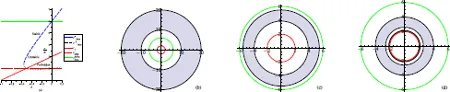
where E and l are constants of motion. The radius and stability properties of circular orbits are completely determined by the behavior of the effective potential which, in turn, depends on the behavior of the first and second radial derivatives. We performed a detailed analysis of the behavior of the effective potential. The result of this study is summarized in Fig. 1. The region of stability determines the spatial region where an accretion disk can exist, and the radius of the last stable circular orbit is interpreted as the minimum inner radius of the disk.
Fig. 1. (a) Radius of the last stable circular orbit as a function of the quadrupole. Below the critical radius rc = m(3 + 2q), no motion is allowed. The outer singularity rsing = 2m is also plotted. Accretion disks are illustrated for positive q in (b), for − 0.5 > q > 0 in (c) and for q = −0.52 in (d).
We see that for positive values of
q the accretion disk is always located outside the Schwarzschild radius of the last stable circular orbit
. For negative values of
q, the disk can be completely inside the radius
. Finally, for values of
q close to −0.5, a second inner disk appears in a region very closed to the outer singularity
rsing = 2
m.
We conclude that the quadrupole parameter can modify drastically the geometric structure of accretion disks. Therefore, it should be possible to determine the value of q from the geometric properties of the disk.
We acknowledge the support through a Grant of the Target Program of the MES of the RK, Grant No. 3101/GF4 IPC-11/2015, DGAPA-UNAM, Grant No. 113514, and Conacyt, Grant No. 166391.
References
1.D. M. Zipoy, J. Math. Phys. 7 (1966) 1137; B. Voorhees, Phys. Rev. D 2 (1970) 2119.
2.H. Quevedo, Int. J. Mod. Phys. D 20, 1779 (2011).
3.K. Boshkayev, E. Gasperin, A.C. Gutierrez-Pineres, H. Quevedo and S. Toktarbay, Motion of test particles in the field of a naked singularity, arXiv: gr-qc/1509.03827.
Orbital stability of the restricted three-body problem in General Relativity
M. Abishev1, H. Quevedo2, S. Toktarbay1* and B. Zhami1
Physical-Technical Faculty, Al-Farabi Kazakh National University,
Al Farabi av. 71, 050040 Almaty, Kazakhstan
Instituto de Ciencias Nucleares, Universidad Nacional Autónoma de México,
AP 70543, México, DF 04510, Mexico
*E-mail: [email protected]
We consider the problem of orbital stability of the motion of a test particle in the restricted three-body problem, by ...