![]()
1
Introduction and guide
The contribution of statistics to business is to be seen everywhere, from risk analysis to big data analytics, from forecasting to process improvement and Six Sigma. Every day managers use reports which include tables, charts, averages and other results of statistical analysis, some simple and some not so simple. Perhaps you just need a useful chart for your PowerPoint presentation.
The main business of statistics is uncertainty and uncertainty is what makes some management decisions difficult. Statistical methods cannot help with all aspects of management uncertainty — will that takeover bid succeed? can we close the deal? — but where uncertainty is due to the variability of output or the availability of only partial information or judgement about some numbers then statistics should be able to help.
Here are two illustrations.
You have to prepare a budget for next year.
The trading company for which you work sells a number of products in different countries.
Some products are in the same sector (tablets, flash drives) but not all (cosmetics, coffee).
The company has not been trading long. It has some data on past sales but it is incomplete.
You rely on the judgement of the product and country managers for sales estimates. They are not always very confident in what they tell you.
Statistical questions: | how to describe the judgemental forecasts and make use of them? what is the effect, if any, of linked sales? can the data we have help? how can uncertainties be combined into a forecast for the company? how should risk be assessed and presented? |
Management questions: | what should be our pricing policy? what to negotiate with our suppliers? should we drop any products and/or introduce new ones? is the risk too high? how can we manage it? |
Are perceptions of our service different in France and in Spain? Informal feedback seems to show they are. If there really is a difference we need to know why. Some market research would be useful but times are tough and we don’t want to waste money on unnecessary surveys.
Statistical questions: | how should data be collected? how big should the samples be? what is the best way of presenting the results? |
Management questions: | what do we do if there is a difference? how big a difference would make it worth doing anything? how sure do we need to be? |
Statistics can make a contribution by quantifying uncertainty which comes from data and judgement. How useful that contribution is depends on how well the management question has been framed and how well the results are presented.
In this book you will find, among other things,
Who should read this book
This book is for managers and management students. Managers are as diverse a group as any other. Some have solid mathematical background and others none. But all manage and so have management problems. Sometimes advice is needed to help decide what to do. Sometimes that advice is statistical.
You have two questions:
You aren’t a statistician but you can probably do more than you think you can. Having made some statistical analyses you have an awareness of what can be done and the confidence to find out what to do.
Your contribution is that you know the business context and enough of the statistics to make the connection.
So the purpose of this book is twofold, to help you make some statistical analyses and to provide some thoughts on that interface between business problems and statistical problems.
Finding what you need
Management problems are often not straightforward. They don’t come pre-labelled.
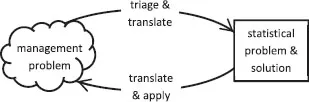
You will have a good idea of what your management problem is but may be less sure of the sort of statistical advice that best fits, or if there is any such advice. Borrowing from emergency medicine call this task triage, deciding where best to get useful advice.
You need to translate from the language of management to the language of statistics: from uncertainty to probability, from variability to variance.
Then make the statistical calculation.
And then translate the result back to the world of your management problem.
This crossing and re-crossing from the manager’s world to the statistical world and back is not trivial and is often the reason why some people find statistics and quantitative methods and the courses that teach them difficult. Once the statistical method is identified it is usually not too hard to make the calculation and provide a statistical answer — the probability is 0.35 — but it may then be hard to decide what this means in practice — the probability is 0.35, so what?
As with any quantitative model a statistical model solves that bit of your problem it can solve and leaves you with the rest. This means that you have to understand enough about the model to decide whether it will give the help you need, or enough to be useful, and then to communicate the result.
statsNotes are designed to help. Organising the material as a hundred or so discrete modules gives you a hundred or so chances to find a match. Some of the units have names which relate to management problems and some relate to statistical method. Not all contain numerical detail. Some are about why and how your management problem might benefit from a little statistical input.
None of the notes is long. This is to encourage you to use them. Each will tell you of other notes you might find helpful to read and will also give some discussion of underlying ideas from both statistics and management.
The motivation is decision support. The quantitative analyses are there to help you decide, not to take the decision for you. This is always important. It is your decision.
The form of the statsNotes
As you flick through this book you will see that what is written is quite dense. Don’t be put off. This is more like a source book. Identify what you need and read around as much as necessary for the job in hand.
Most statsNotes show what to do, then an example of how to do it and then a rationale explaining the context for use and any necessary theoretical points. This is so that you can take what you need quickly. There will also be links to other statsNotes, shown as {B3}, for you to follow as you need or as your curiosity requires.
The design assumption is that you want first to know what to do and then to know the assumptions which justify the recommendation. statsNotes are brief so that you can see at a glance the scope of what is covered and easily pick what you want to read. The shape of a statsNote is
Title helps you find what you need
Recommendation box shows what to do
Example of application
Rationale
why is this a problem?
what is the question?
Therefore: do this
but these are the assumptions
and these are some related issues
Because the statsNotes are compact it is easy for you quickly to scan the page to pick what you want.
It may be that you are pretty sure what you want to do but cannot recall the method. Look at the Recommendation box first.
Or maybe you are one of those people who prefer to know why before you find out how. Read the Rationale section first.
If you are looking for a good fit to your problem you might find it best to first look at the Example. Does that look like your problem?
Not all statsNotes have the same purpose and so they have different structures. Broadly, there are three types:
Perspectives: | an issue with widespread implications
background for recommendations in other notes
Examples {B8, D6} |
Business fit: | a problem from a business point of view
shows how and why a statistical approach can help
Examples {E1, G1} |
Implementation: | how to use a particular statistical model or method
Examples {C1, F10} |
Depending on the purpose of the note some components may not be needed. For example, a Perspectives discussion of a background issue wil...