![]()
| BY ABHIJIT NAG THE NATIONAL BARD There is the public Edwin Thumboo and the private Edwin Thumboo. One writes for the nation, but who is closer to the reader? |
Edwin Thumboo is widely regarded as the unofficial poet laureate of Singapore. “I sing of arms and the man,” begins Virgil in his epic poem, “Aeneid” (as translated by AS Kline). “I sing of Singapore”, may well be the motto of Thumboo. Words must sing, he said, and while his poems can be intimate and personal, his oeuvre is rich in social commentary. Anti-colonialism, nationalism, multiculturalism have all found expression in his works, adding up to an evocative narrative of Singapore.
He is perhaps best known for his poem, “Ulysses by the Merlion”. Published in his eponymous book of poems in 1979, it inspired other poets to write about the Merlion. One couldn’t be a true Singapore poet, it was joked, till one had written about the Merlion.
Thumboo has had a profound influence as a pioneer writer and an academic. “Rib of Earth”, his first book of poems, was published in 1956 when he was a university student. The University of Singapore was among the earliest to begin studies in Commonwealth literature, at his initiative as an academic. His contributions have been acknowledged both at home and abroad. Besides several Singapore awards, the Cultural Medallion winner also received the inaugural SEA Write Award for Asean writers and the Raja Rao Award for his contributions to the literature of the Indian diaspora.
“For me, the language of poetry has to be taut, has to be intense and has to ring,” Thumboo said in an interview with Ronald Klein in 1999. Evening is a perfect example of that — vivid, intense, personal — a poem dedicated to his wife:
The air-con’s goblin hum
Shakes the window’s furtive light.
Outside, our thunders quarrel.
All is familiar, poised.
The scene described is as vivid and intimate as the bedroom in John Donne’s love poems. However, Thumboo could not ignore history being made as Singapore progressed from colonial rule to self-government to full independence. “If you are living in a place like Singapore with so much going on, how can you escape writing about them?” he asked Klein. “I will always write about nation because it is part of my perception,” he said in a later interview with Gwee Li Sui.
The Merlion inspired him for two reasons. Influenced by the Irish poet WB Yeats, he believed mythology had an important role in nation building and the mythical “half beast, half-fish” Merlion was a Singapore icon. It represents the people of Singapore in the poem’s concluding lines:
This lion of the sea,
This image of themselves.
The poem highlights Singapore’s immigrant, multiracial makeup:
Despite unequal ways,
Together they mutate,
Explore the edges of harmony,
Search for a centre;
Have changed their gods,
Kept some memory of their race
In prayer, laughter, the way
Their women dress and greet.
This awareness of Singapore’s ethnic and cultural diversity is part of Thumboo’s multicultural heritage. Born on November 22, 1933, he had an Indian father and a Chinese mother. His father was a schoolteacher from an Anglicised family, but they lived with his mother’s family, who were rich, traditional and Teochew. Living in a big, attap-roofed house on the Mandai foothills, he enjoyed nature, getting wet in the rain, sticking out his tongue to taste the raindrops as a child.
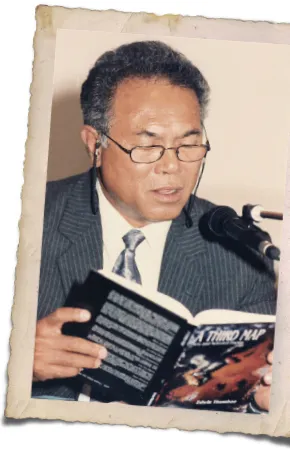
Prof Thumboo reciting a poem at the launch of The Third Map, a collection of his earlier works.
His idyllic childhood shaped him as a poet, but the idyll came to an end with the Japanese Occupation. Uprooted from their home, they moved to Newton and had hard times. They reared pigs, ducks and goats. He had to sell cakes baked by his mother. Later, he worked in a shop. After the war, he went to Victoria School in 1948. That is where he began to write poems. He loved to play with words and began translating Chinese poems with the help of his friends. That inspired him to write his own poems from 1950.
Shamus Frazer, an Oxford-educated English novelist and poet who was teaching at Victoria, became his mentor. He also began mixing in literary circles, meeting teachers, civil servants and others writing in English. “No doubt we were a colony, but we had a distinct middle-class and English-educated way of life,” he reminded Klein.
At the same time, he was a nationalist. At the university, he joined the editorial board of Fajar (Dawn in Malay), a journal published by the University Socialist Club. In May 1954, Fajar published an editorial calling for independence. At that time, Chinese middle school students were clashing with the police over the National Service Ordinance ruling. Thumboo was one of eight university students arrested and tried for sedition. Lee Kuan Yew, who was the club’s legal adviser and a Fajar subscriber, helped them get acquitted.
“Depart white man,” Thumboo wrote in his poem, May 1954, which ends with the lines:
Depart Tom, Dick and Harry,
Gently, with ceremony:
We may still be friends,
Even love you… from a distance.
After graduation, Thumboo worked for the Income Tax Department, the Central Provident Fund Board and briefly at the Singapore Telephone Board before joining the University of Singapore as an assistant lecturer in June 1966. He married his wife Swee Chin in 1963. Thumboo the public poet began to emerge in the second volume, Gods Can Die, published in 1977. This was followed by Ulysses by the Merlion in 1979.
It contained poems like “Island”, about Singapore’s transformation from a thriving colony to an industrial powerhouse.
Aminah, Harun now reside in flats,
Go to school while father
Learns a trade.
Along Shipyard Road,
Not far from Bird Park,
A new song in the air:
Cranes and gantries rise;
Dynamo and diesel hum.
Men in overalls and helmets
Wield machines, consulting plans.
While “Island” celebrates the transformation of Singapore, Thumboo is not blind to what money and politics can do to people. He heaps scorn on the jumped-up, ill-bred executive in “Plush”:
Proud, uncouth, man,
Is this the tapper’s son,
Six years away from Jemaluang
Beneath this slim executive tan?
In Gods Can Die, he takes aim at political opportunists and time-servers:
I have seen powerful men
Undo themselves, keep two realities
One for minor friends, one for the powers that be
Thumboo writes about friendship, politics and change. There is also a love of learning. He has written poems about Victoria School, RELC and the National Library. “Ulysses by the Merlion” is dedicated to Maurice Baker, who taught him at the University of Malaya, and “Fifteen Years After” pays tribute to Shamus Frazer, his earliest mentor. There is also a fascination with words in poems like “Words”, “RELC”, “Language as Power”, “Word as a Linguist”, “Words Loop Again” and “Words for the Day”. Lyrically, he writes about the interaction between poems and the reader in The Poetry Reader:
While by the waters of the Seine, more poems gather.
I read them, they read me.
He can use a marvellous economy of words to surprising effect, painting scenes vividly. As in this description of the immigrant experience in his poem “After the Leaving”:
There are two countries here:
One securely meets the eye,
The other binds your heart.
This is Perth, and yet Malacca.
He is not happy about what the media and the internet are doing to language. In “Muse in Media”, he mourns:
For trade-and-politics are now the hymns.
We lose mysterious richness, marvellous awe
As GATT, MFN… our multiplying acronyms,
Replace redem...