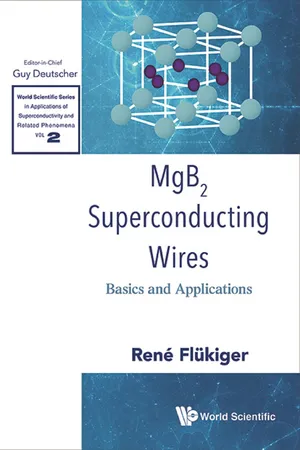
The compendium gives a complete overview of the properties of MgB 2 (Magnesium Diboride), a superconducting compound with a transition temperature of T c = 39K, from the fundamental properties to the fabrication of multifilamentary
eBook - ePub
Mgb2 Superconducting Wires: Basics And Applications
Basics and Applications
- 668 pages
- English
- ePUB (mobile friendly)
- Available on iOS & Android
eBook - ePub
About this book
Information
Subtopic
Science GeneralIndex
Biological SciencesChapter 1
Vortex Matter in the Two-band Superconductor MgB2
Leonardo Civale*,‡ and Adriana Serquis†
*Los Alamos National Laboratory, Los Alamos, NM 87545, USA
†Centro Atómico Bariloche, Bariloche 8400, Argentina
‡[email protected]
The physics of vortex matter in MgB2, the first discovered technologically relevant multiband superconductor (SC), are determined by the parameters of the two gaps and by their coupling. The interplay of the quasi-two-dimensional (2D) σ-band and the almost isotropic π-band results in anomalous and complex behavior of the characteristic lengths and critical fields. The coherence length and penetration depth are magnetic-field dependent, have different T dependence from those in single-band materials, and have different anisotropies. At low T and H the critical currents (Jc) are high and the relaxation rates (S) are low, indicative of large pinning energy. In clean MgB2, as H and T increases, the π-band contribution is strongly suppressed, so Jc decreases and S increases sharply, but C-doping allows maintaining strong pinning up to high fields as needed for applications.
1.Introduction
The subject of this book is the superconducting compound MgB2. Certainly, only a fraction of the hundreds of identified superconductors (SCs) have whole books dedicated to them. What is special about MgB2?
Since the discovery of superconductivity in 1911 until 1973, the highest known transition temperature (Tc) increased from ~4K in Hg to ~23 K in Nb3Ge, at a modest average rate of ~0.3 K/year.1 By then the microscopic origin of superconductivity, based on electron–phonon interactions and described by the extremely successful BCS theory,2 was well understood.3 The general consensus in the early 1980s was that this pairing mechanism was unlikely to produce significantly higher Tc values,4 so superconductivity research (at least from the fundamental science perspective) appeared close to a dead end. Everybody working in the condensed matter and material sciences communities at the time knows how this belief was dramatically shattered by Bednorz and Muller’s discovery in 1986.5 Not only did the highest Tc increase from ~30–164 K (HgBa2Ca2Cu3O8 under pressure) in 1993, at an average rate of ~20 K/year, but the proliferation of whole families of superconducting compounds opened up an unimagined richness of new physics, on top of the potential technological impact.1
By 2001, the field had calmed down significantly, so the discovery of superconductivity6 in MgB2, a simple and well-known binary compound, was a much welcomed surprise. It soon became clear that, in many regards, MgB2 was more similar to conventional low Tc superconductors (LTS) than to the oxide SC (at that time simply called high temperature SCs, or High Temperature Superconductors (HTS)). For one thing, the observation of a significant boron (B) isotope effect7 indicated that superconductivity in MgB2 was phonon–mediated, and strong experimental evidence confirmed the s-wave symmetry of the order parameter.8–14 However, with Tc ~ 39 K, this clearly contradicted the old concept that the Tc of Nb3Ge was close to the upper limit for this mechanism,4 indicating that MgB2 was somehow unique and that it would force us to revise some previously accepted knowledge. The “uniqueness” of MgB2 was reinforced by the fact that, in sharp contrast with the oxides, it was not just the first member of a large new family of SC. The initial hope that isostructural compounds with progressively higher Tc would soon be found did not materialize, only a few other borides and diborides turned out to be superconducting, but with much lower Tc.15 Chemical doping also proved very hard.15
Vortex physics had become a major research field in condensed matter and statistical mechanics since the discovery of the oxide HTS.16 When MgB2 arrived, the vortex matter community knew from the beginning some of the basic questions to ask and had well-developed experimental and theoretical tools to address them, which was certainly not the case in 1986. Do grain boundaries behave as weak links and strongly limit inter-grain critical currents? How large is the anisotropy? Are there vortex liquid phases and melting lines? Are the solid vortex phases crystalline or glassy? What are the dominant pinning centers and mechanisms? Is the vortex dynamics Anderson–Kim (A–K) like or glassy? The previous experience from HTS helped a lot to make fast initial progress. Although overall vortex physics in MgB2 turned out to be closer to LTS than to HTS, there was still another surprise: adding to its uniqueness, it was the first technologically relevant multiband SC.8–14,17,18 As will be discussed below, this resulted in novel vortex behavior.
More recently, iron-based SC were discovered.19 Although they are multiband as MgB2, important differences in the levels of hybridization soon became clear. In addition, they also constitute a huge new family, even larger than the oxides, and exhibit vortex dynamics as fast as the HTS,20 again in sharp contrast with MgB2.
2.Vortex Matter Concepts in Single-band SC
2.1Characteristic lengths and critical fields
In the simplest ...
Table of contents
- Cover
- Halftitle
- Series Editors
- Title
- Copyright
- Contents
- Foreword
- Preface
- List of Contributors
- 1. Vortex Matter in the Two-band Superconductor MgB2
- 2a. Synthesis, Substitutions and Properties of MgB2 Single Crystals
- 2b. Thin Film Deposition and Critical Fields
- 2c. Nanoscale Disorder in MgB2 Thin Films
- 2d. Structure-Property Correlation of MgB2 Wires and Tapes
- 3a. Structure and Properties of Bulk MgB2
- 3b. The Reactive Liquid Infiltration (RLI) Technique for the Bulk Reaction to MgB2
- 4a. Processing of Amorphous Nanosize Boron Powder
- 4b. MgB2 Wires Fabricated Using the Ex Situ Technique
- 4c. MgB2 Wires by In Situ Technique, Mechanical Alloying
- 4d. Pressure Effects on Jc of In Situ and Ex Situ Processed MgB2 Wires
- 4e. Fabrication of MgB2 Wires by Internal Mg Diffusion (IMD)
- 4f. Development and Properties of Advanced Internal Magnesium Infiltration (AIMI) Processed MgB2 Wires
- 5a. Material and Conductor Properties Relevant for Applications: A Fundamental Study
- 5b. AC Losses in MgB2 Wires
- 5c. Effect of Mechanical Load on Jc of MgB2 Wires
- 5d. Properties of Irradiated MgB2, Bulk and Wires
- 6a. MRI Magnets based on MgB2
- 6b. Bulk MgB2 Permanent Magnets
- 6c. Applications for very Fine MgB2 Wires
- 6d. MgB2 Transmission Lines for the Large Hadron Collider
- 6e. Hydrogen Cooled MgB2 Cables
- 6f. Wind Generator Projects based on MgB2 Superconductors
Trusted by 375,005 students
Access to over 1.5 million titles for a fair monthly price.
Study more efficiently using our study tools.
Frequently asked questions
Yes, you can cancel anytime from the Subscription tab in your account settings on the Perlego website. Your subscription will stay active until the end of your current billing period. Learn how to cancel your subscription
No, books cannot be downloaded as external files, such as PDFs, for use outside of Perlego. However, you can download books within the Perlego app for offline reading on mobile or tablet. Learn how to download books offline
Perlego offers two plans: Essential and Complete
- Essential is ideal for learners and professionals who enjoy exploring a wide range of subjects. Access the Essential Library with 800,000+ trusted titles and best-sellers across business, personal growth, and the humanities. Includes unlimited reading time and Standard Read Aloud voice.
- Complete: Perfect for advanced learners and researchers needing full, unrestricted access. Unlock 1.5M+ books across hundreds of subjects, including academic and specialized titles. The Complete Plan also includes advanced features like Premium Read Aloud and Research Assistant.
We are an online textbook subscription service, where you can get access to an entire online library for less than the price of a single book per month. With over 1.5 million books across 990+ topics, we’ve got you covered! Learn about our mission
Look out for the read-aloud symbol on your next book to see if you can listen to it. The read-aloud tool reads text aloud for you, highlighting the text as it is being read. You can pause it, speed it up and slow it down. Learn more about Read Aloud
Yes! You can use the Perlego app on both iOS and Android devices to read anytime, anywhere — even offline. Perfect for commutes or when you’re on the go.
Please note we cannot support devices running on iOS 13 and Android 7 or earlier. Learn more about using the app
Please note we cannot support devices running on iOS 13 and Android 7 or earlier. Learn more about using the app
Yes, you can access Mgb2 Superconducting Wires: Basics And Applications by Ren?? Fl??kiger in PDF and/or ePUB format, as well as other popular books in Biological Sciences & Science General. We have over 1.5 million books available in our catalogue for you to explore.