![]()
CHAPTER 1
INTRODUCTION
1.1.Definitions
•Sustainability — Meeting the needs of today without compromising the ability of future generations to meet their needs.
•Sustainable Design — Applying the principle of sustainability in the design and planning of a project, using less virgin material and less energy; thus causing less pollution and waste.
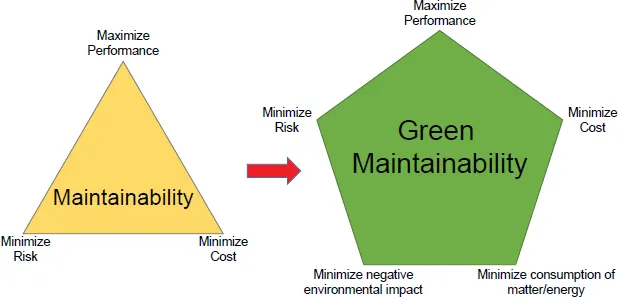
•Maintainability — The ability to achieve the optimum performance throughout the lifespan of a facility within the minimum life cycle cost (LCC) (Fig. 1.1).
•Green FM (Facility Management) — Efficient use of resources with emphasis on environmental consciousness and sustainable practices.
Fig. 1.1. Green Maintainability — sustainable design and maintainability with green FM in mind.
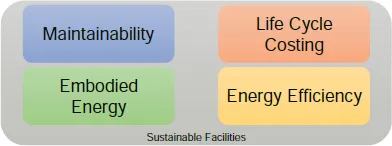
Fig. 1.2. Major research areas of the program.
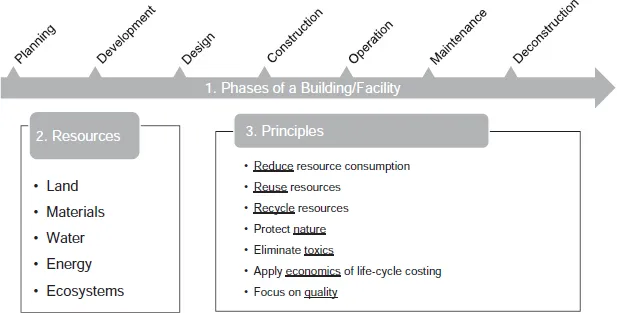
Fig. 1.3. Framework for Green Facilities Management.
Green maintainability refers to sustainable design and maintainability with green facilities management (Green FM) in mind. It requires considerations to maximise the performance, resource and energy efficiency, while minimising the total life cycle cost, embodied energy, environmental impact and consumption of matter/energy throughout the life cycle of a facility, right from the planning/design stage (Fig. 1.1).
Green maintainability incorporates areas in maintainability, LCC, embodied energy, and energy efficiencies (Fig. 1.2), with consideration of matrices of principles and resources for sustainable construction at every phase of the whole facility delivery process (Fig. 1.3).
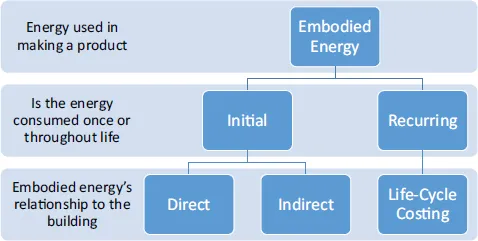
Embodied energy is defined as the commercial energy (fossil fuels, nuclear, etc) that was used in the work to make any product, bring it to market, and dispose of it. It is an accounting methodology which aims to find the sum total of the energy necessary for an entire product lifecycle. This lifecycle includes raw material extraction, transport, manufacture, assembly, installation, disassembly, deconstruction and/or decomposition (Fig. 1.4) [1].
Fig. 1.4. Embodied energy.
The initial embodied energy in buildings represents the non-renewable energy consumed in the acquisition of raw materials, their processing, manufacturing, transportation to site, and construction. This initial embodied energy has two components:
•Direct energy — the energy used to transport building products to the site, and then to construct the building; and
•Indirect energy — the energy used to acquire, process, and manufacture the building materials, including any transportation related to these activities.
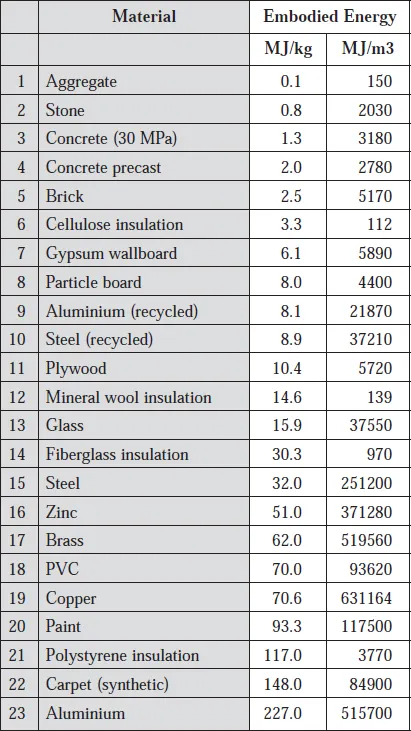
Embodied energy for materials varies from one location to another due to variation in the entire acquisition; manufacturing; transportation and utilisation process. However, a comparative list showing average absolute values can be useful for the selection of materials (Table 1.1).
Materials with high initial embodied energy may have a high percentage of recycled content which require much less energy to recycle than to make them the first time. For example, to recycle aluminium requires only 5% of the energy required to make it the first time (Item 9 vs 23 in Table 1.1).
Table 1.1. Embodied energy (Varies with location) [2].
The recurring embodied energy in buildings represent the non-renewable energy consumed to maintain, repair, restore, refurbish or replace materials, components or systems during the life cycle. The recurring embodied energy is related to the durability of the building materials, components and systems installed in the building, how well these are maintained, and the lifespan of the building [3, 4]. A 'green building' with low initial, but high recurring, embodied energy may not be truly green if it is not designed, constructed, and maintained with due care and understanding of the concept of lifelong maintainability throughout the life cycle of the building. Climate change with adverse impacts ranging from flooding to heat and moisture stresses has made the control of recurring embodied energy ever more difficult globally.
It embraces all stages of the delivery process, from planning, design, detailing, construction, operation, to maintenance and disposal of a facility. It requires a clear understanding of issues associated with durability, serviceability and sustainability for the proper selection of materials, components and systems, as well as the effect of and impact to, the environment.
Initial capital costs and schedules are often given the top priority in most projects, ignoring the fact that the main bulk of the total LCC is attributed to operation and maintenance costs. These high operation and maintenance costs are best minimised right from the planning and design stage (Fig. 1.5).
In the face of challenging maintenance budget, increasing customer expectation and demand for better total building performance, maintainability management has become a significant concern to building owners, developers and facility managers with many organisations developing sustainability policies as an integral part of their Corporate Social Responsibility (CSR) [5, 6]. One of the more impending tasks of the delivery process of a facility is to minimise the rising total facility related cost-in-use and increasing maintenance costs associated with defects arising from design, inferior construction workmanship, maintenance practices and materials’ response to the environment [7–10].
The issue of maintenance management of facilities is a universal one and its consideration at the planning and design stage is of paramount importance on the future performance attributes and its LCC. As modern facilities are designed to meet higher standards, the effect of the decisions made during the planning and design stage would ha...