The aim of this book is to teach undergraduate college or university students, and adults interested in astronomy and astrophysics, the basic mathematics and physics concepts needed to understand the evolution of the universe, and based on this to teac

- 236 pages
- English
- ePUB (mobile friendly)
- Available on iOS & Android
eBook - ePub
Astrophysics and the Evolution of the Universe
About this book
Information
Topic
Physical SciencesSubtopic
Computer Science GeneralChapter 1
Physics Concepts Needed for Astrophysics
In this first chapter, after a brief overview of some basic physics concepts we review the concepts of position, velocity, and acceleration as vectors, needed for the treatment of topics such as the size and rate of expansion of the universe. We then discuss force, Newton’s Law of Motion, and the force of gravity, and review the concept of energy and temperature as a form of energy. As we discuss in later chapters, knowing the temperature of the universe at different times is essential to understand the evolution of the universe. Finally we briefly introduce Dark Energy.
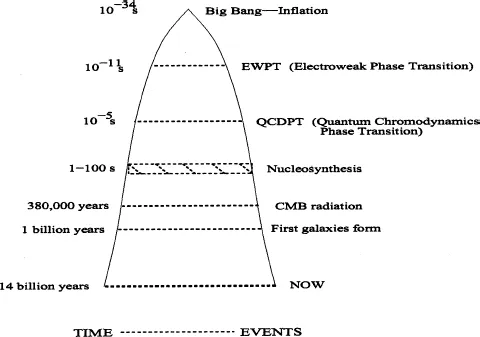
From Big Bang to now.
The figure shows the evolution of the universe from the very early time, when inflation took place, through cosmological phase transitions EWPT (particles got masses) and QCDPT (neutrons and protons form), emitted the Cosmic Microwave Background Radiation (CMBR) from which we learn the constituents of the universe, to the present time with stars and galaxies. We will explore all of these events in this book.
1. Overview of Some Basic Physics Concepts
The basic concepts reviewed in this chapter are treated in greater detail in some textbooks, such as Blatt [1], Halliday and Resnick, or some more recent texts.
1.1. Time, Position, Distance, Velocity, Acceleration, Force, Newton’s Law of Motion, Energy, Temperature
1.1.1. Time = t, Position = r, Distance, Velocity
Calling time = t and position = r, at time = t1 an object is at position r1, and at time t2 at position r2. Let us define the difference in time as ∆t, and the difference between positions as distance:

Velocity = v, speed in one spatial dimension, is the distance an object moves in a time difference divided by the time difference, in the limit as the time difference becomes very small:

That is, v is the rate of change of position with respect to time. As we shall see in the next section, velocity is a vector, with magnitude and direction, and the quantity v = speed is the magnitude of the velocity.
1.1.2. Acceleration, Force, and Newton’s Law of Motion
If v1, v2 are speeds at t1,t2, then acceleration = a is the rate of change of speed with respect to time:

Force = F causes an object to move. That is, it changes its speed. From the definitions above, force causes acceleration.
NEWTON’S LAW OF MOTION: if a force F acts on an object with mass m, then m has acceleration = a, which is

Newton’s Law of Motion, which we study in detail in Section 3, is one of the most important principles in science.
1.1.3. Work and Energy
Work: If a force is exerted on an object and it moves a distance = d, then the force does work = W = force times distance. If work is exerted on a mass m, m gets energy, E, equal to the work:
W = E.
The types of energy are:
| KINETIC ENERGY | = | energy of motion. |
| POTENTIAL ENERGY | = | stored energy. |
| HEAT ENERGY | = | energy of a substance due to its components, such as atoms, moving. A type of internal kinetic energy. |
TEMPERATURE = T of an object is a measurement of its heat energy, with heat energy = kT, where k is Boltzman’s constant. As we shall see in later chapters, T is a very important property when we explore the evolution of the universe.
We shall study energy in detail later in this chapter.
1.2. Units of Time, Distance, Velocity, Acceleration, Force, Energy, Temperature
1.2.1. Powers of Ten
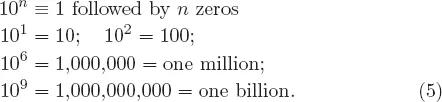
Before we discuss the units, we need to define the powers of ten.
1.2.2. Units of Time, Distance, Velocity, and Acceleration
The unit of time is second = sec = s
| 1 minute | = | 60s |
| 1 hour | = | 60 minutes = 60 × 60 s = 3,600 s = 3.6 × 10³ s |
| 1 year | = | 365 days = 365 × 24 × 3,600 s = 31,536,000 s |
| = | 3.1536 × 10⁷ s ≃ 3.15 × 10⁷ s |
The unit of distance or position i...
Table of contents
- Cover Page
- Title Page
- Copyright
- Contents
- Preface
- Chapter 1. Physics Concepts Needed for Astrophysics
- Chapter 2. Forces and Particles
- Chapter 3. Hubble’s Law: Expansion of the Universe
- Chapter 4. Stars, Galaxies, Etc.
- Chapter 5. Neutrino Oscillations, Symmetries, and Pulsar Kicks
- Chapter 6. Einstein’s Special and General Theories of Relativity
- Chapter 7. Radius and Temperature of the Universe from the General Theory of Relativity
- Chapter 8. Cosmic Microwave Background Radiation (CMBR)
- Chapter 9. Electroweak Phase Transition (EWPT)
- Chapter 10. Quantum Chromodynamic Phase Transition (QCDPT)
- 11. Gravitational Waves
- Solutions to Problems
- Appendix: Vector Calculus and Maxwell’s Equations
- Index
Trusted by 375,005 students
Access to over 1.5 million titles for a fair monthly price.
Study more efficiently using our study tools.
Frequently asked questions
Yes, you can cancel anytime from the Subscription tab in your account settings on the Perlego website. Your subscription will stay active until the end of your current billing period. Learn how to cancel your subscription
No, books cannot be downloaded as external files, such as PDFs, for use outside of Perlego. However, you can download books within the Perlego app for offline reading on mobile or tablet. Learn how to download books offline
Perlego offers two plans: Essential and Complete
- Essential is ideal for learners and professionals who enjoy exploring a wide range of subjects. Access the Essential Library with 800,000+ trusted titles and best-sellers across business, personal growth, and the humanities. Includes unlimited reading time and Standard Read Aloud voice.
- Complete: Perfect for advanced learners and researchers needing full, unrestricted access. Unlock 1.5M+ books across hundreds of subjects, including academic and specialized titles. The Complete Plan also includes advanced features like Premium Read Aloud and Research Assistant.
We are an online textbook subscription service, where you can get access to an entire online library for less than the price of a single book per month. With over 1.5 million books across 990+ topics, we’ve got you covered! Learn about our mission
Look out for the read-aloud symbol on your next book to see if you can listen to it. The read-aloud tool reads text aloud for you, highlighting the text as it is being read. You can pause it, speed it up and slow it down. Learn more about Read Aloud
Yes! You can use the Perlego app on both iOS and Android devices to read anytime, anywhere — even offline. Perfect for commutes or when you’re on the go.
Please note we cannot support devices running on iOS 13 and Android 7 or earlier. Learn more about using the app
Please note we cannot support devices running on iOS 13 and Android 7 or earlier. Learn more about using the app
Yes, you can access Astrophysics and the Evolution of the Universe by Leonard S Kisslinger in PDF and/or ePUB format, as well as other popular books in Physical Sciences & Computer Science General. We have over 1.5 million books available in our catalogue for you to explore.