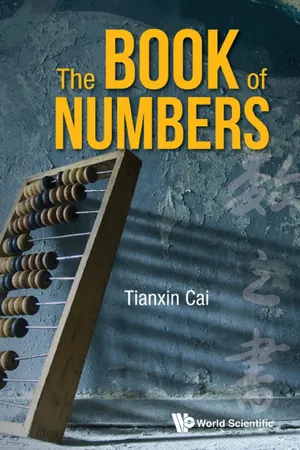
Natural numbers are the oldest human inventions. This volume describes their nature, laws, history and current status. The first five chapters contain not only the basics of elementary number theory for the convenience of teaching and continuity of rea
- 368 pages
- English
- ePUB (mobile friendly)
- Available on iOS & Android
eBook - ePub
Book Of Numbers, The
About this book
Information
Topic
Sciences biologiquesSubtopic
Science généraleChapter VII
Additive and Multiplicative Number Theory
Additive number theory and multiplicative number theory are both important in number theory. Additive number theory is also called Dui Lei Su Shu Lun in Chinese by L.K. Hua (1910–1985), and he published a book with the title. As two branches of number theory, there are a few intersections between them. However, inspired by the form of the abc conjecture, we try to combine the addition and multiplication in Waring’s problem. We obtain a new class of Diophantine equations and some unexpected results. Later, this idea is gradually expanded, involving several classic number theory problems. Now we select six of them to study, including five classical number theory problems, and the last one is the abcd-equation, which is our creation. Recently, the Romanian-born Germany mathematician Preda Mihailescu published a survey article entitled Around ABC (Newsletter of European Math. Soc. 3 (2014) 29–35), and mentioned two of them. In a note he calls this kind of equations yin–yang equations.
31.New Waring’s Problem
In 1770, Lagrange showed (Section 17) that every positive integer can be expressed as a sum of at most four squares of nonnegative integers. The proposition was probably already known to Diophantus, since he gave some examples in his Arithmetic and later it was formally conjectured by the French mathematician and poet Bachet (1581–1638), who is the translator of the Latin version of Arithmetic (1621).
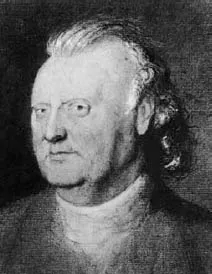
Portrait of English mathematician Waring
In his comments, Fermat claimed (as he did in Fermat’s last theorem) that he had proved this proposition, but no one found it. In the same year that Lagrange gave the proof, the English mathematician Edward Waring (1736–1798) asserted that for every k, there was a number s = s(k) such that every positive integer n can be expressed as a sum of s kth powers of positive integers, i.e.,

In the next 139 years, several special cases of Waring’s problem were solved, for example, k = 3, 4, 5, 6, 7, 8, 10. It was in 1909 that Hilbert finally solved the problem in the affirmative for all k. So Waring’s assertion is also called the Hilbert–Waring theorem. Once we know that...
Table of contents
- Cover
- Halftitle
- Title
- Copyright
- Preface
- Contents
- I. The Division Algorithm
- II. The Concept of Congruence
- III. Congruences
- IV. Quadratic Residues
- V. N th Power Residues
- VI. Congruences Modulo Integer Powers
- VII. Additive and Multiplicative Number Theory
- Appendix A The List of Prime Numbers Less Than 10000
- Bibliography
Trusted by 375,005 students
Access to over 1.5 million titles for a fair monthly price.
Study more efficiently using our study tools.
Frequently asked questions
Yes, you can cancel anytime from the Subscription tab in your account settings on the Perlego website. Your subscription will stay active until the end of your current billing period. Learn how to cancel your subscription
No, books cannot be downloaded as external files, such as PDFs, for use outside of Perlego. However, you can download books within the Perlego app for offline reading on mobile or tablet. Learn how to download books offline
Perlego offers two plans: Essential and Complete
- Essential is ideal for learners and professionals who enjoy exploring a wide range of subjects. Access the Essential Library with 800,000+ trusted titles and best-sellers across business, personal growth, and the humanities. Includes unlimited reading time and Standard Read Aloud voice.
- Complete: Perfect for advanced learners and researchers needing full, unrestricted access. Unlock 1.5M+ books across hundreds of subjects, including academic and specialized titles. The Complete Plan also includes advanced features like Premium Read Aloud and Research Assistant.
We are an online textbook subscription service, where you can get access to an entire online library for less than the price of a single book per month. With over 1.5 million books across 990+ topics, we’ve got you covered! Learn about our mission
Look out for the read-aloud symbol on your next book to see if you can listen to it. The read-aloud tool reads text aloud for you, highlighting the text as it is being read. You can pause it, speed it up and slow it down. Learn more about Read Aloud
Yes! You can use the Perlego app on both iOS and Android devices to read anytime, anywhere — even offline. Perfect for commutes or when you’re on the go.
Please note we cannot support devices running on iOS 13 and Android 7 or earlier. Learn more about using the app
Please note we cannot support devices running on iOS 13 and Android 7 or earlier. Learn more about using the app
Yes, you can access Book Of Numbers, The by Tianxin Cai, Jiu Ding in PDF and/or ePUB format, as well as other popular books in Sciences biologiques & Science générale. We have over 1.5 million books available in our catalogue for you to explore.