This book provides a comprehensive summary of the status of emerging sensor technologies and provides a framework for future advances in the field. Chemical sensors have gained in importance in the past decade for applications that include homeland sec
- 496 pages
- English
- ePUB (mobile friendly)
- Available on iOS & Android
eBook - ePub
Semiconductor-based Sensors
About this book
Information
CHAPTER 1
60-GHz CMOS Micro-radar System-in-package for Noncontact and Noninvasive Measurement of Human Vital Signs and Vibrations
Teyu Kao, Jenshan Lin
Department of Electrical and Computer Engineering
University of Florida
1064 Center Drive, NEB 559, Gainesville, FL 32611-6130
1.1. Introduction
1.1.1. Doppler radar for vital sign and vibration detection
Non-contact vital sign and vibration detections using Doppler radar system have drawn intensive interests over the past decades. Significant progress has been made on improving detection range and accuracy, reducing system size and cost, and exploring various detection targets and applications [1]-[5]. Compared to other detection methods such as laser-based [6] and interferometer [7] sensors, Doppler radar generally has simple architecture implemented by discrete components on printed circuit board (PCB) or integrated circuit (IC), making it a low-cost and low-power solution. Depending on the frequency and power of electromagnetic wave transmitted by the radar, it was also found effective in special environments such as low visibility and through-wall search and detections. A typical Doppler radar system for non-contact detections is shown in Figure 1 where an un-modulated signal T(t) is transmitted with the amplitude normalized to unity:

where f and ϕvco are the frequency and phase noise of the voltage controlled oscillator (VCO). T(t) is reflected and phase modulated by the target displacement x(t) which is chest-wall movement in this case. The baseband output B(t) can be expressed as [8]:

where λ is wavelength of T(t), Gs is defined as the total system gain, and ϕt is total residue phase accumulated in the circuit and transmission path. Assuming x(t) is much smaller than λ and ϕt is odd multiples of π/2, the system shows approximately linear transfer function (optimal detection points). For example, as ϕt = -π/2, B(t) can be simplified by small angle approximation:

As x(t) << λ, the baseband output B(t) is proportional to the target displacement x(t), and it can be sampled by an analog-to-digital convertor (ADC) and performed Fast Fourier Transform (FFT) to obtain frequency domain information such as heartbeat and respiration rates.
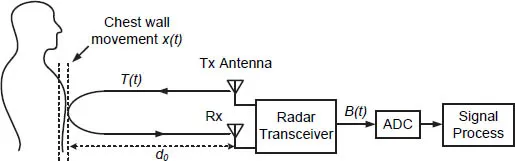
Figure 1. A typical vital sign detection using Doppler radar system.
1.1.2. 60-GHz radar implementation on CMOS
Many successful human heartbeat and respiration detections by Doppler radar systems have been demonstrated at the frequency range from a few to hundreds of GHz [9] [10]. The increase in radar frequency improves the sensitivity to small movement and reduces the circuit component size due to smaller wavelength. As shown in equation (3), the shorter λ in the denominator provides a higher “system demodulation gain” to distinguish small displacement at a longer distance. For instance, a 228-GHz heterodyne radar system reports the detection of vital sign at 50 m away [10]. Ideally the linear system response can track arbitrary movement of x(t) as long as λ is much greater than x(t). Higher radar frequency potentially enables the detection of very small vibration of insects, acoustic devices, micro-electro-mechanical systems (MEMS), and factory equipment for different applications.
The total system gain Gs in equation (2) is usually determined by antenna gains, power loss during the reflection and propagation (distance), and transceiver circuits. In radar design, moving the operating frequency up to millimeter-wave (mm-wave) range theoretically achieves larger radar received power by less antenna area. Generally the antenna gain G increases with frequency for the same antenna effective area Ae [11]:

For a simple flat-plate reflector perpendicular to the line of sight (LOS) at far-field, the radar cross section σ is approximately [12]:

where T is the actual area of the plate. Radar range equation can be used to estimate the received power under far-filed condition for simple analysis:

where Pt and Pr are the transmitted and received power. Gt and Gr are the gain of transmitter (Tx) and receiver (Rx) antennas, and R is the distance between the target and radar. Plugging equations (4) and (5) into equation (6), the received power can be estimated by:

where At and Ar are the effective area of Tx and Rx antennas. The equation shows apparent advantage of short λ if air absorption is negligible in a few meters range. Comparing 6-GHz and 60-GHz radar systems, for example, Pr at 60 GHz is theoretically 102 times higher than that at 6 GHz even if 1/10 area is used for Tx and Rx antennas.
Given the booming growth of modern wireless technology, sub-6-GHz bands are increasingly crowded by various protocols such as Bluetooth, Wi-Fi, and LTE. Next generation of cellular network (5G), for example, is expected to move to mm-wave frequencies for wider available bandwidth and less interference. Similarly the researches on Doppler radar for biomedical, security, and other daily applications have been exploring higher frequencies such as Ka band [3] [13] and 60-GHz unlicensed band [14] for higher detection resolution (shorter λ) and less chance of interfering with other wireless products. Design challenges including loss, noise, and transistor performances at higher frequencies need to be overcome by more accurate electromagnetic modeling, proper circuit architecture, and compact system integration.
Doppler radar system can be implemented by discrete components on PCB [3] or instrument level for testing and proof of concepts [9]. Compared to the board level implementation, SoC (system-on-chip) or SiP (system-in-package) are desired in terms of cost and system integration. Traditionally for IC operating above tens of GHz, III-V compound semiconductor (GaAs) and SiGe heterojunction bipolar transistors (HBT) process are adopted for its superior high-frequency performance. For example, the unity-current-gain frequency (fT) / power-gain cutoff frequency (fMAX) of a HBT can reach around 200/300 GHz in 130-nm process. Several single-chip Doppler radar systems are implemented on SiGe based processes to achieve high conversion gain and better noise performance [5] [15].
Nowadays the economies-of-scale of complementary-symmetry metal-oxide-semiconductor (CMOS) technology with the ability to integrate other circuits on the same die makes it a very low-cost and appealing IC platform. Single-chip Doppler radar transceivers on CMOS have been successfully developed for non-contact vital sign detection [2] [16] [17] in sub-6-GHz frequencies. Attributing to the improved transistor performance in scaled CMOS, fT / fMAX reaches about 120/150 GHz in 90-nm process and 200/300 GHz in 45-nm process, and the same trend is expected in more advanced CMOS technologies [18]. Increasing number of works on mm-wave CMOS circuits and systems have been reported for wireless communication, radar, and imaging [19]-[21]. The work in this chapter introduces the first CMOS Doppler radar chip targeting 60-GHz unlicensed band, and it is fully integrated with antennas to demonstrate a low-cost SiP. System architecture, component design considerations, and experiment results will be presented in the following sessions.
1.2. CMOS Radar Chip Design and Fabrication
1.2.1. System consideration
Doppl...
Table of contents
- Cover
- Halftitle
- Title
- Copyright
- Contents
- Preface
- 1. 60-GHz CMOS Micro-radar System-in-package for Noncontact and Noninvasive Measurement of Human Vital Signs and Vibrations
- 2. Biomimetic Fractal Nanometals As A Transducer Layer in Electrochemical Biosensing
- 3. Carbon Nanodots for Sensor Applications
- 4. Rapid Detection of Biotoxin and Pathogen, and Quick Identification of Ligand-Receptor Binding Affinity Using AlGaN/GaN High Electron Mobility Transistors
- 5. Stability and Reliability of III-Nitride Based Biosensors
- 6. GaN-Based Hydrogen Sensors
- 7. Graphene-based Chemical Sensors
- 8. Electronic Micro-Sensors for Metabolite Detection Based on Conductivity Change of Polyaniline
- 9. ZnO Nanorod Based Sensors
- 10. Scalable Nanomanufacturing of Broadband Antireflection Coatings on Semiconductors
- 11. Breath biomarker Detection by Chemical Sensors
- 12. Gallium Nitride Microelectronics for High-Temperature Environments
- 13. Emerging Nanotechnology for Strain Gauge Sensor
- Index
Trusted by 375,005 students
Access to over 1.5 million titles for a fair monthly price.
Study more efficiently using our study tools.
Frequently asked questions
Yes, you can cancel anytime from the Subscription tab in your account settings on the Perlego website. Your subscription will stay active until the end of your current billing period. Learn how to cancel your subscription
No, books cannot be downloaded as external files, such as PDFs, for use outside of Perlego. However, you can download books within the Perlego app for offline reading on mobile or tablet. Learn how to download books offline
Perlego offers two plans: Essential and Complete
- Essential is ideal for learners and professionals who enjoy exploring a wide range of subjects. Access the Essential Library with 800,000+ trusted titles and best-sellers across business, personal growth, and the humanities. Includes unlimited reading time and Standard Read Aloud voice.
- Complete: Perfect for advanced learners and researchers needing full, unrestricted access. Unlock 1.5M+ books across hundreds of subjects, including academic and specialized titles. The Complete Plan also includes advanced features like Premium Read Aloud and Research Assistant.
We are an online textbook subscription service, where you can get access to an entire online library for less than the price of a single book per month. With over 1.5 million books across 990+ topics, we’ve got you covered! Learn about our mission
Look out for the read-aloud symbol on your next book to see if you can listen to it. The read-aloud tool reads text aloud for you, highlighting the text as it is being read. You can pause it, speed it up and slow it down. Learn more about Read Aloud
Yes! You can use the Perlego app on both iOS and Android devices to read anytime, anywhere — even offline. Perfect for commutes or when you’re on the go.
Please note we cannot support devices running on iOS 13 and Android 7 or earlier. Learn more about using the app
Please note we cannot support devices running on iOS 13 and Android 7 or earlier. Learn more about using the app
Yes, you can access Semiconductor-based Sensors by Fan Ren, Stephen J Pearton in PDF and/or ePUB format, as well as other popular books in Physical Sciences & Chemistry. We have over 1.5 million books available in our catalogue for you to explore.