The 1882 paper by the mathematical physicist Gustav Robert Kirchhoff on diffraction theory is still being discussed to this day, but has never been translated into English. This volume contains the first English translation of the Kirchhoff treatise, a
eBook - ePub
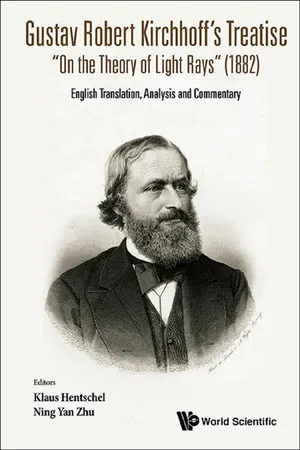
Gustav Robert Kirchhoff's Treatise "On The Theory Of Light Rays" (1882): English Translation, Analysis And Commentary
English Translation, Analysis and Commentary
- 168 pages
- English
- ePUB (mobile friendly)
- Available on iOS & Android
eBook - ePub
Gustav Robert Kirchhoff's Treatise "On The Theory Of Light Rays" (1882): English Translation, Analysis And Commentary
English Translation, Analysis and Commentary
About this book
Information
Topic
Physical SciencesSubtopic
Science HistoryKirchhoff’s Theory for Optical Diffraction, Its Predecessor and Subsequent Development: The Resilience of an Inconsistent Theory, by Jed Z. Buchwald (Caltech) and Chen-Pang Yeang (Univ. of Toronto)
Abstract
Kirchhoff’s 1882 theory of optical diffraction forms the centerpiece in the long-term development of wave optics, one that commenced in the 1820s when Fresnel produced an empirically successful theory based on a reinterpretation of Huygens’ principle, but without working from a wave equation. Then, in 1856, Stokes demonstrated that the principle was derivable from such an equation albeit without consideration of boundary conditions. Kirchhoff’s work a quarter century later marked a crucial, and widely influential, point for he produced Fresnel’s results by means of Green’s theorem and function under specific boundary conditions. In the late 1880s, Poincaré uncovered an inconsistency between Kirchhoff’s conditions and his solution, one that seemed to imply that waves should not exist at all. Researchers nevertheless continued to use Kirchhoff’s theory — even though Rayleigh, and much later Sommerfeld, developed a different and mathematically consistent formulation, which, however, did not match experimental data better than Kirchhoff’s theory. After all, Kirchhoff’s formula worked quite well in a specific approximation regime. Finally, in 1966 Marchand and Wolf employed the transformation of Kirchhoff’s surface integral that had been developed by Maggi and Rubinowicz for other purposes. The result yielded a consistent boundary condition that, while introducing a species of discontinuity, nevertheless rescued the essential structure of Kirchhoff’s original formulation from Poincaré’s paradox.
1.Introduction
On 22 June 1882, the University of Berlin’s professor of theoretical physics, Gustav Robert Kirchhoff (1824–1887), read an influential paper titled “Zur Theorie der Lichtstrahlen” (“On the theory of light rays”) to a meeting of the Prussian Academy of Sciences in Berlin. The purpose of the paper was to deduce from the wave equation the expression governing the diffraction of light by an aperture on an otherwise opaque screen. To do so Kirchhoff assumed a particular set of boundary conditions: namely, that both the amplitude of the disturbance as well as its spatial gradient vanished on the screen, but that they remained unaltered over the aperture itself.1 He was in this way able to generate a solution for scalar diffraction that could yield the empirically-successful (so far as was then known) expression that Augustin Fresnel (1788–1827) had produced six decades before using an altogether different line of argument (on which more below). Despite its frequent presence in physicists’ and engineers’ publications, Kirchhoff’s theory of diffraction has not until recently attracted the attention of physics (or mathematics) historians for understandable reasons: historical focus has principally aimed at episodes in 19th century optics and electromagnetism that brought either fundamental changes — e.g. the wave theory of light, electromagnetic field theory, kinetic theory and statistical mechanics — or influential technological breakthroughs — e.g. Hertz’s production of electric waves and the subsequent invention of wireless telegraphy. Kirchhoff’s theory fits neither criterion. It did not introduce any novel physical entities or mechanisms beyond what wave optics had stipulated; nor did it lead to technological innovation. It nicely fits, one might say, Thomas Kuhn’s conception of “normal science”, in which practitioners solve problems that arise within a given system without violating its fundamental boundaries.2
Although Kirchhoff’s theory did not have significant ontological or technological implications, it nonetheless raised important questions concerning the use of mathematics in theoretical physics. What made the theory interesting in subsequent years is the mathematical inconsistency of the boundary conditions that were used. So far as was known at the time, however, his solution worked quite well empirically, and Kirchhoff himself never remarked the inconsistency. Decades after the French mathematician Henri Poincaré (1854–1912) published a deleterious consequence of the inconsistency in 1892,3 the theory nevertheless continued to appear in major textbooks and research periodicals in optics and electromagnetism. Physicists and engineers treated it not as an antiquated and inconsistent effort to derive empirically workable results, but as a good enough working model, for Kirchhoff’s solution nicely fit both optical and microwave experimental data under particular, but commonly applicable, conditions. Indeed, physicists’ and engineers’ interest in, and use of, Kirchhoff’s theory has certainly not waned over the decades.4
The persistent deployment of an apparently inconsistent theory even after recognition of its flaws is not unique in the history of physics. The infamous divergence of the quantum field integrals in self-energy calculations in quantum electrodynamics (QED) and physicists’ various ad-hoc manipulations to bypass the problem before the introduction of renormalization provides one noteworthy example.5 Another concerns early 20th-century Cambridge mathematicians’ continued use of circulatory theory to explain airfoil lifting despite a salient contradiction — namely, d’Alembert’s paradox, according to which there should be no lift at all in a perfect fluid — that had been well known for centuries.6 In these cases, a major reason for the tenacity of an admittedly problematic theory was essentially pragmatic: the physical-mathematical problem was simply too complex, and no comparable alternative was available at the time.
Despite the similarities, Kirchhoff’s account of diffraction differed in one essential respect from these two examples that makes this situation particularly compelling. In the first decades of the twentieth century, Lord Rayleigh (1842–1919) and Arnold Sommerfeld (1868–1951) derived different solutions to the same diffraction problem under a set of consistent boundary conditions. Unlike the cases of QED before renormalization and the circulatory theory of airfoil lifting in the early twentieth century, therefore, a mathematically consistent alternative was in fact available. Yet the existence of a seemingly more appealing and logical alternative did not eliminate or marginalize Kirchhoff’s theory. This mathematically inconsistent (and physically untenable) solution has continued to appear and thrive in textbooks and periodicals as the standard approach to the problem of diffraction. Why, one may ask, did scientists continue to stay with Kirchhoff’s theory despite the presence of a consistent alternative?
Recently, several historians and philosophers have begun to pay closer attention to this curious episode.7 These studies deepen our understanding of conceptual and technical aspects of Kirchhoff’s theory and help us clarify its philosophical implic...
Table of contents
- Cover
- Halftitle
- Title Page
- Copyright
- Editor’s Foreword
- Contents
- List of Figures
- Biographical Introduction, by Klaus Hentschel
- Commentary on Kirchhoff’s Theory of Diffraction, by Ning Yan Zhu
- Gustav Robert Kirchhoff: On the Theory of Light Rays
- Kirchhoff’s Theory for Optical Diffraction, by Jed Z. Buchwald and Chen-Pang Yeang
- Why Kirchhoff’s Approximation Works, by Peter Vickers
- A Brief Bibliometric Analysis by Werner Marx
- Name Index
Trusted by 375,005 students
Access to over 1.5 million titles for a fair monthly price.
Study more efficiently using our study tools.
Frequently asked questions
Yes, you can cancel anytime from the Subscription tab in your account settings on the Perlego website. Your subscription will stay active until the end of your current billing period. Learn how to cancel your subscription
No, books cannot be downloaded as external files, such as PDFs, for use outside of Perlego. However, you can download books within the Perlego app for offline reading on mobile or tablet. Learn how to download books offline
Perlego offers two plans: Essential and Complete
- Essential is ideal for learners and professionals who enjoy exploring a wide range of subjects. Access the Essential Library with 800,000+ trusted titles and best-sellers across business, personal growth, and the humanities. Includes unlimited reading time and Standard Read Aloud voice.
- Complete: Perfect for advanced learners and researchers needing full, unrestricted access. Unlock 1.5M+ books across hundreds of subjects, including academic and specialized titles. The Complete Plan also includes advanced features like Premium Read Aloud and Research Assistant.
We are an online textbook subscription service, where you can get access to an entire online library for less than the price of a single book per month. With over 1.5 million books across 990+ topics, we’ve got you covered! Learn about our mission
Look out for the read-aloud symbol on your next book to see if you can listen to it. The read-aloud tool reads text aloud for you, highlighting the text as it is being read. You can pause it, speed it up and slow it down. Learn more about Read Aloud
Yes! You can use the Perlego app on both iOS and Android devices to read anytime, anywhere — even offline. Perfect for commutes or when you’re on the go.
Please note we cannot support devices running on iOS 13 and Android 7 or earlier. Learn more about using the app
Please note we cannot support devices running on iOS 13 and Android 7 or earlier. Learn more about using the app
Yes, you can access Gustav Robert Kirchhoff's Treatise "On The Theory Of Light Rays" (1882): English Translation, Analysis And Commentary by Klaus Hentschel, Ning Yan Zhu in PDF and/or ePUB format, as well as other popular books in Physical Sciences & Science History. We have over 1.5 million books available in our catalogue for you to explore.