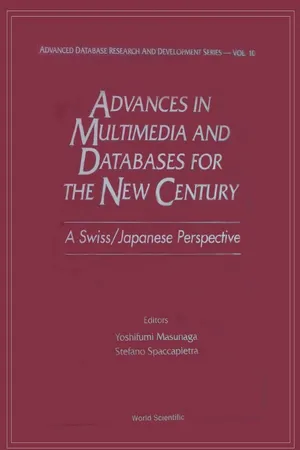
This Switzerland-Japan Joint Seminar on Multimedia and Databases was held to achieve at least three goals. First, it enabled us to present and discuss our recent research results and exchange our ideas for further promotion of science and technology. The second goal was to establish a friendly relationship between the Swiss and the Japanese. The last, but not least, aim was to disseminate information about our plans by publishing the proceedings of this seminar. We thought that publishing the outcome of the seminar would be essential in order not to store the treasure — the seminar results — secretly.
eBook - PDF
Advances In Multimedia & Databases For The New Century - A Swiss/japanese Perspective
- 225 pages
- English
- PDF
- Available on iOS & Android
eBook - PDF
Advances In Multimedia & Databases For The New Century - A Swiss/japanese Perspective
About this book
Information
Table of contents
- Preface
- Contents
- Distance Learning
- Interoperability and flexible interactive document design for distant learning
- Implementation of Review Functions for Lecture Recordsin VIEW Classroom
- Data and Process Design
- Information System integration with the static and dynamic aspects
- Workflow Modeling from a Database Point of View
- Storage Architecture
- Mass Archiving of Multimedia Data
- High performance parallel association rule mining and its dynamic load balancingmechanism over homo/heterogeneous PC cluster system
- Virtual Reality and Databases
- Database and Virtual Human Representation on the WEB
- The Virtual World Database System— Its Concept, Design, and Prototyping
- Augmented/Restricted Reality Hypermedia Systemsbased on Spatial Databases
- Temporal Databases
- A Framework for CharacterizingSpatio-Temporal Data Models
- Enhancing Databases by Introducing Spatial Data Types forNon-Geographical Applications
- Integration Issues
- All Together NowTowards Integrating the World's Information Systems
- Integration of Heterogeneous Information Sources in InfoWeaver
- Information Systems Infrastructure
- Higher Order Databases and Multimedia Information*
- Part I: Higher Order Databases
- 1. Introduction
- 2. Higher Order Databases
- 2.1. What is a Higher Order Database?
- 2.2. DBHO as middleware
- 2.3. DBHO Research
- Part II: Multimedia Information
- 3. Design Considerations of a Distributed,component-based architecture
- 3.1. Autonomy
- 3.2. Extensibility by Specialized Components
- 3.3. Coordination
- 3.4. Replication and Parallelization
- 4. Specialized Components
- 4.1. Image Servers
- 4.2. Feature Extraction Services
- 4.3. Index Service
- 4.4. A Short Overview of the VA-File
- 4.5. Coordinator
- 5. Coordinating Higher-Order Processes
- 5.1. Examples of Transactional Processes
- 5.2. Transactional Process Management
- 6. Parallelization and Replication
- 6.1. Ressource Management for Preprocessing
- 6.2. Parallelization of NN-Search
- 7. Implementation Status and Evaluation
- 7.1. Status of Components
- 7.2. Status of the Image database
- 7.3. Benefits of Parallel Feature Extraction
- 7.4. Benefits of Parallel NN-Search
- 8. Conclusions
- Acknowledgments.
- References
- A Metadatabase System Architecturefor Integrating Heterogeneous Databaseswith Temporal and Spatial Operations
- 1 Introduction
- 2 The meta-level system architecture
- 2.1 Uniformly formalizing all underlyingintegration systems in the meta-levelsystem
- 2.2 Combining underlying integrationsystems in the meta-level system.
- 2.3 Transforming data representationsand controlling data grains among heterogeneouslegacy databases.
- 3 Functions for computing semanticalequality and similarity
- 3.1 Mathematical Model of Meaning
- 3.2 Basic functions for computing semanticalrelationships
- 3.2 Basic functions for computing semanticalrelationships
- 4 The system structure
- 5 Conclusion
- References
- Web Database Architecture and Interfaces
- Client-Server Database Architectures for the Web
- 1, Introduction
- 2. OMS Object-Oriented Database Systems
- 3. Internet OMS
- 4. OMS Personal Web Assistant
- 5. Web-Based OMS Database Developer
- 6. Client-Side Databases
- 7. Conclusions
- References
- Access Control and Views in Web Data Management
- 1. Introduction
- 2. As-Much-As-Allowed Access Control andViews for Web
- 2.2. An Example
- 3. Navigation-Dependent Web Views: Link Activationby User Navigation
- 3.1. Link Activation
- 3.2. Complementation of Information Using LinkActivation Statements
- 4. TV-Program Views of Web Data
- 5. Concluding Remarks
- Acknowledgements
- References
- Identification of Query Result Subdocumentsand Reverse Indices in XML Databases
- 1 Introduction
- 2 XML and XML trees
- 3 Identification of query result subdocuments
- 4 NRP-PAT Index
- 5 Conclusion
- References
- Observer's Paper Contribution
- Credibility of Data in World Wide Web
- 1. Introduction
- 2. Evaluation Criteria
- 2.1 Accuracy
- 2.2 Objectivity
- 2. 3 Coverage
- 2.4 Authority
- 2.5 Currency
- 2.6 Search Engines
- 2.7 Hypertext Links and Frames
- 2.8 Ownership Evaluation
- 2.8 Data presentation on the web page
- 2.9 Uniqueness
- 2.10 Reviews
- 2.11 Searching for data within a site
- 3. Methods for ensuring credibility of data inWWW
- 3.1 "Last update" method
- 3.2 "Majority basis" method
- 3.3 "Polling" Method
- 3.4 "Query-driven11 method
- 3.5 Information Retrieval via search engines
- 4. Conclusions and Future work
- Acknowledgement
- References
- A New Visual Approach for Effective Hypertext Retrieval
- 1 Introduction
- 1.1 Background
- 1.2 Overview of Visual Web Browser
- 2 The graph model
- Visual Web Browser architecture
- 4 A fast accessible linkage server
- 5 Information Altering
- 6 On-line animated visualizer
- 7 Remarks
- References
- Author Index
Trusted by 375,005 students
Access to over 1.5 million titles for a fair monthly price.
Study more efficiently using our study tools.
Frequently asked questions
Yes, you can cancel anytime from the Subscription tab in your account settings on the Perlego website. Your subscription will stay active until the end of your current billing period. Learn how to cancel your subscription
No, books cannot be downloaded as external files, such as PDFs, for use outside of Perlego. However, you can download books within the Perlego app for offline reading on mobile or tablet. Learn how to download books offline
Perlego offers two plans: Essential and Complete
- Essential is ideal for learners and professionals who enjoy exploring a wide range of subjects. Access the Essential Library with 800,000+ trusted titles and best-sellers across business, personal growth, and the humanities. Includes unlimited reading time and Standard Read Aloud voice.
- Complete: Perfect for advanced learners and researchers needing full, unrestricted access. Unlock 1.5M+ books across hundreds of subjects, including academic and specialized titles. The Complete Plan also includes advanced features like Premium Read Aloud and Research Assistant.
We are an online textbook subscription service, where you can get access to an entire online library for less than the price of a single book per month. With over 1.5 million books across 990+ topics, we’ve got you covered! Learn about our mission
Look out for the read-aloud symbol on your next book to see if you can listen to it. The read-aloud tool reads text aloud for you, highlighting the text as it is being read. You can pause it, speed it up and slow it down. Learn more about Read Aloud
Yes! You can use the Perlego app on both iOS and Android devices to read anytime, anywhere — even offline. Perfect for commutes or when you’re on the go.
Please note we cannot support devices running on iOS 13 and Android 7 or earlier. Learn more about using the app
Please note we cannot support devices running on iOS 13 and Android 7 or earlier. Learn more about using the app
Yes, you can access Advances In Multimedia & Databases For The New Century - A Swiss/japanese Perspective by Yoshifumi Masunaga, Stefano Spaccapietra in PDF and/or ePUB format, as well as other popular books in Computer Science & Information Technology. We have over 1.5 million books available in our catalogue for you to explore.