Probability and Expectation
eBook - ePub

Probability and Expectation

  1. 208 pages
  2. English
  3. ePUB (mobile friendly)
  4. Available on iOS & Android
eBook - ePub

Probability and Expectation

About this book

In China, lots of excellent students who are good at maths take an active part in various maths contests and the best six senior high school students will be selected to form the IMO National Team to compete in the International Mathematical Olympiad. In the past ten years China's IMO Team has achieved outstanding results — they have won the first place almost every year.

The author is one of the senior coaches of China's IMO National Team, whose students have won many gold medals many times in IMO.

This book is part of the Mathematical Olympiad Series which discusses several aspects related to maths contests, such as algebra, number theory, combinatorics, graph theory and geometry. This book will, in an interesting problem-solving way, explain what probability theory is: its concepts, methods and meanings; particularly, two important concepts — probability and mathematical expectation (briefly expectation) — are emphasized. It consists of 65 problems, appended by 107 exercises and their answers.

Frequently asked questions

Yes, you can cancel anytime from the Subscription tab in your account settings on the Perlego website. Your subscription will stay active until the end of your current billing period. Learn how to cancel your subscription.
No, books cannot be downloaded as external files, such as PDFs, for use outside of Perlego. However, you can download books within the Perlego app for offline reading on mobile or tablet. Learn more here.
Perlego offers two plans: Essential and Complete
  • Essential is ideal for learners and professionals who enjoy exploring a wide range of subjects. Access the Essential Library with 800,000+ trusted titles and best-sellers across business, personal growth, and the humanities. Includes unlimited reading time and Standard Read Aloud voice.
  • Complete: Perfect for advanced learners and researchers needing full, unrestricted access. Unlock 1.4M+ books across hundreds of subjects, including academic and specialized titles. The Complete Plan also includes advanced features like Premium Read Aloud and Research Assistant.
Both plans are available with monthly, semester, or annual billing cycles.
We are an online textbook subscription service, where you can get access to an entire online library for less than the price of a single book per month. With over 1 million books across 1000+ topics, we’ve got you covered! Learn more here.
Look out for the read-aloud symbol on your next book to see if you can listen to it. The read-aloud tool reads text aloud for you, highlighting the text as it is being read. You can pause it, speed it up and slow it down. Learn more here.
Yes! You can use the Perlego app on both iOS or Android devices to read anytime, anywhere — even offline. Perfect for commutes or when you’re on the go.
Please note we cannot support devices running on iOS 13 and Android 7 or earlier. Learn more about using the app.
Yes, you can access Probability and Expectation by Zun Shan, Shanping Wang;;; in PDF and/or ePUB format, as well as other popular books in Mathematics & Mathematics General. We have over one million books available in our catalogue for you to explore.

Information

1.Coin Tossing

The first round of 2004 Europe Soccer Cup is Greece versus Portugal. At the beginning of the game, the referee let the two team captains come up and asked them to decide who should guess the result of coin tossing. Then he took out a coin and tossed it into the air. The result is the head side faced up on the ground, which is in accordance with what the Greece team captain had guessed. Therefore, the captain decided which goal his team will attack in the first half of the match. The game ended with a surprising result that Greece defeated Portugal by 2 : 1.
Assuming that the coin is made evenly, therefore, when it reaches the ground, the chance of the head side up and that of the tail side up are the same, i.e. half to half, or both is equal to
image
.
The “chance” mentioned above is called “probability” in mathematics.
Suppose there are n possible results in an experiment, and the occurrence probability of each result is the same; if among them there are m results belonging to event A, then we say the probability of A is
image
, expressed as P(A) =
image
, where P(A) denotes the probability of A.
For example, when tossing a coin, there are two possible results: the head side up (denoted by A) and the tail side up (denoted by B). So n = 2, and
image
Now tossing a coin three times, please find
(1) the probability that the head side occurs just once, and
(2) the probability that the head side occurs at least once.
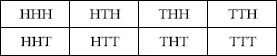
Solution: (1) When tossing a coin three times, there are 8 possible results, as shown below,
image
(H = the head side up, and T = the tail side up). Among them there are 3 results belonging to the event “the head side occurs just once”, so the required probability is
image
.
In general, tossing a coin n times will produce 2n possible results, among which there are
image
results belonging to the event “the head side up occurs k times exactly”. So the occurrence probability of this event is
image
(2) Among the 8 possible results mentioned above, there is only one in which the head side does not face up even once in the three coin tosses, while in the other 7 results the head side faces up at least once. So the probability required is
image
.
In general, when tossing a coin n times, the probability that the head side does not face up even once is
image
and that the head side faces up at least once
image
When we say that, in tossing a coin, the probabilities of the head side up and the tail side up are both equal to
image
, we do not mean that the two events will both occur
image
time in a toss. The number of times must be a nonnegative integer. So in every time of tossing a coin, the result is either the head side up or the tail side up, and will never be half time the head side up and half time the tail side up. If tossing a coin many times, however, the number of the head side up and that of the tail side up are roughly equal. Although this conclusion seems apparent, some conscientious people still made efforts to test it. For example, the famous French scholar Georges-Louis de Buffon (1707 – 1788) had tossed a coin more than 4 thousand times, and obtained the result as shown below:
Total number of tests The head side up Frequency
4040 2048 0.5069
Here, the frequency (of the head side up) is the ratio between the number of the head side up and that of the total tosses, i.e.
image
Another scholar, the great English statistician Karl Pearson (1857 – 1936), went even further by doing the test 2 times, and obtained the result as shown below:
image
From the table above we see that the chance that the head side faces up is really about
image
, and its frequency is tending to the probability
image
with the increase of the number of tosses.

2.General Di Qing’s Coins

Di Qing (1008 – 1057), a distinguished military general of Northern Song Dynasty, was sent by the emperor to attack a powerful rebel army headed by Nungz Cigaoh (1025 – 1055) in South China. Before going out to fight the enemy, Di called together his troops and said: “Here are 100 copper coins, and I will toss them on the ground; if the result is that all the head...
Table of contents

  1. Cover
  2. Halftitle
  3. Series Editor
  4. Title
  5. Copyright
  6. Introduction
  7. Contents
  8. 0. Basic Knowledge
  9. 1. Coin Tossing
  10. 2. General Di Qing’s Coins
  11. 3. Rolling Dice
  12. 4. Wei Xiao-bao’s Bet
  13. 5. Hold All the Trump Cards
  14. 6. Roll One-Spot
  15. 7. Red Balls and Black Balls
  16. 8. Same Month and Day
  17. 9. Integer Divisibility
  18. 10. Repeated Experiments
  19. 11. Silver Medal Dream
  20. 12. Fight Between Brothers
  21. 13. Subject Groups
  22. 14. More Dice
  23. 15. Custodian Turned Thief
  24. 16. Put Back or Not
  25. 17. Match Problem
  26. 18. Put Balls into Drawers
  27. 19. Problem of Matches
  28. 20. Trial in a Three-Judge Court
  29. 21. Win Twice in Succession
  30. 22. Fire Blank Shots
  31. 23. Catch a Turtle in a Jar
  32. 24. Diagnosis Rate
  33. 25. Running Well
  34. 26. Money Change Problem
  35. 27. Donkey versus Elephant
  36. 28. East Wind versus West Wind
  37. 29. Dowry Problem (I)
  38. 30. Dowry Problem (II)
  39. 31. Job Interview
  40. 32. Boxing Match (I)
  41. 33. Boxing Match (II)
  42. 34. Boxing Match (III)
  43. 35. Rein in on the Brink of the Precipice (I)
  44. 36. Rein in on the Brink of the Precipice (II)
  45. 37. Who Will Gamble Away?
  46. 38. Equal in Strength
  47. 39. Put All Money in One Bet
  48. 40. Indeterminate Equation
  49. 41. Throw Copper Coin onto a Small Table
  50. 42. Appointment of People in Hurry
  51. 43. Obtuse Triangle
  52. 44. Buffon’s Needle
  53. 45. Bertrand’s Paradox
  54. 46. Odd or Even Number
  55. 47. Rational or Irrational Number
  56. 48. Real Roots or Not
  57. 49. Divide the Stake
  58. 50. Sleeping Beauty
  59. 51. Number of Hits
  60. 52. The Suicide Club
  61. 53. The First Ace
  62. 54. How Many Pairs in Average
  63. 55. Many Holidays
  64. 56. Buy Lottery Tickets
  65. 57. Not to Indulge in Gambling
  66. 58. Social Party
  67. 59. Success by Trying Once or More Times
  68. 60. The 108 Heroes
  69. 61. Who is Sick?
  70. 62. A Fallen and Broken Rod
  71. 63. Broken into Three Fragments
  72. 64. The Number of Cross Points
  73. 65. Throw a Wire Ring
  74. Exercises
  75. Key to Exercises