![]()
Case Study 1: Botswana — National School Feeding Programme
Country Profile
Population in 2011: 2,000,000 (Statistics Botswana, 2011a).
Gross Domestic Product Per Capita in 2012 (US$): 7,191 (World Bank, 2013).
Population ages 0–14 years in 2012 (% of total): 34 (World Bank, 2013).
Primary School Gross Enrollment Ratio (6–12 years and 7–13 years) in 2011 (%): 113 and 99 (Statistics Botswana, 2011b).
Primary School Net Enrollment Ratio in 2009 (%): 84 (World Bank, 2013).
Under-fives suffering from stunting (moderate and severe) in 2007–2011 (%): 31 (UNICEF, 2013).
Employment in agriculture in 2006 (% of total employment): 30 (World Bank, 2013).
Introduction
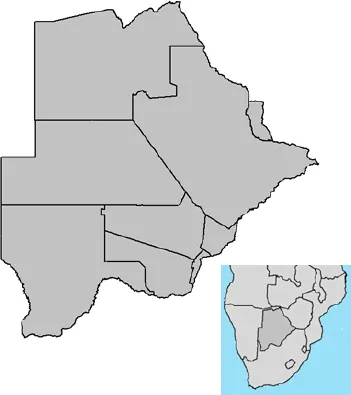
Botswana is a landlocked country in Southern Africa (Figure 1) with a total population of approximately 2 million in 2011 (Statistics Botswana, 2011a). Two-thirds of the country is desert and has semi-arid environments. Although Botswana was one of the poorest countries in the world at independence in 1966, it became one of the world’s fastest growing economies, and achieved middle-income status by 1994. The gross domestic product growth rate averaged 9% per year in the years up to 2007–2008 (Republic of Botswana, 2010). This growth is largely due to its rich diamond base and other mineral resources such as copper–nickel and soda ash, coupled with prudent economic management.
Figure 1: Map of Botswana by region and in Africa
Source: GADM (2013).
Government revenue especially from mining has been used to build infrastructure and to provide social services such as health, education, and training. However, Botswana’s wealth is unevenly distributed with unemployment still high at 18% especially among youth and school graduates at various levels (Statistics Botswana, 2011c). The incidence of poverty, although decreasing, is relatively high,1 and is higher in rural areas than in urban centers. Using the less than 1 dollar a day threshold, poverty in rural areas in 2009–2010 was 8% compared to 6% in urban villages, and 3% in cities and towns.2 In addition, the global economic downturn did not spare Botswana as the economy experienced 6% shrinkage in 2009 due to a decrease in the mineral export revenues (Statistics Botswana, 2011c).
Botswana is a semi-desert country with most parts of the country characterized by poor agricultural potential. The agriculture sector provides only 3% of the formal private sector and parastatal employment (Republic of Botswana, 2010). The two main components of the sector are livestock and arable production. Arable agriculture is based on traditional communal and subsistence farming, with limited commercial activity. Livestock is the dominant subsector accounting for 74% in 1993–1994 and 55% in 2007–2008 of the agricultural gross domestic product.
Rain fed agriculture dominates the subsistence agricultural sector and the food producing areas are mainly in the eastern districts of the country. The main food crops grown in Botswana are sorghum, maize, millet, and legumes (bambara nuts, groundnuts, and cowpeas) and fresh produce such as watermelons, butternuts, pumpkin, and sweet reeds. However, agriculture is still characterized by low productivity and production.
Available data show that the population of public primary school children between the ages of 6 and 12 years increased from 272,143 in 1997 to 299,497 in 2007 (Republic of Botswana, 2011; Central Statistics Office, 2005; Central Statistics Office, 2011; Central Statistics Office, 2012). The gross enrollment ratio for 6–12 year olds and 7–13 year olds were 113% and 99% in 2011, respectively (Statistics Botswana, 2011b), indicating that Botswana is in principle able to accommodate all of its school-age population. Overall, enrollment trends for public primary schools in Botswana have stabilized at over 330,000 school children since 2009, making it possible for authorities to plan (project) the school feeding budget. Total education expenditure as a percentage of the gross domestic product during the period 2001–2010 has shown large variations, between 6% and 12%, with a drop to 1% and 10% in 2008 and 2010, respectively, as a result of the global financial crisis.
The total underweight prevalence among under-fives declined from 15% to 4% between 1993 and 2009. In using only this indicator to measure child nutrition status and health, Botswana has experienced substantive improvement in child nutrition in the last 15 years.
Botswana has successfully implemented its National School Feeding Programme since 1998. The Ministry of Local Government and Rural Development (MLGRD) is the institution responsible for program implementation, but school feeding is also one of several vulnerable group feeding and food security programs co-ordinated as part of The Revised National Food Strategy under the Ministry of Finance and Development Planning (Republic of Botswana, 2000).
School feeding initially started in 1966 in response to widespread malnutrition among children resulting from a continuous five-year drought period. The country was also not self-sufficient in food production and like other African countries, Botswana started its National School Feeding Programme with the financial and implementation assistance from the United Nations World Food Programme (WFP), a situation that prevailed until 1993 when the gradual process of WFP’s withdrawal of resources and implementation assistance started. By this time, it was evident that the number of school feeding beneficiaries had steadily increased (300,419 beneficiaries in 672 public primary schools across the country in 1993), but in addition, Botswana had graduated to a middle-income country, and the government was no longer eligible for WFP support. The period between 1993 and 1997 is considered as a transition period, WFP’s resources and implementation support decreased as the government increasingly took more control over implementation. Since 1998, school feeding has been modified and refined over the years. Among the changes was the government’s investment in improved infrastructure, partially decentralizing the procurement process and modifications to the menu.
The Botswana National School Feeding Programme has universal coverage and reaches school children (grades 1–7) in all government-owned/public primary schools in the country, providing one meal a day to over 330,000 school children. Through the Remote Area Dweller Programme, a second meal is provided to school children in very remote areas or from marginalized communities. The MLGRD primarily uses a centralized procurement model to buy the dry and non-perishable food supplies in bulk and delivers them to districts. The purchase of perishable food items is decentralized to the District Councils. Since 2009, the Councils also purchase fresh/seasonal crops from local farmers, albeit on a small scale.
Methodology
This chapter is largely drawn from The Botswana School Feeding Programme: A Case Study (Republic of Botswana, 2012) and on information from the report Botswana: The Transition to a National School Feeding Programme (Isler, 2012a).
This chapter provides an overview of the Botswana National School Feeding Programme, to include experience with the Home Grown School Feeding (HGSF) programmes. There was also interest to identify critical points across the supply chain that has led to the program’s success. Both secondary and primary data collection methods were used. Primary data collection was limited to qualitative methodologies which included key informant interviews, and focus group discussions from a wide range of stakeholders involved in the program, to include national-, district- and school-level government staff, suppliers, and community members. In addition, regional and national stakeholder workshops were held to validate the data.
Country School Feeding Program Factsheet
Start Date | | 1998 (program initially started in 1966 with WFP support). |
Design and Implementation | Rational/Impact | Objectives are to: |
| | • Prevent school children from feeling hungry during school. • Provide school children with a balanced diet. • Keep school children in school for the entire day. • Improve school attendance. |
| Implementation Levels | Universal coverage, reaches all school children in grades 1–7 in government-owned/public primary schools. In 2011, 332,972 school children were reached through 750 public primary schools. |
| Supply, Storage, and Logistics | Suppliers distribute commodities to the Food Depots (four regional and 20 Districts). The Food Depots* are managed by the Division of Food Relief Services at the MLGRD. The trucks from the Division of Food Relief Services supply food commodities to the public primary schools. |
| Modality, Food Basket Details | One daily mid-morning hot meal provides a third of the daily energy requirements. In the Remote Area Dwellers’ Districts, a second meal (the same as the mid-morning meal) is provided. |
| Food Preparation | Food is prepared at school by cooks identified from the community, but paid by the government. |
Policy and Legal Frameworks Documents | • Suggested Guidelines on the Management of Primary School Feeding Programmes in Botswana (Bornay et al., 1993). • The Revised National Food Strategy (Republic... |