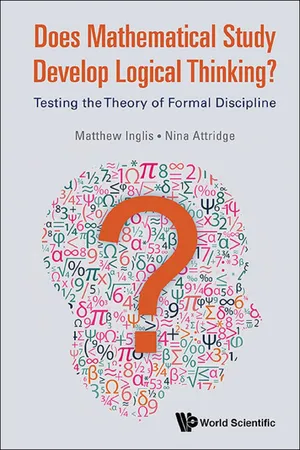
For centuries, educational policymakers have believed that studying mathematics is important, in part because it develops general thinking skills that are useful throughout life. This 'Theory of Formal Discipline' (TFD) has been used as a justification for mathematics education globally. Despite this, few empirical studies have directly investigated the issue, and those which have showed mixed results.Does Mathematical Study Develop Logical Thinking? describes a rigorous investigation of the TFD. It reviews the theory's history and prior research on the topic, followed by reports on a series of recent empirical studies. It argues that, contrary to the position held by sceptics, advanced mathematical study does develop certain general thinking skills, however these are much more restricted than those typically claimed by TFD proponents.Perfect for students, researchers and policymakers in education, further education and mathematics, this book provides much needed insight into the theory and practice of the foundations of modern educational policy.
eBook - ePub
Does Mathematical Study Develop Logical Thinking?: Testing The Theory Of Formal Discipline
Testing the Theory of Formal Discipline
- 204 pages
- English
- ePUB (mobile friendly)
- Available on iOS & Android
eBook - ePub
Does Mathematical Study Develop Logical Thinking?: Testing The Theory Of Formal Discipline
Testing the Theory of Formal Discipline
About this book
Information
Subtopic
Science GeneralIndex
Biological SciencesTable of contents
- Cover
- Halftitle
- Title Page
- Copyright Page
- Dedication
- Acknowledgements
- Contents
- List of Figures
- List of Tables
- List of Abbreviations
- 1. The Theory of Formal Discipline
- 2. Investigating the Theory of Formal Discipline
- 3. Cross-Sectional Differences in Reasoning Behaviour
- 4. Longitudinal Development in Conditional Reasoning
- 5. The Modus Tollens Inference and Mathematics
- 6. Conditional Inference Across the Mathematical Lifespan
- 7. Why Would Studying Advanced Mathematics Develop Conditional Reasoning?
- 8. Summary and Conclusions
- Appendix A Reasoning Tasks
- Appendix B Abstract Conditional Inference Task
- Appendix C Thematic Conditional Inference Task
- Appendix D Abstract Syllogism Task
- Appendix E Thematic Syllogism Task
- Appendix F Abstract Truth Table Task
- Appendix G The Cypriot Curriculum
- Appendix H Proof Comprehension
- Bibliography
- Index
Trusted by 375,005 students
Access to over 1.5 million titles for a fair monthly price.
Study more efficiently using our study tools.
Frequently asked questions
Yes, you can cancel anytime from the Subscription tab in your account settings on the Perlego website. Your subscription will stay active until the end of your current billing period. Learn how to cancel your subscription
No, books cannot be downloaded as external files, such as PDFs, for use outside of Perlego. However, you can download books within the Perlego app for offline reading on mobile or tablet. Learn how to download books offline
Perlego offers two plans: Essential and Complete
- Essential is ideal for learners and professionals who enjoy exploring a wide range of subjects. Access the Essential Library with 800,000+ trusted titles and best-sellers across business, personal growth, and the humanities. Includes unlimited reading time and Standard Read Aloud voice.
- Complete: Perfect for advanced learners and researchers needing full, unrestricted access. Unlock 1.5M+ books across hundreds of subjects, including academic and specialized titles. The Complete Plan also includes advanced features like Premium Read Aloud and Research Assistant.
We are an online textbook subscription service, where you can get access to an entire online library for less than the price of a single book per month. With over 1.5 million books across 990+ topics, we’ve got you covered! Learn about our mission
Look out for the read-aloud symbol on your next book to see if you can listen to it. The read-aloud tool reads text aloud for you, highlighting the text as it is being read. You can pause it, speed it up and slow it down. Learn more about Read Aloud
Yes! You can use the Perlego app on both iOS and Android devices to read anytime, anywhere — even offline. Perfect for commutes or when you’re on the go.
Please note we cannot support devices running on iOS 13 and Android 7 or earlier. Learn more about using the app
Please note we cannot support devices running on iOS 13 and Android 7 or earlier. Learn more about using the app
Yes, you can access Does Mathematical Study Develop Logical Thinking?: Testing The Theory Of Formal Discipline by Matthew Inglis, Nina Attridge in PDF and/or ePUB format, as well as other popular books in Biological Sciences & Science General. We have over 1.5 million books available in our catalogue for you to explore.