![]()
Chapter 1
How Embryogenesis Began in Evolution
We define embryogenesis as the process of producing the right kind of new cell, in the right place at the right time. This phrase “the right cell, in the right place, at the right time” is an expression attributed to Hans Driesch around 18901,2. All other aspects of embryology like morphogenesis, differentiation, and regeneration arise from embryogenesis of a first simplest proto-life form. Where and how did this first life originate?
There is a delightful scene from the Star Trek Next Generation television series where a powerful, immortal being, Q, takes Captain Jean Luc Picard back in time and space to stand looking down at a tiny pool on a hostile volcanic planet3. Q tells Picard this is Earth eons ago and Picard should look in the pool. Q then laughs. Q says that THE miracle is about to occur. Right there in that puddle, Picard’s far distant first ancestor is about to come into existence. Q comments that humans are the mere product of a pond of goo4. In their ongoing debate about the merit of humans Picard quotes Shakespeare saying:
“I know Hamlet. And what he might say with irony I say with conviction. ‘What a piece of work is man! How noble in reason! How infinite in faculty! In form, in moving, how express and admirable. In action, how like an angel. In apprehension, how like a god…’”5.
Our God-like form is assumed to have begun in a primordial soup from some primitive bit of RNA (or proteins6) that was able to self-replicate7. There are many hypotheses about the conditions that allowed first life to form and many attempts to simulate the event by chemistry8-14 or computer15-17. The two most common places that this remarkable feat is thought to have been accomplished inside the simplest of membranes are in a pool of water or near a hot hydrothermal vent18,9.
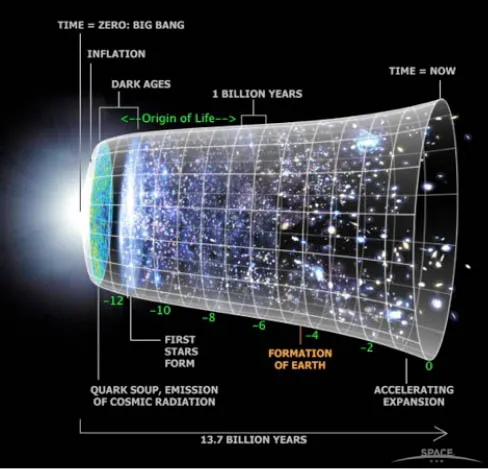
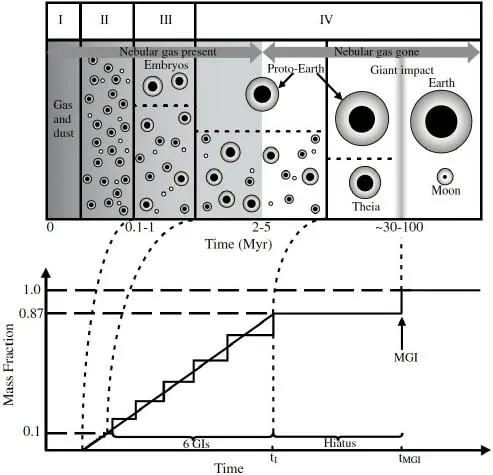
Our universe started with the Big Bang 13.75 billion years ago21 (Figure 1.1). It started hot and cooled down, forming galaxies and stars and perhaps planets as early as 200 million years after the Big Bang22. Earth formed much later, 4.54 billion years ago23 (Figure 1.2). Our records of life on Earth begin a mere 4.1 billion years ago with what looks like fossil prokaryotes24,25 and chemical signatures26-28 presumed to be unique to life. While prokaryotes are simple compared to us, they are organisms that have evolved to levels of complexity far beyond the proto-life forms scientists envision at the origin of life. So where did life begin? Did first life start here on Earth at some time before 4.1 billion years? Did it begin somewhere else29 and then was transported here30,31? As mankind gets ready to travel beyond our moon this is becoming a more urgent question and many hypotheses have been brought forward to try to answer it.
Figure 1.1. Development of the universe since the Big Bang, courtesy of the Hubble Space Telescope Science Institute, on which we have superimposed Alexei Sharov’s estimate for the origin of life, 9.7 ± 2.5 billion years ago. For details see “Life Before Earth” (2013, 2016)19,20.
Figure 1.2. In this diagram the Earth formed 4.54 billion years ago from gas and dust during a period of 3 to 6 million years. The “embryos” here at stage III are formed from gas, dust and planetesimals of stages I and II. The denser core of the Earth and the other bodies is shown in black, and the outer part in grey. Collision of the Earth with another planet the size of Mars, called Theia, melted much or all of the surface, in this scenario. This figure is used with the kind permission of Gang Yu32.
If life started elsewhere in our turbulent Milky Way galaxy33 and traveled to Earth, this increases the possible environments that life may have started in. It also increases the total time available for life to have evolved to form those first recorded prokaryotes. If life formed on Earth then the maximum time is less than the 4.54 billion years since Earth started. If life started elsewhere and traveled here, then the potential time is stretched up to 13.55 billion years ago. We eukaryotes are far more complex than our prokaryotic ancestors. Humanity arose from our prokaryotic ancestors in a mere 4.1 billion years. This means, if life began beyond Earth, then complex intelligent beings like us could have arisen in our universe as soon as 9.5 billion years ago, well before Earth even formed.
Figure 1.3. On this semilog plot, the complexity of organisms, as measured by the logarithm of the amount of coding nucleotide base pairs in DNA20, is linear with time (i.e., exponentially increasing). Time is counted backwards in billions of years before the present (time 0). This method of plotting allows extrapolation back to just one base pair between 9 and 10 billion years ago, albeit with a large margin of error (not shown). The extrapolation to “one” (log10 = 0) molecule is justifiable in one model for the origin of life34, or as the result of an abiotic process35. This plot suggests: 1) there was no intelligent life in our universe prior to the origin of Earth; 2) life took a long time, about 5 billion years, to reach the complexity of bacteria (prokaryotes); 3) Earth was seeded by a primitive form of life, rather than anything more complex than prokaryotes, and the panspermia hypothesis is correct29. However this model eliminates the idea that former intelligent life seeded Earth36; 4) life did not start on Earth; 5) attempts to synthesize the origin of life from scratch may have to emulate many cumulative rare events that occurred during that 5 billion year period before bacteria; 6) the Drake equation for guesstimating the number of civilizations in the universe37 may be wrong, as intelligent life like us has just begun appearing in our universe. It has been hypothesized that there could be many planets with intelligent life in the universe. This model would explain why we have not found any sign of it yet (Fermi’s paradox38). The time scale is roughly compatible with the idea that life may have originated shortly after parts of the universe cooled down after the Big Bang39. This figure is from “Life before Earth”19.
Maybe life on Earth started with nothing more complicated than prokaryotes because it took 9.5 billion years for life to evolve that far. Extra...