- 236 pages
- English
- PDF
- Available on iOS & Android
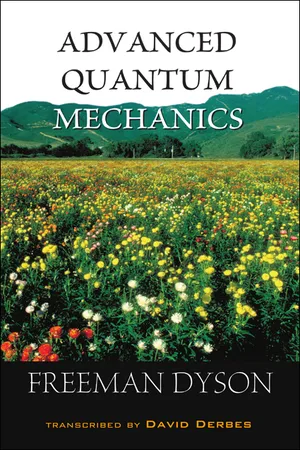
Advanced Quantum Mechanics
About this book
Renowned physicist and mathematician Freeman Dyson is famous for his work in quantum mechanics, nuclear weapons policy and bold visions for the future of humanity. In the 1940s, he was responsible for demonstrating the equivalence of the two formulations of quantum electrodynamics — Richard Feynman's diagrammatic path integral formulation and the variational methods developed by Julian Schwinger and Sin-Itiro Tomonoga — showing the mathematical consistency of QED.
This invaluable volume comprises the legendary, never-before-published, lectures on quantum electrodynamics first given by Dyson at Cornell University in 1951. The late theorist Edwin Thompson Jaynes once remarked “For a generation of physicists they were the happy medium: clearer and motivated than Feynman, and getting to the point faster than Schwinger”.
Future generations of physicists are bound to read these lectures with pleasure, benefiting from the lucid style that is so characteristic of Dyson's exposition.
Frequently asked questions
- Essential is ideal for learners and professionals who enjoy exploring a wide range of subjects. Access the Essential Library with 800,000+ trusted titles and best-sellers across business, personal growth, and the humanities. Includes unlimited reading time and Standard Read Aloud voice.
- Complete: Perfect for advanced learners and researchers needing full, unrestricted access. Unlock 1.4M+ books across hundreds of subjects, including academic and specialized titles. The Complete Plan also includes advanced features like Premium Read Aloud and Research Assistant.
Please note we cannot support devices running on iOS 13 and Android 7 or earlier. Learn more about using the app.
Information
Table of contents
- Contents
- Preface
- Generally used Notation
- 1 Introduction
- 2 The Dirac Theory
- 3 Scattering Problems and Born Approximation
- 4 Field Theory
- 5 Examples of Quantized Field Theories
- 6 Free Particle Scattering Problems
- 7 General Theory of Free Particle Scattering
- 8 Scattering by a Static Potential. Comparison with Experimental Results
- Notes
- References
- Index